

Researchers knew the California drought was already a record breaker when they set out to find its exact place in history, but they were surprised by what they discovered: It has been 500 years since what is now the Golden State has been this dry.
The U.S. state of California is in the fourth year of a severe drought with temperatures so high and precipitation so low that rain and snow evaporate almost as soon as it hits the ground. A research paper released Monday said an analysis of blue oak tree rings in the state’s Central Valley showed that weather conditions haven’t been this dire since the 1500s. That was around the time when European explorers landed in what became San Diego, when Columbus set off on a final voyage to the Caribbean, when King Henry VIII was alive.
“The results were astonishing,” said Valerie Trouet, an associate professor at the University of Arizona who was a senior author for the study. “We knew it was an all-time low over a historical period, but to see this as a low for the last 500 years, we didn’t expect that. There’s very little doubt about it.”
The study was published in the journal Nature Climate Change. Other authors include Soumaya Belmecheri, a research associate at the University of Arizona’s Laboratory of Tree Ring Research, Eugene R. Wahl, a scientist at the National Oceanic and Atmospheric Administration’s climate data center and David W. Stahle, a professor in the Geosciences Department at the University of Arkansas. The National Science Foundation, the Department of the Interior and the Swiss National Science Foundation funded the work.
In a statement, Nature said the “findings highlight the critical condition” of California’s reservoirs and groundwater, where water the state needs for municipalities and agriculture is stored. Both of those sources are slowly being drained with little precipitation to replenish the rivers and lakes that supply them.
Because of the California drought, the small amount of moisture stored in plants and the soil is quickly evaporating into the state’s dry atmosphere, exposing the parched ground to lightning strikes that spark wildfires. California has experienced about a thousand more wildfires this fire season compared to last, including two that are currently raging in the northern part of the state.
California is having its “second-busiest season in a decade,” said Stanton Florea, a spokesman for the Forest Service’s Pacific Southwest Region, which manages 21 million acres of wildlands in California.
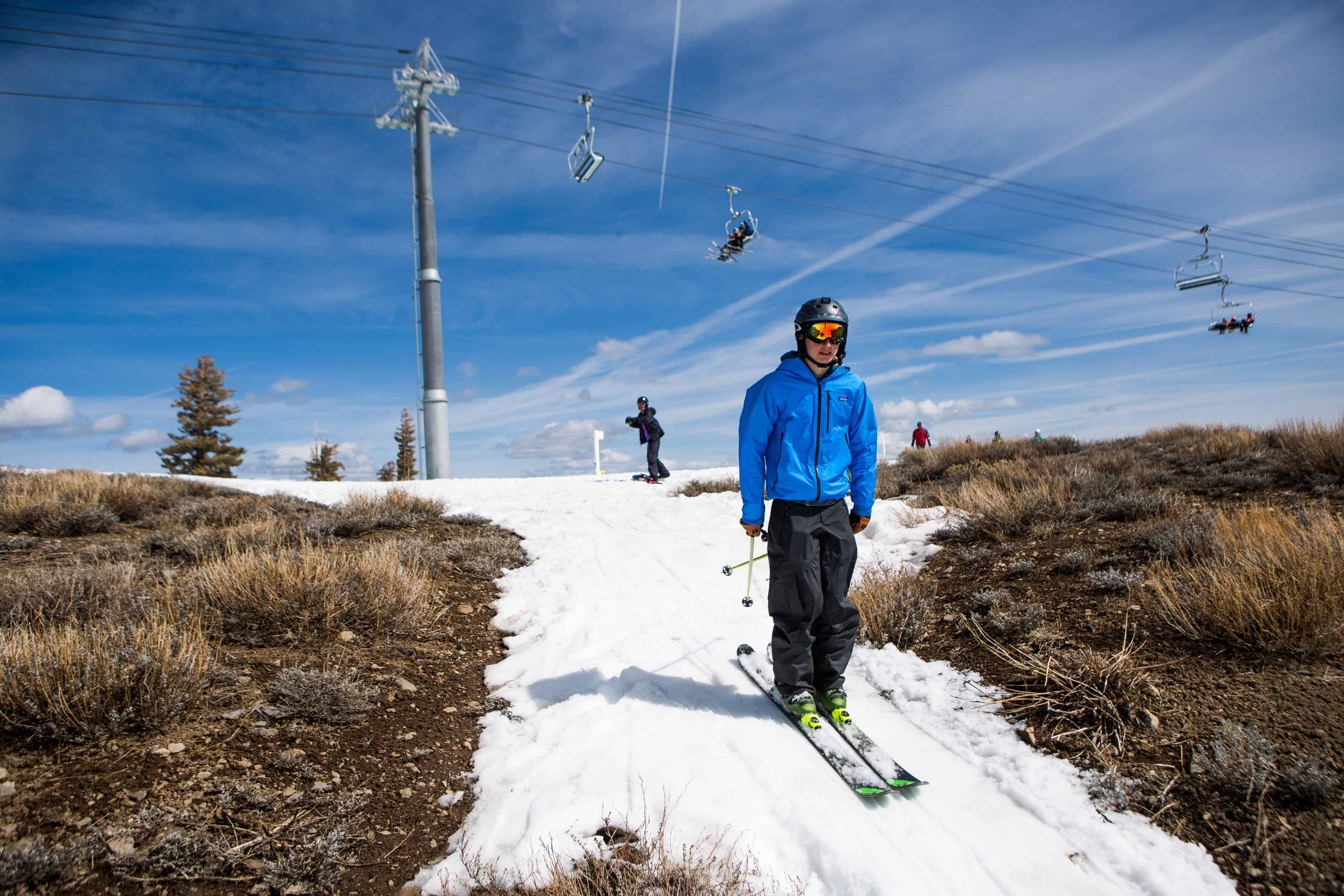
In April, Gov. Jerry Brown ordered the state’s first mandatory water cut for metropolitan areas. He announced the restriction from a dry patch of grass in the Sierra Nevada near Lake Tahoe that normally would have been wet from melting snow. But this year, for the first time in 75 years of measuring, officials said they found “no snow whatsoever” in the mountains.
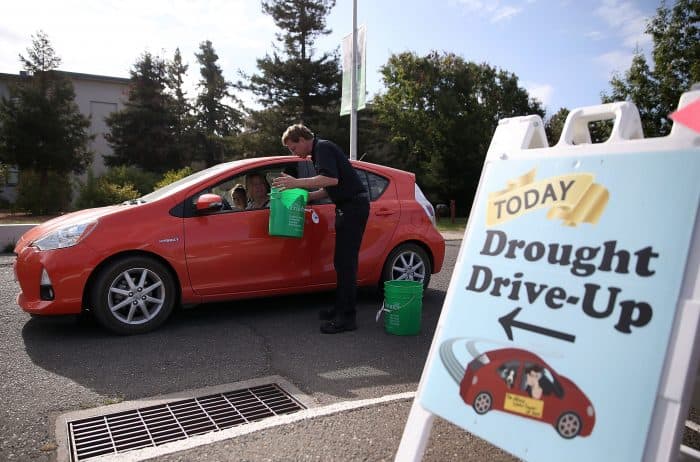
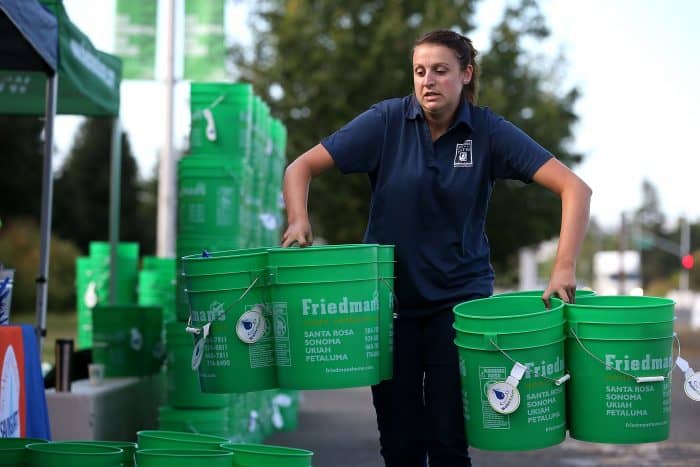
Since that day, the state’s 400 water utilities have implemented water cuts of up to 35 percent in some areas, and farmers who long enjoyed the right to freely take water from rivers to water crops and hydrate livestock gave up a quarter of those rights for fear that the state would restrict them even more. Federal and state officials have used convoys to truck salmon and other fish from one part of the state to another fearing a mass die off if they tried to migrate to the Pacific Ocean in rivers that are abnormally low and completely dry in places.
Getting worse
And the news keeps getting worse. A study by scientists at NASA and Columbia University said California was one of several states in the Southwest facing a mega-drought that could last up to 30 years if greenhouse gas emissions are not dramatically curtailed by 2050. A study by scientists at Stanford University said a future of more-frequent drought in California is a near certainty because temperatures are increasing at a time when precipitation rates are steady, allowing heat to overwhelm the moisture. And another Columbia study said the current California drought is part of a natural pattern, but human-caused climate change has made it significantly worse.
The Columbia study analyzed month-to-month climate data between 1901 and 2014 to find fluctuations in precipitation, wind, temperature and humidity. It said average temperatures in California have increased by 2.5 degrees Fahrenheit over 113 years. And, starting in the 1960s, heat increased with the introduction of more greenhouse gases from automobiles and other sources.
“When greenhouse gases accumulate, it’s like a bully showing up at your door to demand that you give it more and more every year,” said the study’s lead author, Park Williams, a bio-climatologist at Columbia University’s Earth Science Institute. In California, that meant more moisture evaporated from rain and from groundwater sprayed on crops in farming regions such as the Central Valley.
Thursday’s study “confirms the same message” of the earlier studies, and supports their warnings about the impacts of climate change, Trouet said. “It’s dry. We’re not just confirming, we’re refining.”
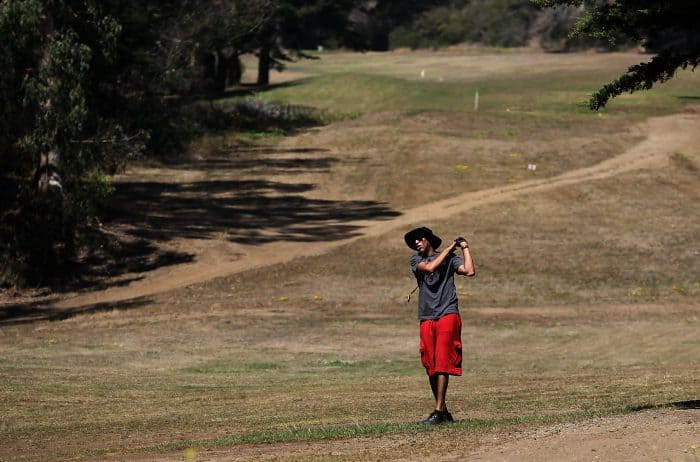
The historic nature of the current California drought was well known, but how it ranked over time was not. When Trouet and her team learned in April that snowpack that usually supplies 30 percent of the California’s potable water each year was so low, “we realized we had the data from previous research to put this into context for the longer term,” she said.
What they didn’t have were fresh tree samples, so Stahle of Arkansas traveled to the Central Valley and extracted a core sample from blue oak trees. Blue oaks love winter rain, and their tree rings express it with wide bands. Low periods of moisture result in narrow bands. “It’s like a bar code,” said Trouet.
Blue oaks in the valley are a long way from the Sierra Nevada mountains in the northern part of the state, but the same weather systems that supply rain to the low elevations where they stand result in snow in high mountain elevations. Analyzing the new core samples and others taken in previous years, the scientists didn’t observe rings as narrow at low elevations as today’s until a period that dated from the 1500s.
“We looked at the past 500 years,” Trouet said. “This is the most extreme. It doesn’t mean this won’t happen again for another 500 years. It’s likely that this will happen more often in the future because of the low amount of precipitation combined with higher temperatures makes it likely that they will occur together more often, causing droughts.”
© 2015, The Washington Post





