

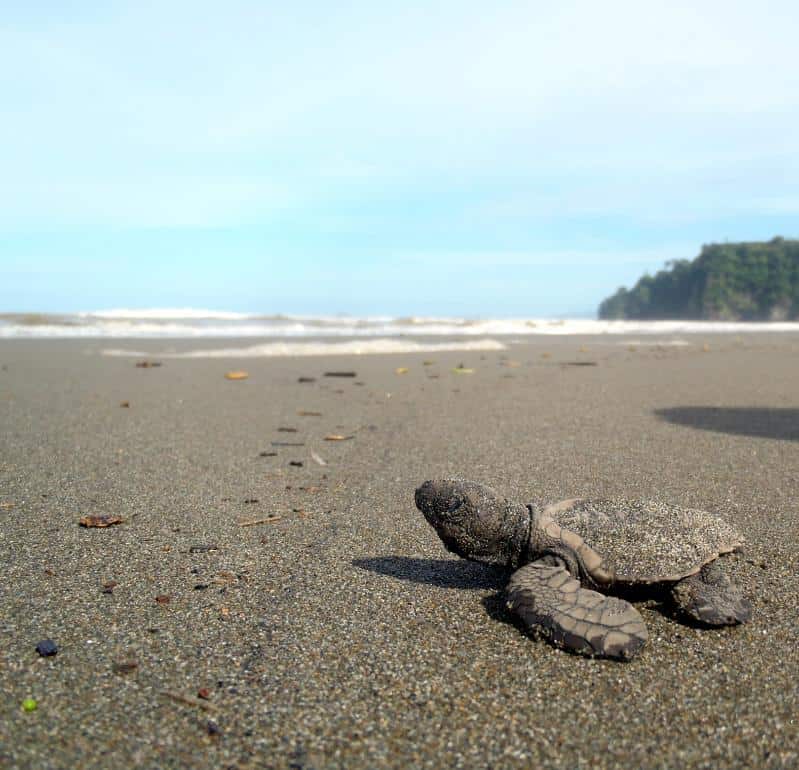
Imagine walking along a deserted beach in the moonlight and suddenly being witness to the magic of a leatherback turtle emerging from the sea, her whole body shimmering with the phosphorescence of sea plankton. The silence is broken only by the surf and the rhythmic sound of this relic of the dinosaur age clumsily dragging herself up the beach to find a safe nesting place to lay her eggs.
Pacuare Nature Reserve, 800 hectares of pristine lowland tropical rain forest and six kilometers of deserted beach, is located between the Tortuguero canals and the Caribbean Sea, 25 km north of the Atlantic port city of Limón. The reserve was purchased by the British-based Endangered Wildlife Trust in 1989 and was only afterward found to be an important sea turtle nesting site, primarily for leatherbacks but also for green and hawksbill turtles.
For many generations, the area’s residents would collect leatherback turtle eggs, either to supplement their diet or to sell to buyers eager to benefit from the eggs’ reputed aphrodisiacal effects. The green turtle would be killed for its meat (as in green turtle soup) and eggs, and the hawksbill for its beautiful shell to make jewelry.
Turtle populations have declined drastically in recent years as a result of these activities and land development along the coastlines, and all three of the abovementioned species are on the critically endangered list.
Though prohibited by law, local residents still steal the eggs and kill turtles for their meat and shells. Some restaurants in Limón offer turtle on their menus, especially during the active turtle season.
In 1994, a volunteer turtle protection program was established on the reserve, which is now recognized as one of the most important turtle nesting sites in Central America. In the 2008 turtle season, 643 nests were counted, of which approximately 6 percent were lost to poachers, according to the Endangered Wildlife Trust.
The turtle protection program has always encouraged local participation, including visits from high school students and employment of reformed poachers as guards.
What makes a visit to the reserve so special is the unique hands-on experience that makes visitors feel they really are contributing to the protection of the turtles. Upon arrival, guests and volunteers receive an orientation talk in preparation for the evening turtle-protection activities. Small groups of volunteers, guests, biologists and research assistants, on rotation throughout the night, leave to patrol the beach, primarily as a deterrent to prevent poachers from stealing the eggs, but also to collect important statistical data about the turtles. These data are correlated at the reserve and are made available to visiting guests and volunteers. A daily nest count during the season is posted in the community lecture room.
March through June is leatherback nesting season on the Caribbean side of Central America, while July through September is the green turtle season, with some overlap in June when both species are nesting.
In addition to participating in the turtle program, guests and volunteers can walk along a main trail running parallel to the beach, which offers an excellent opportunity to see the varied wildlife and birds. The reserve is home to more than 27 species of mammals, including monkeys, peccaries and deer, as well as many reptiles. In 2008, two large cats – a puma and an ocelot – were spotted by Scott Hardy, an administrator of last year’s turtle program. Additionally, some 230 bird species have been recorded over the past several years in the reserve, which is a known nesting site for the rare agami heron.
Shorter trails lead to the lagoons and other areas of special interest, such as an orchard with 42 species of fruits and vegetables, including noni and cacao trees. A boat ride can be arranged along the Tortuguero canals, where sloths, monkeys, wading birds, caimans and freshwater turtles may be observed.
Accommodation is available either as a guest staying a minimum of two nights in the lodge or as a volunteer staying a minimum of one week in the cabins.
The main lodge offers three double bedrooms with en suite half-bathroom, kitchen and sitting area. The shower area is below the house, supplied by rainwater; hot water is available, if required. The wraparound veranda overlooks the beach in front and the forest in back, where howler monkeys gather to enjoy the fruit of the mango trees.
Generally used by volunteers and staff members, the cabins are basic but quite adequate, with communal bathrooms, kitchen and dining area and lecture rooms.
Guests staying at the lodge may take their meals there or join the volunteers, research assistants and biologists for some animated conversation in the communal kitchen and dining area. There is no electricity; bright lights can disorient the turtles and affect their nesting abilities, so candlelight or kerosene lamps are used to ensure the reptiles are not disturbed.
Access to the reserve from San José is via Matina, a village two hours along the San José-Limón highway. From there, a 30-minute drive through banana plantations leads to La Trocha, a landing stage on the Tortuguero canals, where a boat collects visitors for the 20-minute trip to the reserve.
The visitors’ price, including accommodation in the lodge, meals, boat transportation to and from La Trocha, trips along the canal, guided night patrol on the beach and access to all parts of the reserve, is $80 per person, per night, with a minimum stay of two nights.
.





