

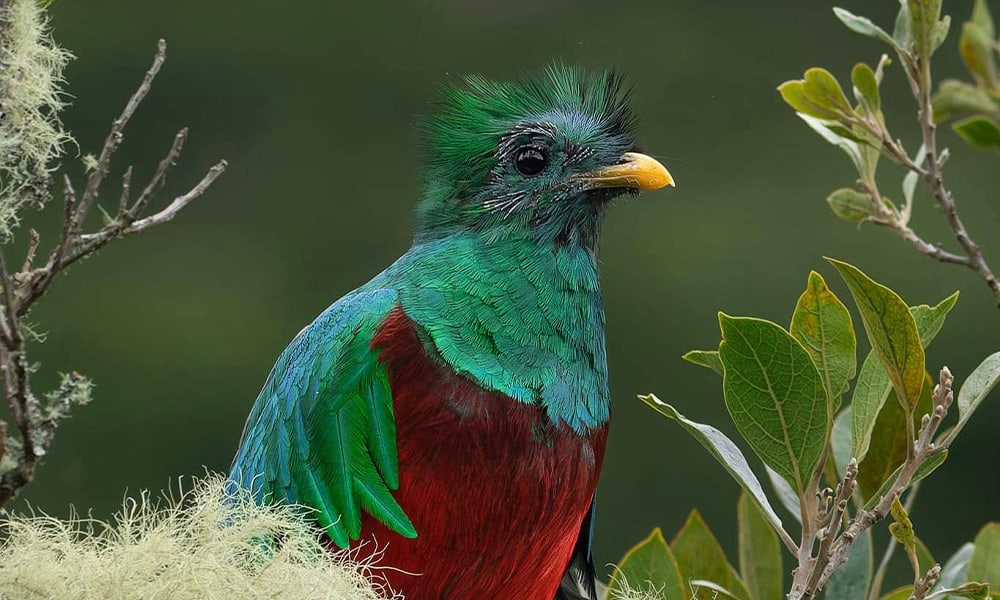
In a highland cloud forest just minutes off the Inter-American Highway near Cerro de la Muerte, south of the capital, Paraíso del Quetzal mountain lodge definitely delivers on the promise of its name: It is a paradise for resplendent quetzals, as well as for visitors who come from all over the world to catch sight of this most famous of Costa Rican birds.
Recent visitors have included a delegation of government officials from Guatemala, who made a special trip here last November, hoping to catch their first-ever sighting of a live quetzal – the official national bird of their country and the namesake of its currency.
They did see one, and the day is commemorated in a group photo hanging on the lodge wall, showing a beaming group of Guatemalans with their happy host, lodge owner Jorge Serrano.
If you’re driving south from San José through the mountains, you can’t miss the giant quetzal painted on the sign for Mirador de Quetzales, at Kilometer 70 of the Inter American Highway. Formerly known as Finca Eddie Serrano, the Mirador’s A-frame cabins are a landmark lodge on the Cerro de la Muerte road.
Eddie Serrano was the first homesteader on this mountain, arriving from Cartago, east of the capital, in the midst of the Civil War in 1948. Seventeen years ago, by then the father of four daughters and four sons, he opened the Mirador, pioneering nature tourism in this mountain zone.
After Eddie Serrano’s death 10 years ago, his youngest son, Jorge, managed the Mirador for seven years. But he was itching to move forward with his own ideas, without having to consult the entire family.
“It was the biggest decision – and the saddest – of my life, to leave behind all that my father and I had built together,” Jorge says.
Three years ago, he and his wife Bertillia, along with their four children,moved slightly downhill from the Mirador and created their own version of a paradise for quetzals, now recognized as a model of sustainable development (see box).
Their nine-hectare property was once a pasture hemmed by primary forest. But after three years of letting native plants grow and planting ornamentals to attract birds and butterflies, it’s now a lush, sloping meadow alive with birds.
Eight red-roofed, wooden cabins are sprinkled around the steeply inclined property, most with a maximum of privacy. The farthest cabin, with the longest hike and the most spectacular view, juts out over the valley.
If climbing up and down steep trails at high altitude is not your cup of tea, three cabins are closer in and on a level with the main lodge and restaurant. My favorite is No. 4, just downhill from the lodge, hidden in a lavish garden of ferns, fuchsia and “poor man’s umbrella” plants, and within sound of a trickling stream.
The cabins are small and cozy, each with a double bed and a bunk tucked into an alcove. The interior blond wood looks and smells fresh, and each cabin has large windows looking onto a private deck. Jorge has wielded his brush in most of the cabins, painting birds on headboards and walls.
The tiled bathrooms are small but they provide the most essential thing you look for at this chilly altitude (2,600 meters): showers with really hot water. Beds are piled high with fleecy blankets, and for really cold nights, when the temperature can drop into the 40s Fahrenheit, Bertillia hands out very welcome hot water bottles, which will keep your toes warm the entire night.
The rustic, wood main lodge is open, bright and welcoming, with an old-fashioned wood stove and long, wooden tables embellished with colorful local birds painted by Jorge. The entire back wall consists of windows framing a view of mountains, forest and valley.
But you hardly notice the view at first because your eye is caught by flashes of violet, aqua, flame and emerald, as magnificent and fiery-throated hummingbirds mob the feeders just outside the windows. Perched on a stool and leaning on a table, you can easily sit for hours observing hummingbirds in action.
To find the quetzals, though, you have to hit the trail. Within five minutes of setting off on the steep, four-kilometer El Robledal trail in early May, my birding partner and I caught sight of our first resplendent quetzal of the day, trailing his extravagantly long, greenish-blue tail feathers. By the time we retraced our steps two hours later, with the help of budding bird guide Fabio Salazar, only 16, we had seen seven more and heard the constant calls of countless more quetzals.
Sprinkled around the forest are aguacatillo (wild avocado) trees, the food of the quetzal and the reason you are almost guaranteed to see one here.
After wolfing down a hearty típico breakfast of gallo pinto, eggs, fried sweet plantains, toast, marmalade and coffee, we headed out on another trail, this time with Jorge Junior, a 17-year-old student at the Santa María de Dota high school, and already a knowledgeable guide. Along the way we had excellent views of other highland species, including ochraceous pewees, endemic to this zone, hairy woodpeckers, buffy tuftedcheeks and both long-tailed and black-and yellow silky-flycatchers.
Even if you’re not a birder, the vistas of cloud-enshrouded mountains and valleys here will thrill you, as will the hiking trails through ancient oak forest, dripping with moss and epiphytes and burnished by slanting rays of the early-morning sun.
Along with the towering oak trees – many of them 400 to 600 years old – there are magnificent mountain cypresses. One is rumored to be 1,000 years old; though you might have your doubts at first, when you circle the tree’s impressive 40-meter perimeter of massive roots, you may be convinced.
At the top of the El Robledal trail, on a clear day, you can see three volcanoes: Irazú, Turrialba and, more rarely, Arenal. The morning we climbed the trail, we saw Turrialba smoking away.
Other trails will lead you to waterfalls, rivers, an old plane wreck and million-yearold fossils. Along the trails, you may encounter wild mountain goats, rabbits and squirrels, along with myriad mountain birds. If you’re lucky, you might see a tapir or at least tapir tracks.
Tucked into the forest are a dozen or more round tables with tree-stump stools where you can plop down and spend some time observing or relaxing.
If you are really ambitious, you can hike 14 kilometers over the next hill to reach the village of Copey. Ask for a hiking map at the lodge if you want to set out on your own.
Most visitors arrive in the afternoon, admire the hummingbirds and have an early supper – simple and traditional, with a choice of chicken, pork chop or trout (which has a tendency to be overcooked, so ask for it “suave”), along with rice and beans, excellent vegetable picadillos and natural fruit juices. Then it’s early to bed to get up at the crack of dawn for the main event: the early-morning bird walk and the search for a quetzal. As Jorge proudly states, “We are 100 percent about birds here.”
Having bagged a quetzal for their bird list, the visitors are usually off. But if you live in Costa Rica, you have the luxury of lingering longer, exploring the trails and absorbing the beauty and tranquility of this rare, natural paradise.
The Model of a Mountain Eco-lodge
When Jorge Serrano set out to build his own lodge from scratch, his goal was to be as eco-friendly as possible, using only plantation wood to build, minimizing water and electricity use, recycling, regenerating open areas of the forest and planting new trees.
His hard work and vision paid off this year when Paraíso del Quetzal received the first-ever Blue Flag ecological award to be granted in this zone. On May 4, the family celebrated with an official ceremony attended by local municipal officials, tour operators and representatives from the Costa Rican Tourism Institute (ICT). As the assembled guests sang the national anthem, Jorge’s mother, Leonor Obando, 73, raised the Blue Flag.
Jorge isn’t resting on his laurels. He wants to make improvements to the lodge to make it more comfortable, while retaining its rusticity. The Quetzal Education Research Center (QERC) in nearby San Gerardo de Dota may set up research here, protecting and studying quetzal nests, and Jorge is working with the new Costa Rican Ornithologists Union, which plans to offer birding courses here.





