

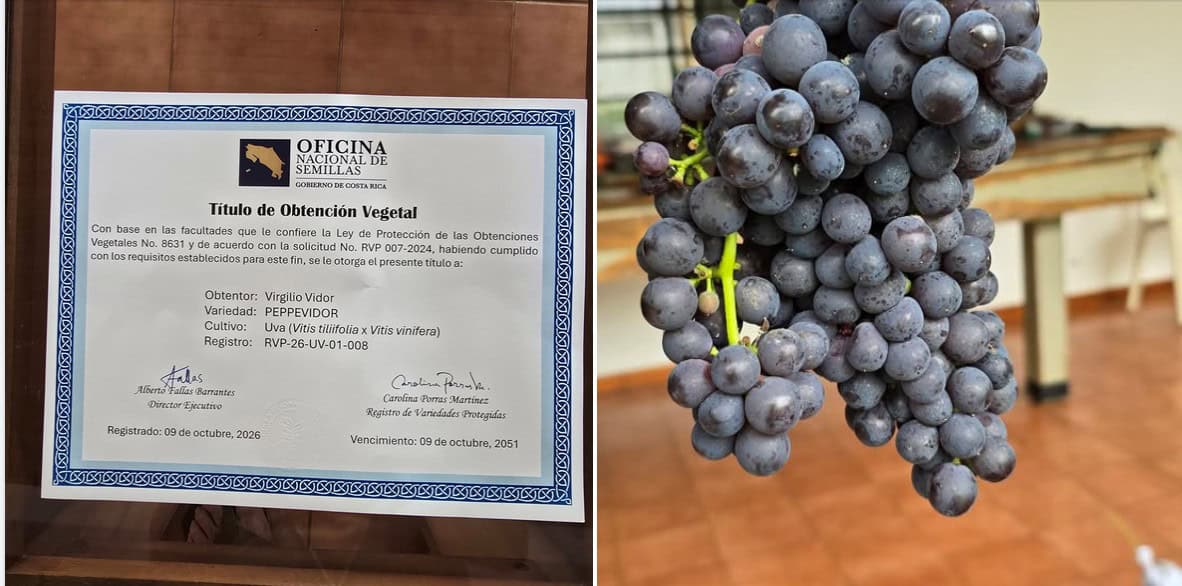
Costa Rica now has a wine grape of its own. Peppevidor, a hybrid bred to grow in tropical heat, was certified as a new plant variety by the National Seed Office (Oficina Nacional de Semillas), capping roughly half a century of work by Italian-born grape breeder Virgilio Vidor. Vidor, 78, says it is the first wine grape developed in Costa Rica to receive official registration. He crossed a wild grape native to Costa Rica with a European wine grape and named the result after his late brother, Giuseppe.
Peppe is the familiar Italian short form of that name. The official notice of his application, filed with the seed office in June 2024, lists the cross as Vitis tiliifolia, a wild grape that grows across Central America, with Vitis vinifera, the species behind nearly all of the world’s wine. That pairing matters because European grapes struggle here for two reasons. They need a cool season to rest and then bud evenly, which the tropics do not provide.
And in warm climates they are vulnerable to Xylella fastidiosa, a bacterium that clogs the vine’s water-carrying tissue and causes what growers call Pierce’s disease. Peppevidor grows without a cold season and resists the bacterium, according to Vidor. He said the grape is at home in Costa Rica because part of its ancestry comes from the local wild vine, describing it as functionally rather than perfectly tropical, since its Costa Rican and Italian genes are mixed.
Vidor said the certification confirms the plant is a new variety, distinct from all others. He added that he was delighted Costa Rica now has the grape, which he said belongs to Costa Ricans. Tasters who have tried wine made from Peppevidor describe it as light red in color, with notes of coffee that they say capture something of Costa Rica.
The Costa Rica Institute of Technology (TEC) carried out the technical examination needed to register Peppevidor as a new variety. Carlos Alvarado, director of the TEC’s Centro de Vinculación, said it was the first time the university had conducted an examination of this kind. He said the experience will allow it to take on more in the future and will be passed on to its students.
Vidor arrived from Italy in December 1972, at 24, with his parents and younger brother. His father’s family came from the Prosecco wine country near Treviso, and the Vidors settled on a farm near Playa Panamá, in the northwestern province of Guanacaste, where they began planting vines.
In the 1970s the farm became the base of a tropical viticulture project financed by the Costa Rican government and the U.S. Agency for International Development, with Vidor as its director. When disease began attacking the vines, he turned to hybridization rather than abandon the effort, searching for a grape that could withstand Guanacaste’s long dry season and tropical pests.
Breeding a grape is slow work. Vidor has said a new hybrid needs at least a decade of trials before its viability can be confirmed or ruled out. The grapes long grown in Costa Rica, such as Isabella, are hybrids developed elsewhere, and until now none bred in the country had been officially registered, according to Vidor.
His farm still works as an experimental vineyard, where he tests hundreds of hybrids. Italy has named him a Commendatore of the Order of Merit of the Italian Republic, one of its highest honors, for his rural development work in Central America and his research on tropical viticulture.
Wine has always been a niche product in Costa Rica, and our few vineyards have relied on varieties bred for other climates. A grape bred here, from a native vine, gives that small scene something it has never had before, a variety that started in Costa Rica’s own forests.





