

WASHINGTON — The Dominican Republic-Central American Free Trade Agreement (DR-CAFTA) has been an overall success for Costa Rica, and so will eventual membership in the controversial Trans-Pacific Partnership (TPP), insists the former government official who lobbied hard for DR-CAFTA’s ratification five years ago.
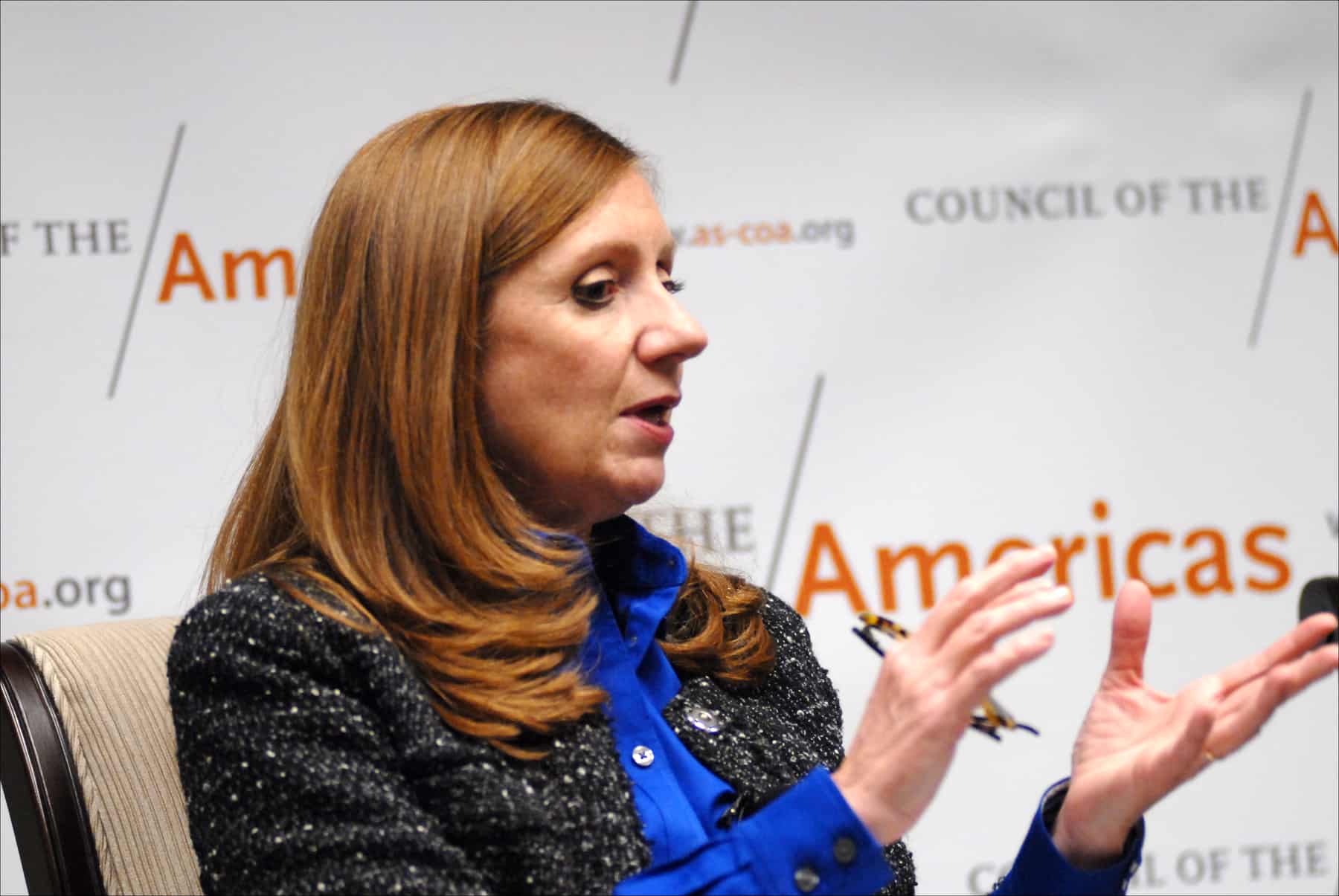
Anabel González, the country’s foreign trade minister from 2010 to 2014 under former President Laura Chinchilla, is today senior director of the World Bank Group’s global practice on trade and competitiveness. She spoke Thursday at a Washington panel arranged by the Americas Society/Council of the Americas to examine the long-term implications for Latin America of the TPP, a far-reaching trade pact recently sealed among 12 Pacific Rim countries.
“Virtually every article written about TPP refers to an agreement with Asia,” said AS/COA’s vice-president, Eric Farnsworth, who moderated the panel. “Frequently, China is the focus, even though China isn’t a party to the agreement. But TPP is not just about Asia. It reaches the shores of North and South America … and may have downside implications for Central America and the Caribbean.”
González, citing a World Bank study published earlier this year, praised DR-CAFTA, which beginning in August 2004 gradually eliminated tariffs and quotas between the United States, the Dominican Republic and five Central American countries: Costa Rica, El Salvador, Guatemala, Honduras and Nicaragua.
Costa Rica ratified the treaty following a national referendum in 2007 in which 51.6 percent of voters approved of it. The accord took effect Jan. 1, 2009. Costa Rica now accounts for around 40 percent of DR-CAFTA exports to the United States — from computer processors to coffee — far outpacing its Central American neighbors.
“The results have been quite impressive in terms of mobile penetration and the reduction in prices for telecom services — not only for consumers but also for foreign investors who require these types of services. Overall, the story has been a very positive one,” said González, adding that foreign direct investment in manufacturing, specifically medical devices, has been substantial over the past five years.
She did not, however, address Costa Rica’s stagnant wages and its dramatically higher cost of living compared to Panama and other Central American countries since Costa Rica ratified its participation in DR-CAFTA five years ago.
According to the World Bank report, one of the treaty’s most important benefits since 2009 has been “to reinforce government commitment to liberal trade and FDI-friendly policies and to strengthen the legal framework on the rights of foreign investors.”
González said, “CAFTA also opened up Costa Rica’s long-standing monopolies on telecom and insurance. This is why the agreement was very controversial, with labor unions and the public sector opposing the opening.”
Christopher Padilla, vice-president of governmental programs at IBM and a former U.S. undersecretary of commerce for international trade, backed González’s reading of DR-CAFTA’s benefits.
“Look at Costa Rica’s success,” Padilla said. “DR-CAFTA has drawn in foreign investment. IBM has invested heavily in Costa Rica thanks to its telecom reform laws.”
In economic terms, however, DR-CAFTA is puny compared to the TPP, whose 12 member nations — which include the United States, Australia, Canada, Mexico, Japan, Peru and Vietnam — together comprise 40 percent of the world’s economy.
“The TPP is a very strong agreement from a commercial standpoint, with many groundbreaking provisions in it,” said Padilla. “Of particular interest to IBM, this is the first trade agreement to have extremely strong provisions to safeguard digital trade in the 21st century. So much of the economy these days depends on data flows, but what we’ve seen in recent years is governments trying to put up barriers around the Internet, to nationalize the Internet or restrict the movement of data across borders for reasons of privacy and national security.”
He added: “This agreement sets as a default that data should flow freely unless there’s a very strong reason it shouldn’t. Another default is there should not be any requirement to store data locally, and to move data across borders as needed. Finally, it prevents measures a government might take to require the release of source code, which is the crown jewel of any technology company.”
Padilla, whose firm was one of the first corporate supporters of TPP, predicted that “before the end of this year, the vast majority of the U.S. business community will come out strongly in support of this agreement and push strongly for its passage.”
TPP’s future in U.S. Congress in doubt
The same day as the AS/COA panel, however, Senate Majority Leader Mitch McConnell (R-KY) crushed any hope that Congress would approve TPP before the 2016 presidential elections.
Speaking to The Washington Post, McConnell said President Obama would risk defeat of the trade deal if he lobbied for passage next year, warning that “it certainly shouldn’t come before the election. There’s significant pushback all over the place.”
Leading GOP presidential contender Donald Trump has already called it a “disaster,” while Hillary Clinton, who leads the polls among the Democrats, is also against the deal.
Yet Arturo Sarukhan, Mexico’s former ambassador to the United States, said his country’s experience with the North American Free Trade Agreement (NAFTA) suggests that the TPP may actually turn out to be a win-win for the region.
“If you look at Mexico when we negotiated NAFTA and look at Mexico today, it’s a radically different country,” said Sarukhan, now a private consultant in Washington. “The reason why it changed is that Mexico knew that for it to get the votes it needed on Capitol Hill, it would have to enact a host of economic reforms. It prodded Mexico to become a less inward-looking country than it had been in decades.”
Likewise, he said, TPP “could have a very strong positive effect in injecting domestic change in countries that need to move forward and do wholesale reforms like Mexico did 20 years ago.”
TPP could isolate Central America
But for countries that are not part of TPP, it could be a different story.
“In the case of textiles and apparel, there is concern in Central America — especially in the Northern Triangle and Nicaragua — about the impact this may have vis-à-vis Vietnam,” said IBM’s Padilla, noting that foreign investment could be diverted to Asia as a result of the TPP.
Serious issues could also arise if, in the future, the TPP’s current roster will be expanded only to countries belonging to the 21-member Asia Pacific Economic Cooperation (APEC) group.
“If so, that’s not very good news for Latin America,” he warned. “Colombia is a case in point. I would argue that other countries like Costa Rica and Panama should also be members of TPP.”
González agreed with Padilla’s suggestion, noting that the treaty “has the potential for driving reforms even in non-member countries as a way of coping with TPP. In Indonesia and Thailand, key reforms are being considered precisely because of non-membership, or the hope of becoming a member. The risks it presents for Latin American countries are associated with trade diversion and preference erosion.”
She added: “I think many of these countries should give serious consideration to becoming members of TPP. For Central American countries, participation in global value chains is absolutely essential.”





