

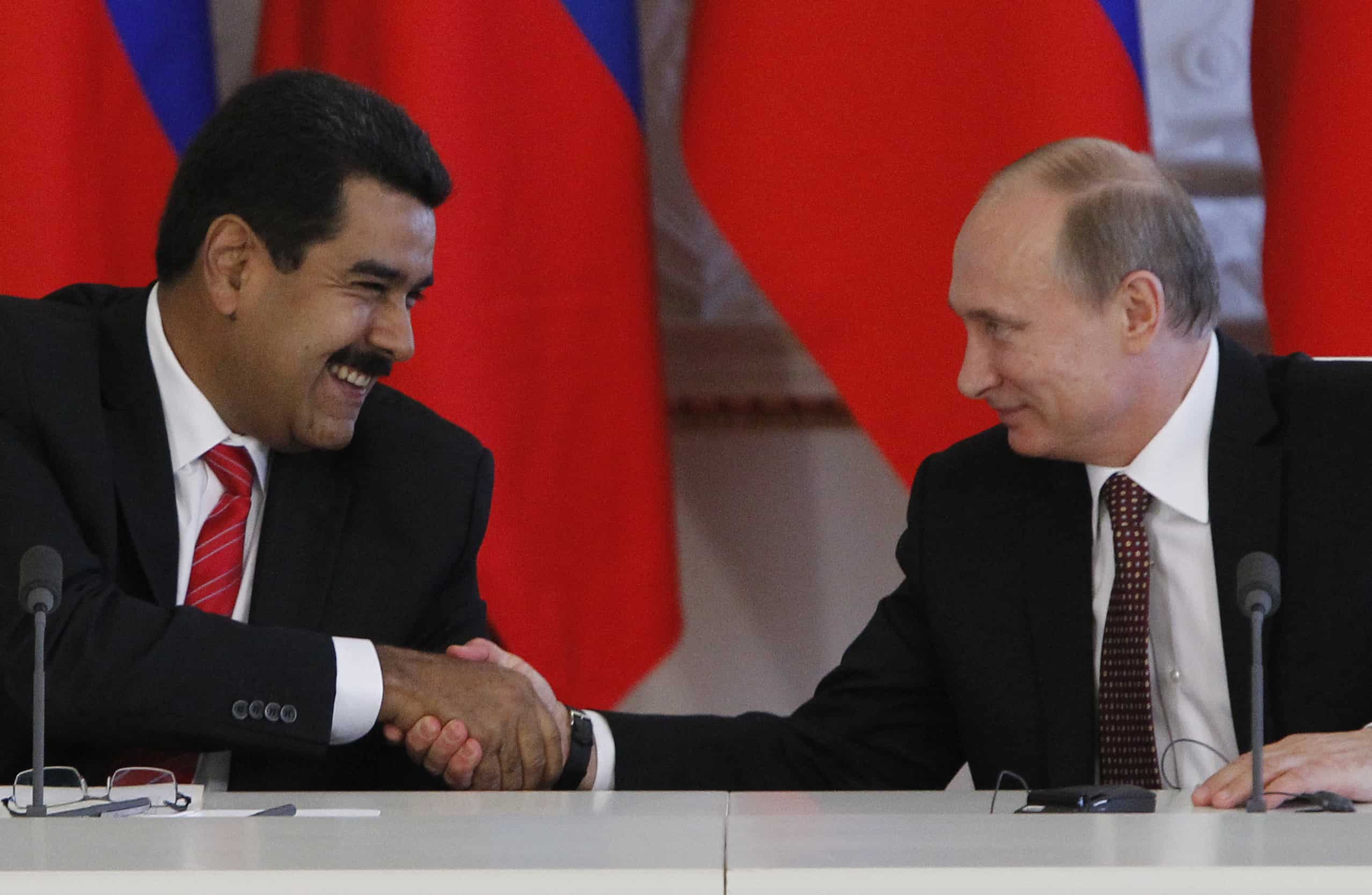
Vladimir Putin’s Russia, eager to return to superpower status, is increasingly trying to play out its conflict with the United Sates in Latin America while “profiting from weapons sales and challenging and provoking the USA,” Costa Rican social scientist Constantino Urcuyo told a U.S. congressional committee in Washington, D.C. last Thursday.
Speaking before House Subcommittee on the Western Hemisphere at a hearing convened to discuss Russia’s engagement in the region, Urcuyo said that Russia has made inroads in the hemisphere by providing military assistance and material aid to such anti-U.S. governments as Nicaragua, Venezuela, Bolivia and Ecuador.
“Russia’s regional old friends and new allies provide a haven for extra-hemispheric powers that seek to counterbalance the power of the USA, by strengthening anti-imperialist nationalism against Washington,” said Urcuyo, speaking in his capacity as the academic director of Political Administrative Research and Training (CIAPA), a Costa Rica think tank.
Russia’s interest in Latin America is focused on the military not the human development realm, said Urcuyo, also a professor at the University of Costa Rica.
He said the U.S. should not try to address the problem with Russia in Latin America unilaterally.
U.S. policy “must emerge from a dialogue with Latin American countries that considers all national interests and defines multilateral political partnerships around mutual prosperity and human development,” he said.
The UCR professor said the United States should broaden its focus on Central America security issues beyond the war on drugs.
“Excessive attention to this issue can blind us to the active presence of extra-hemispheric actors who could use regional conflicts to divert attention from their own conflicts in other spots around the globe,” he concluded.
Urcuyo said that Latin American countries must be made aware that they should not be trapped in a Russian conflict.
Former Washington Post Latin America correspondent Doug Farah, now president of IBI Consultants, told the committee that with the fall of the Berlin Wall in 1989 and the collapse of the Soviet Union, Russia’s influence in Latin America “ebbed to almost nothing.”
“Yet given its current positioning, one could argue that Russia now has more influence in Latin America than ever before, even including at the height of the Cold War,” Farah said. “This will likely remain true despite the recent announcement of the normalization of diplomatic relations between Cuba and the United States, and Russia’s ongoing economic turmoil.”
See also: Central American leaders concerned over rekindling of Nicaragua-Russia military ties
Shifting away from democratic values
Urcuyo said Putin is motivated by nationalism that demands a superpower role for Russia.
“Russia is nostalgic for having lost the Soviet Empire and wants to show the world that it is still a member of the major powers and capable of projecting power in its main adversary’s backyard,” Urcuyo said. “On the other hand, Putin plays to his domestic audience. The resurgence of great Russian nationalism is fostered by the audacity of a leader that enters the influence area of the United States of America.”
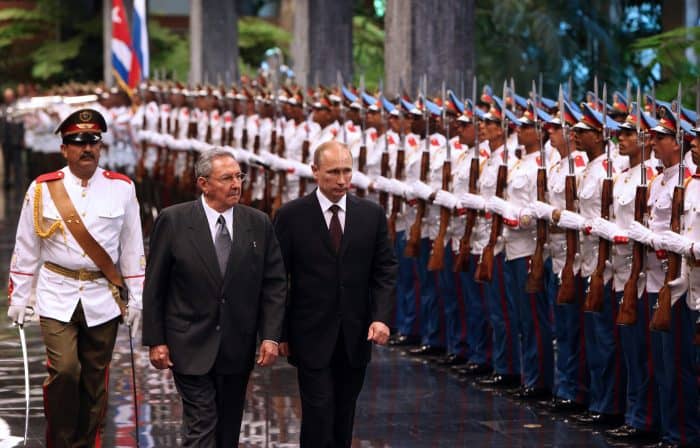
Farah outlined the kind of assistance Russia is providing to the “virulently anti-American” leaders of the Bolivarian Alliance for the Peoples of Our America (ALBA).
“The Putin government is providing ALBA nations with weapons, police and military training and equipment, intelligence technology and training, nuclear technology, oil exploration equipment, financial assistance, and an influential friend on the United Nations Security Council and other international forums,” Farah said.
Russia support of ALBA is assisting a shift away from democratic values in some parts of the hemisphere, he added.
“With Russia’s help and advice, the once-shared hemispheric values of a functioning democratic system are being replaced by a toxic mix of anti-democratic values, massive corruption, and a doctrine that draws on totalitarian models,” Farah said.
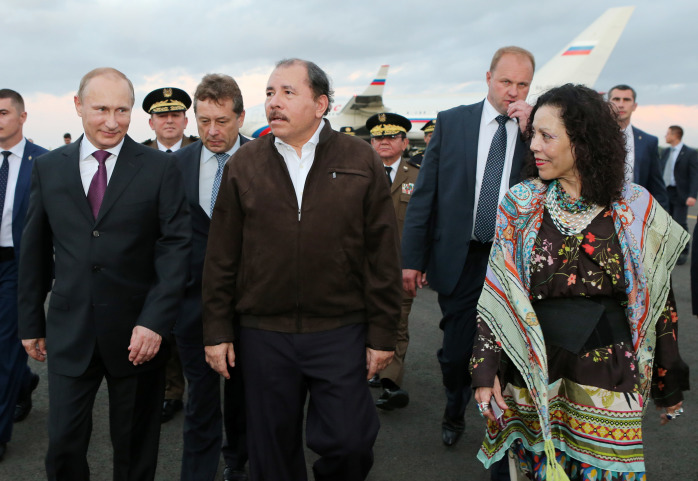
Urcuyo focused particular attention on Nicaragua, formerly a Soviet Cold War ally, which he called, “Russia’s gateway to Latin America.”
“Russia has a historical background of close relations with Managua in terms of political, military and educational terms,” Urcuyo said. “Currently, though, collaboration links have become closer. The Russian ministers of defense and foreign affairs visit frequently, and a Russian anti-drug training center has opened near Managua.”
Urcuyo called the training assistance “paradoxical,” as drugs transited though Nicaragua don’t end up in Russia.
“Some observers interpret it as a form of covert, strategic expansion,” said Urcuyo. “Russia’s intention could be to obtain military bases as regional beachheads or to trade political military assets as it did during the Cuban missile crisis.”
The recent announcement that Russia plans to sell MiG-29s and frigates to Nicaragua also raise concerns as the sales fit more the scenario of confronting Colombia over the two countries’ maritime conflict than fighting the drug war, he said, adding that the sales would effect the regional balance of forces and abrogate arms agreements signed by Managua to end the regional Cold War conflicts in the 1980s.
Russia’s maneuvering in Central America is of particular concern to army-less Costa Rica, which took Nicaragua to the International Court of Justice at The Hague after the Sandinista government laid claim to Isla Calero at the mouth of the San Juan River, a wetland area that Costa Rica claims as its own.
Urcuyo quoted Costa Rican President Luis Guillermo Solis during a recent trip to Europe: “We are very concerned about the continuous presence of high authorities of the Russian government in Nicaragua, such as the minister of defense, and the presence of armed vessels of the Russian Navy in the waters of that country.”
Markets and the sphere of influence
Also testifying before the subcommittee was Diana Villiers Negroponte, public policy scholar at the Woodrow Wilson Center for Scholars, who said that Russia had three reasons for wanting to more engage Latin America.
“Markets is one of the reasons that Russia has expanded its interest and its presence,”Villiers Negroponte said.
Russia is looking to sell military equipment, heavy industrial equipment and goods from its growing information technology sector, she said.
Secondly, “Russia needs friends” to support it in the U.N. and other forums when the West condemns the Russian annexation of Crimea and its activities in Ukraine.
Thirdly, the West’s involvement in places like Poland, the Baltics and Ukraine – the Russian sphere of influence – has prompted Russia “to meddle in what some would call our backyard,” she said.
Villiers Negroponte urged Washington to counter Russian aims in the hemisphere by addressing the underlying causes of conflict in Latin America: poverty and the uneven distribution of wealth.
“We should pass the billion dollar program to support Central America,” she said.
If the United States doesn’t do something to address these issues someone else will, she added.
“If we are not to show that we care about these underlying problems, exacerbated further by the drug trade, exacerbated further by the presence of military weapons, then we should expect that others will fill the space,” Villiers Negroponte said. “I sincerely hope that space is not filled by Russia.”





