

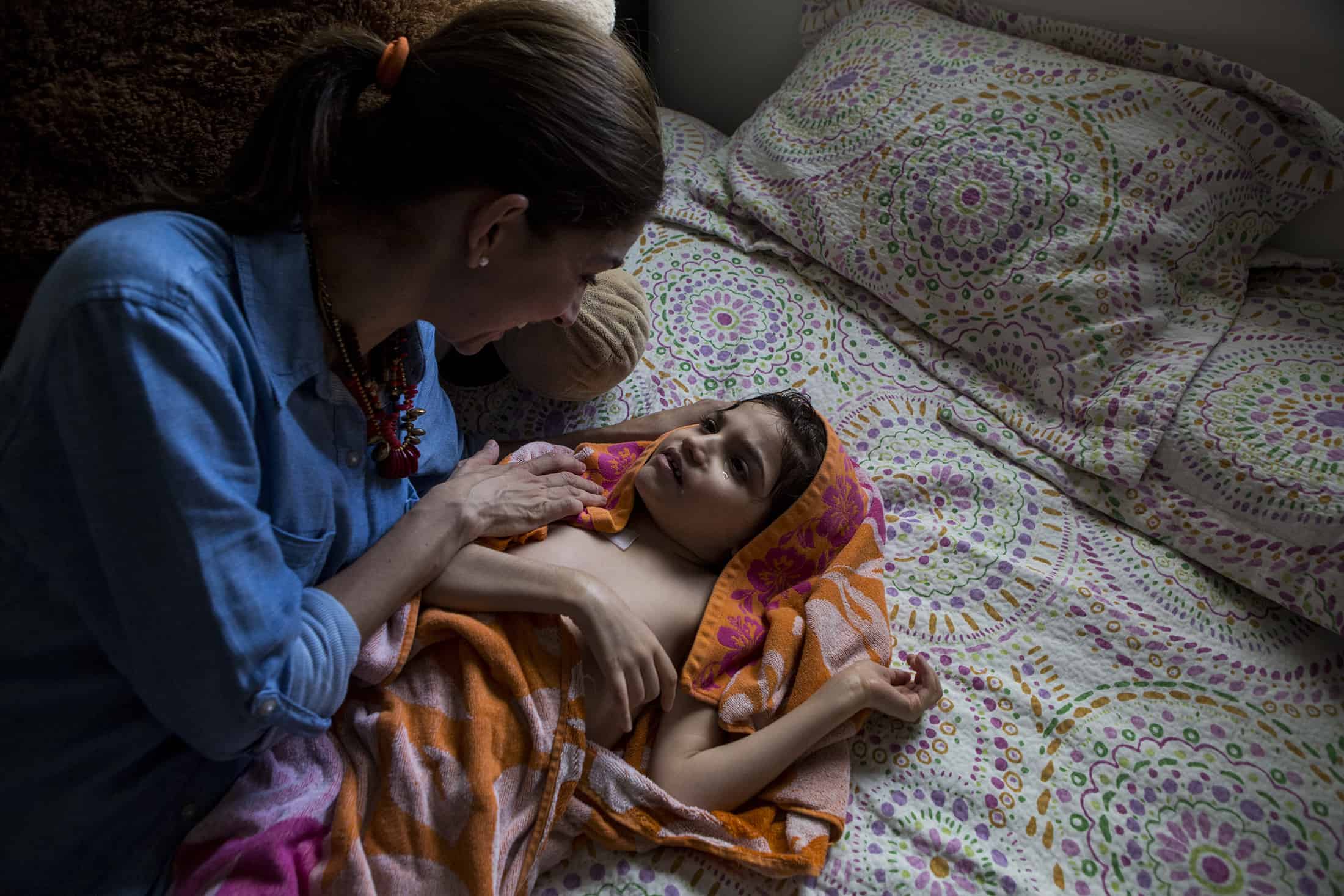
MONTERREY, Mexico — They can tell the next one’s coming when she begins rubbing her hands together, as if washing them. Her head slumps, and she looks left. She starts to flick her fingers and knead her skinny thigh.
About once an hour, Grace Elizalde’s brain electrifies in epileptic seizures intense enough that her brown eyes dance wildly back and forth and she spreads her arms out like a cartoon ghost. These are the big brain quakes, but there are hundreds of flash tremors each day that leave the 8-year-old Mexican girl exhausted and limp.
After years of cycling through anti-convulsive medications, her family is now desperate to try the one experimental treatment that Mexico prohibits — a marijuana oil that has helped U.S. children in similar conditions. But even as states approve marijuana for recreational and medicinal use, the country that is the main channel for illegal narcotics to the United States opposes legalization as staunchly as ever.
With the exception of more liberal Mexico City, public opinion in this socially conservative country falls strongly against legalization. Tens of thousands of Mexicans have died in the country’s war with its drug-trafficking gangs, a toll that hasn’t weakened the government’s policy.
Earlier this month, though, a federal judge ruled that the Mexican government could not prevent Grace’s parents from importing cannabidiol (CBD) to treat her seizures. If the family can obtain the product, Grace could become the first person to legally use marijuana in Mexico.
“We’re up against time,” said her father, Raúl Elizalde. “The seizures keep getting stronger.”
In the United States, the taboo on using marijuana is vanishing. In Mexico, perceptions of the plant are far different. Just a tiny fraction of Mexicans say they have smoked marijuana, compared with about half of U.S. citizens. Polls have shown that most Mexicans expect that legalization would increase the use of drugs while failing to curb violence.
“It’s wrong to think that legalization would resolve the problems of drug trafficking and public security; rather, it would aggravate the problem of public health,” said Eduardo Santillán Pérez, a Mexico City legislator from the left-wing Party of the Democratic Revolution (PRD). “If you are poor, jobless, uneducated, without alternatives for your free time, marijuana risks pushing you into illicit activities.”
The Elizaldes understand the concerns about drug violence. As they were raising Grace, their home town of Monterrey became one of the country’s most crime-ridden cities, with the Zetas and Gulf cartels vying for dominance. The fathers of both Raúl and his wife, Mayela Benavides, were kidnapped. Mayela was robbed on her way to pick up Grace from school. At one point, two men entered Raúl’s hair-accessory store and informed him they were from “The Company,” which he knew to mean the Zetas. They charged him $150 a month, coming with their notebooks to collect, until he chose to close down.
“It was pure terror,” Raúl said.
Mayela and her husband didn’t see themselves as activists promoting legalization. They just sought medicine for their daughter — and for other sick children.
“This isn’t something we wanted to do to break the paradigm or anything,” Raúl said. “This is our last chance.”
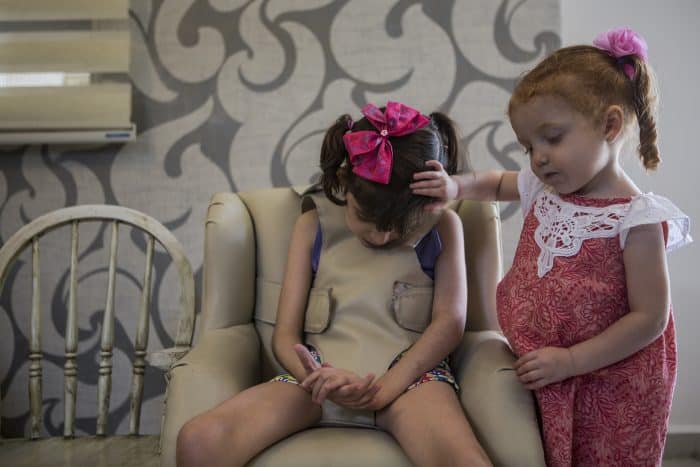
While Grace sucks her thumb in their sun-filled living room, her mother opens a plastic tub with accordion folders, notebooks, brain scans and journal articles, the documentation of her eldest daughter’s medical odyssey.
“She was not like a normal baby,” Mayela said.
Graciela Elizalde Benavides was born on July 10, 2007, apparently healthy. But her parents soon noticed that she appeared to have trouble hearing and would cry for long periods. She was allergic to many foods — corn, milk, nuts, seafood, pork, strawberries and citrus fruits. It wasn’t until after her doctors operated on her for acid reflux that they realized her convulsions were not caused by intestinal trouble. She was eventually diagnosed with Lennox-Gastaut syndrome, a severe form of epilepsy.
Mayela had trained as an engineer and worked in economic development, but caring for Grace became her full-time job. In an Excel spreadsheet, she has documented the 19 anti-convulsive pills and powders Grace has taken in various combinations since August 2008. The side effects have often been distressing: Medicines have shrouded her peripheral vision, caused incessant drooling and made it difficult to chew. Her parents have visited more than a dozen neurologists, plus orthopedists and gastroenterologists, optometrists and geneticists. They experimented with homeopathic drops, acupuncture, herbal infusions.
Raúl once drove three hours to the border town of Laredo, Texas, and spent $5,147.07 to fill a prescription for Cortrosyn, which Mayela injected in Grace’s buttocks at 6 a.m. for 40 days.
“It didn’t work,” she said.
Even at 8 years old, Grace is like an infant. She once learned to say “Mama” but then lost the ability to speak. Mayela bathes her and changes her diapers, brushes her teeth and hair, dresses her from the plastic foot braces to the bow in her hair. When seizures come on, Grace gets strapped into a leather chair with a harness made by her aunt, to avoid falling. A small percentage of children with her condition don’t survive past childhood.

Saúl Garza Morales, a neurologist in Mexico City, eventually recommended surgery to sever the corpus callosum, the nerve fibers dividing two halves of her brain, in an attempt to block the seizures’ spread. The Elizaldes risked the procedure, but her condition only worsened.
“The girl had so many seizures that her development couldn’t advance,” said Garza, the chief of the neuroscience department at the National Institute of Perinatology. “We have exhausted all known recourses.”
The one thing they hadn’t tried was marijuana.
See also: Medical marijuana proposal in Costa Rica gets Health Ministry review
Elsewhere in Latin America, left-leaning governments have rejected the anti-drug stance promoted by successive U.S. administrations. Marijuana is now legal in Uruguay, while Chile has approved it for medicinal use. Advocates push legalization less as an issue of personal freedom and more as a way to take the narcotics business away from violent cartels.
But attempts to legalize marijuana in Mexico have foundered. Mexican President Enrique Peña Nieto said last year that his opposition to such efforts came from “personal conviction.” Even in Mexico City, where residents voted in favor of gay marriage and access to abortion, marijuana legalization failed.
“Almost nobody wants to study or talk about marijuana,” said José Luis Oliveros Usabiaga, a conservative politician who heads the commission on youth in the lower house of congress. “If there’s an addict in the family, it’s shameful to talk about. It’s a taboo in Mexican society.”
After Colorado and Washington state voted to legalize marijuana in 2012, Fernando Belaunzarán, a Mexican lawmaker, proposed similar legislation. Belaunzarán thought it was absurd that Mexicans were dying in a war over a drug that could be bought over the counter in parts of the United States. He later co-sponsored another bill for medicinal use. Neither has won much support.
“The war on drugs has generated such an avalanche of ideology that it’s difficult to break these prejudices,” he said.
The Elizaldes reached out to Belaunzarán after they’d heard of the case of Charlotte Figi, a Colorado girl whose grand mal seizures declined dramatically after she began taking CBD oil. Colorado is one of 15 states where the product is now legal. But few people have studied how CBD works against epilepsy.
“We don’t have a lot of data that we would expect from other types of medical treatments,” said Alan Shackelford, a Harvard-trained doctor who treated Figi and is a member of Colorado’s scientific advisory council on medical marijuana. “But it’s a Catch-22. Our government places such draconian restrictions on being able to study cannabis in any way, that it’s very hard to get that data.”
He said there are enough positive signs that it warrants trying the drug on many patients, including those with Lennox-Gastaut, which is notoriously difficult to treat.
“Seizures themselves are dangerous,” Shackelford said. “The potential downside of not trying it is death.”
The Elizaldes do not expect a miraculous recovery for Grace. But they hope that CBD might diminish or eliminate the seizures, allowing her to make progress in her therapy.
Raúl had considered buying the oil in Colorado and taking it home in his pocket.
“If they deny everything, I would do it,” he said. “But what we’re looking to do is the correct and legal way. Because medically this could open things for more children who are in the same position.”
The Mexican constitution gives citizens the right to protection of their health. That was the argument Belaunzarán used when he wrote on June 4 to Mexico’s health secretary requesting permission to import cannabis oil for Grace’s treatment.
The ministry responded three weeks later with a firm no, arguing that there was no conclusive evidence that cannabidiol was safe or effective in treating epilepsy. The use of marijuana products “increases the risk of cognitive alterations, addictions, and the presence of psychotic disorders in those who consume it,” a ministry official wrote to the family. The greatest risk, he said, was for “patients under 15.”
Attorneys working pro-bono for the family challenged the decision. On Aug. 11, a federal judge, Martín Adolfo Santos Pérez, granted initial permission to the family to import the marijuana oil for her use.
“This is a historic step,” Belaunzarán said.
But many barriers remain. It is illegal to transport marijuana products across state lines and most foreign borders. The Mexican government could appeal the ruling. Some other countries, such as Brazil, have authorized the importation of CBD from the United States, so the Elizaldes hope to prevail.
A Health Ministry spokesman declined to comment on the case.
“I trust that people in the government can be sensible,” said Garza, the neurologist. “The reason we’re proposing the use of an experimental pharmaceutical like cannabidiol is because the girl’s situation requires it.”
Belaunzarán said his greatest hope was that it would work for Grace. “This is a story that deserves a happy ending,” he said.
© 2015, The Washington Post





