

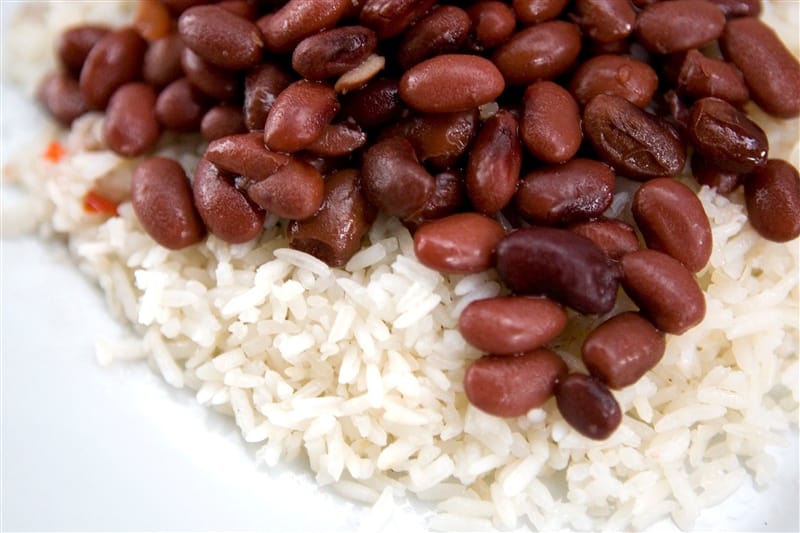
Don’t panic. Your gallo pinto is safe. Or at least a little bit safer thanks to new research that may help save the world’s beans from the future effects of climate change.
Climate models now show that up to 50 percent of the world’s bean cropland could be lost to extreme heat by 2050. Central America is particularly susceptible to these changes.
Climatologists expect that up to 68 percent of Nicaragua’s bean farmland will be subject to extreme heat stress by 2030.
In response to these gloomy predictions, scientists at the International Center for Tropical Agriculture (CIAT), based in Cali, Colombia, have identified 30 lines of beans that can tolerate extreme heat.
To identify the survivors, researchers cultivated beans in unusually hot areas and in greenhouses to test their yields.
“It was easy to identify the good materials: they were the only ones that had any pods at all,” Steve Beebe, the researcher in charge of the study, said. “Heat stress affects pollination and does not permit normal formation of seeds and pods.”
To create the beans, scientists crossed the protein-rich common bean — a food staple in Latin America and Africa — with the drought and heat-resistant tepary bean.
The breeding project’s original purpose was to find drought-resistant beans. But as research began to show the threat of rising temperatures on the crop, CIAT launched a side project to identify which strains could also beat the heat.
The most successful beans were the small red beans popular in many Central American dishes. But a black bean known as SEN 52, which is already on the market in Nicaragua, also proved successful.
When SEN 52 was tested in Costa Rica it produced more than twice the average yield of beans cultivated by farmers in the area.
“Incredibly, the heat-tolerant beans we tested may be able to handle a worst case scenario where the buildup of greenhouse gases causes the world to heat up by an average of 4 degrees Celsius (7.2. degrees Fahrenheit),” Beebe said.
While the high yields are good news for the bean farmers of the future, they also indicate that hotter temperatures may already be affecting Central America’s bean crop more than agricultural experts originally thought. This means that farmers in hot regions need not wait for devastatingly high temperatures to begin benefitting from the new beans.
The discovery could help save a staple crop that millions of people rely on.
“Climate change will bring many changes to agriculture, not only higher temperatures,” Beebe said. “Droughts may increase in frequency and some years will suffer excess rainfall. However, the climate models tell us that at least we can counter the effects of increasing temperature with these new beans.”





