

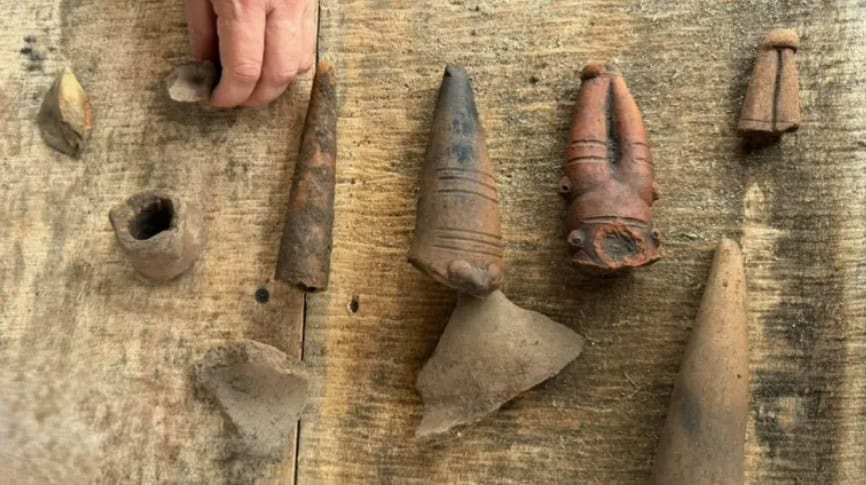
Costa Rica’s National Museum sent an archaeologist to a rural high school in Pérez Zeledón yesterday after construction crews rebuilding the campus turned up materials that may be of archaeological value. The materials surfaced during reconstruction of the Liceo Rural Buena Vista.
The Ministry of Public Education (MEP) and the National Commission for Risk Prevention and Emergency Response (CNE) tightened security around the site and reported the situation to the Ministry of Culture and Youth (MCJ), according to a statement the ministry released on Sept. 19.
The Culture Ministry said the National Museum’s specialist would examine the extent, characteristics and dispersion of the evidence found in the ground. That assessment is meant to establish the nature and scope of the materials and determine, on technical grounds, what happens next.
Culture Minister Jorge Rodríguez Vives said Costa Rica has enormous archaeological wealth that must be protected, and that a find of this kind requires authorities to act responsibly under technical criteria and the country’s laws. He credited the MEP with acting immediately to secure the site and said it now falls to the National Museum to carry out the inspection and define the steps that follow.
Officials outlined two possible outcomes. If the inspection confirms the evidence is limited and clearly defined, the National Museum could carry out a targeted rescue, recovering the materials so work can move ahead. If the materials cover a larger area or require a broader intervention, the museum will set a work plan matched to the site’s characteristics, coordinating with the MEP and the CNE according to each institution’s responsibilities.
Any action falls under Law 6703 on National Archaeological Heritage, which protects movable and immovable objects produced by Indigenous cultures that existed before or at the time of Spanish settlement in Costa Rica, along with remains associated with them.
The school’s reconstruction is funded through the Emergency Program for Comprehensive and Resilient Infrastructure Reconstruction (PROERI), carried out under a CNE emergency declaration. Within that program the CNE acts as coordinating executing body, while the MEP serves as executing unit with responsibility for technical oversight, coordination and supervision of the works.
The Culture Ministry has not described the materials publicly or said when the inspection results will be released. It said it would report its findings once the on-site evaluation concludes, along with the measures needed to protect any heritage and the route the school project will follow.
Costa Rica’s southern region is one of the richest archaeological zones. The nearby Diquís Delta is home to the pre-Columbian stone spheres, whose settlements were declared a UNESCO World Heritage Site in 2014, and earlier excavations in Pérez Zeledón have documented Indigenous ceremonial and burial sites.





