

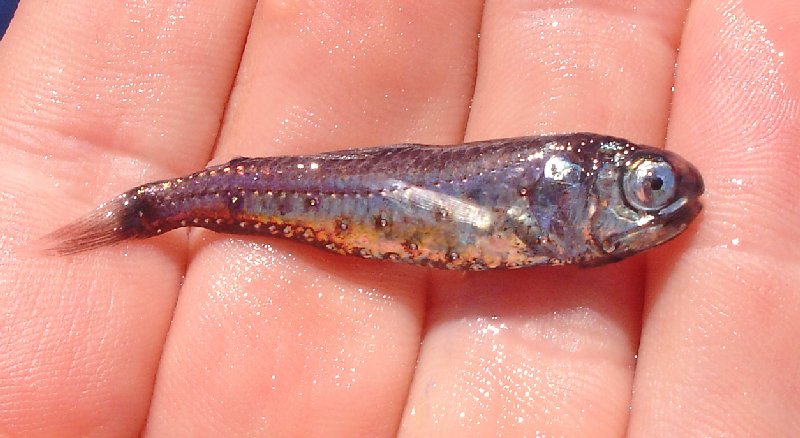
When my daughter reached down and picked up the little fish from the surface of the deep blue sea, she asked me what kind it was. Since I knew she was wanting something more specific than sardina roja, I told her I didn’t know. Neither did the old and famous marine biologist standing next to us who has sailed and dived the seven seas for seven decades. We had just spent hundreds of hours filming the largest dolphin pods known, for the biggest documentary ever made about the oceans – but no one had thought to identify, or even really look at, the fish that made the vast bait balls that the dolphin megapods, and much more, feasted on. So I took this photo.
Turns out the photo was the first known identification of the sardina roja in Costa Rica. The books showed it to be the little lantern fish, Symbolophorus, the secret to the Costa Rican deep-carbon sink: They make carbon sink to the bottom of the sea with their fins.
Little lantern fish are smaller than your finger and live so deep that very few people have ever seen one alive, unless you hang out southwest of the Isla del Caño Biological Reserve, off the shores of Costa Rica’s Osa Peninsula. Further offshore than the island, where the continental shelf plunges to the deep sea, the sardina roja stain the surface of the blue sea red.
This is the only place known in the world where these fish can be reliably seen alive. People using sonar see them every night. On sonar, these fish – the most numerous animal on the planet with a backbone – swim in such thick clouds that they appear to be the bottom of the ocean. Every night, all around the world, this false bottom of fish rises up just a bit from the depths of the sea, eats heaps of carbon-rich plankton, and then drops back down again and poops carbon.
During a week in which climate change has taken center stage, in a world in which carbon emissions have become an enormous ecological threat, and in an era when great minds are searching for ways to achieve carbon sequestration to remove it from the atmosphere, it is amazing to consider that these tiny lantern fish sink far more carbon than all of the world’s forests combined. Because offshore Osa is the only place in the world where these fish can be reliably seen and studied, it offers an astounding opportunity to better understand the crucial little lantern fish carbon-sink dynamics and help us negate having burned way too much carbon.
During the shoot of the biggest dolphin documentary ever made, we sailed at night off the shores of Osa, watching the dolphins glowing and throwing brilliant trails of bioluminescent plankton. We saw that on the windless and smooth surface glowed countless lights brighter than the spectacular stars above, even without the movement that makes most bioluminescent organisms light up. The famous badass underwater cameraman who was with us said it must be the reflection of the stars. I said it might be sea worms or spawn. My daughter said it was little lantern fish. We laughed. She grabbed a net, went astern, and dipped it full of little lantern fish.
On dark nights, lantern fish fill the sea off Osa with lights. This glittering surface mesmerizes those lucky enough to glimpse this extraordinary phenomenon. But they are not just beautiful – these fish are tremendously powerful, too. If we can learn more about their secrets, they may help Costa Rica and the world light the way to carbon neutrality, and perhaps a brighter future.
Contact costacetacea@gmail.com or visit www.costacetacea.com for more from columnist Shawn Larkin.





