

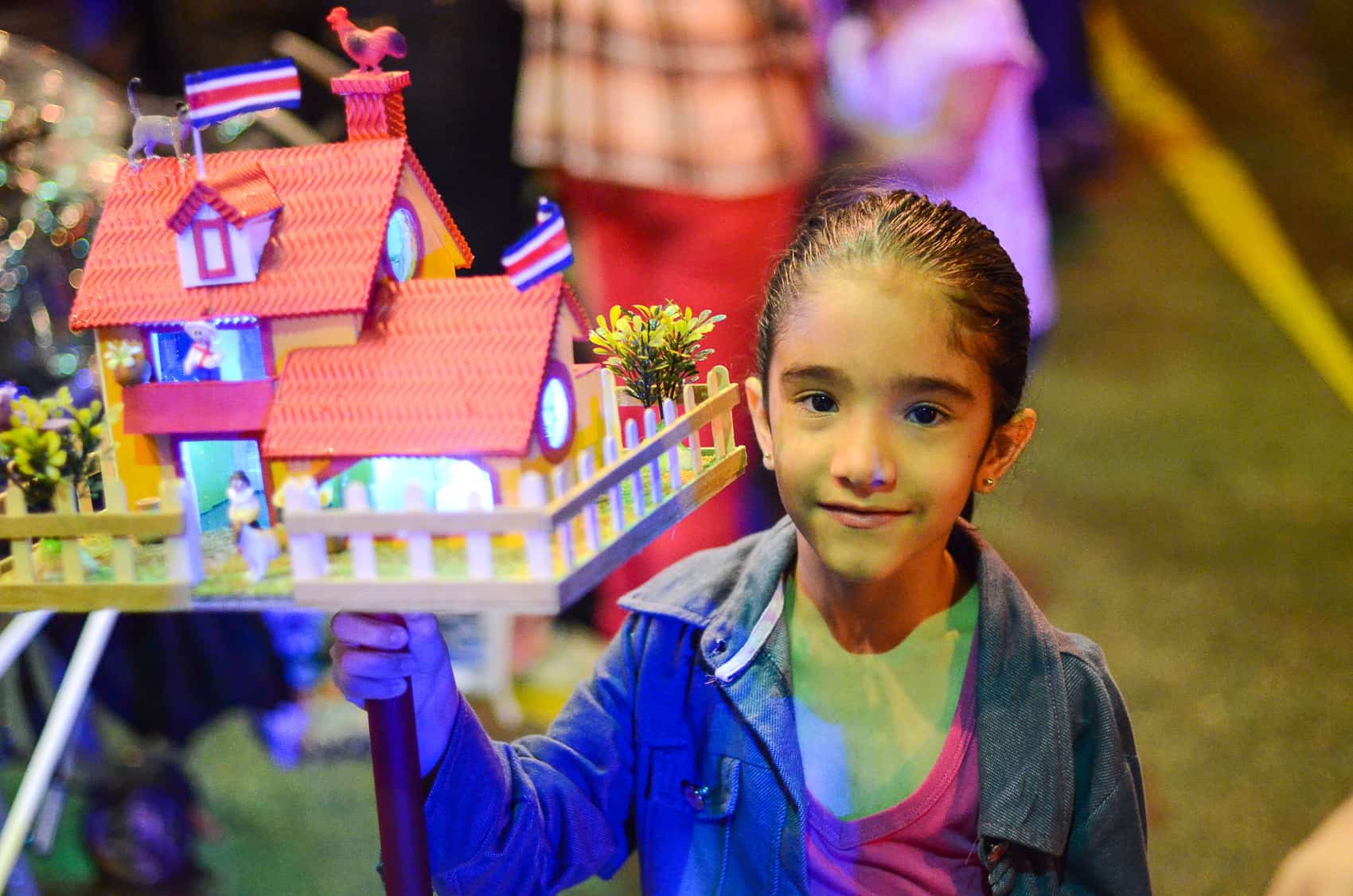
When I was growing up, faroles – the handmade lanterns meant to symbolize the 19th-century journey that brought the message of Central American independence to Costa Rica – were simple constructions, made of paper – like a red, white and black accordion with a candle inside. We typically made them in school during preparations for the civic festival to mark Costa Rica’s Independence Day on Sept. 15.
Today, faroles come in all shapes and sizes. Giant crests with the Costa Rican flag are highlighted by bright reflectors; there are elaborate “casitas típicas” (typical homes) and large oxcarts that are so heavy the lantern’s pole can barely support them.
In today’s traditional parades, you can even find large footballs converted into lanterns, faroles with disco lights, and the dreadful Pitufina, or Smurfette, along with any of the cartoon character Smurfs, for that matter.
The truth is that in Costa Rica, any excuse is a good one for mounting a “molote,” or large crowd, and as is the tradition, on the evening of Sept. 14 kids pour into the streets with their parents to light up the night with their lanterns.
But why do we do this?
The best-known version of where lantern parades originated centers on a Guatemalan woman named María Dolores Bedoya. As the story goes, in the middle of the Central American independent movement, Bedoya ventured out into the night on Sept. 14, 1821 in what is now Antigua, Guatemala. With a lantern in hand, she called the residents of the town to meet in the plaza to rally for independence.
At the time, the legislators of the provinces of Guatemala were meeting in Antigua, which was the most important city in Guatemala.
The townsfolk gathered in the plaza with lanterns all night and into the early morning, waiting for a decision from legislators. Finally, on Sept. 15, the act of independence was signed, declaring Central America’s liberation from Spain. That’s when the chapines (Guatemalans) began shouting, “¡Viva la patria! ¡Viva la libertad!” (“Long live the homeland! Long live liberty!”)
Costa Rica belonged to the council of León, Nicaragua, and no one here really knew what was happening at the time. It wasn’t until Oct. 29 when a letter reached Cartago, east of the current capital of San José, notifying Costa Ricans of the news of independence.
Since then, lanterns have become a traditional decoration to mark the events. After Costa Rica’s war of 1948, political leaders decided to revive the country’s “patriotic values,” and to promote the lantern parades, they asked teachers to motivate their communities to encourage lantern making and prizes for the prettiest lanterns.
In 1953, Manuel Ureña was named director of San José schools, and he declared Sept. 14 at 6 p.m. the official time and date for lantern parades across the country.
Since then, lantern making has become a tradition. As I remember them, lanterns were made with scissors, glue, cardboard and tissue paper at the kitchen table, and always at the last minute. They may have been a little uneven, wrinkled and messy back then, but they were authentic.
Look for lantern parades across Costa Rica tonight at 6 p.m.





