

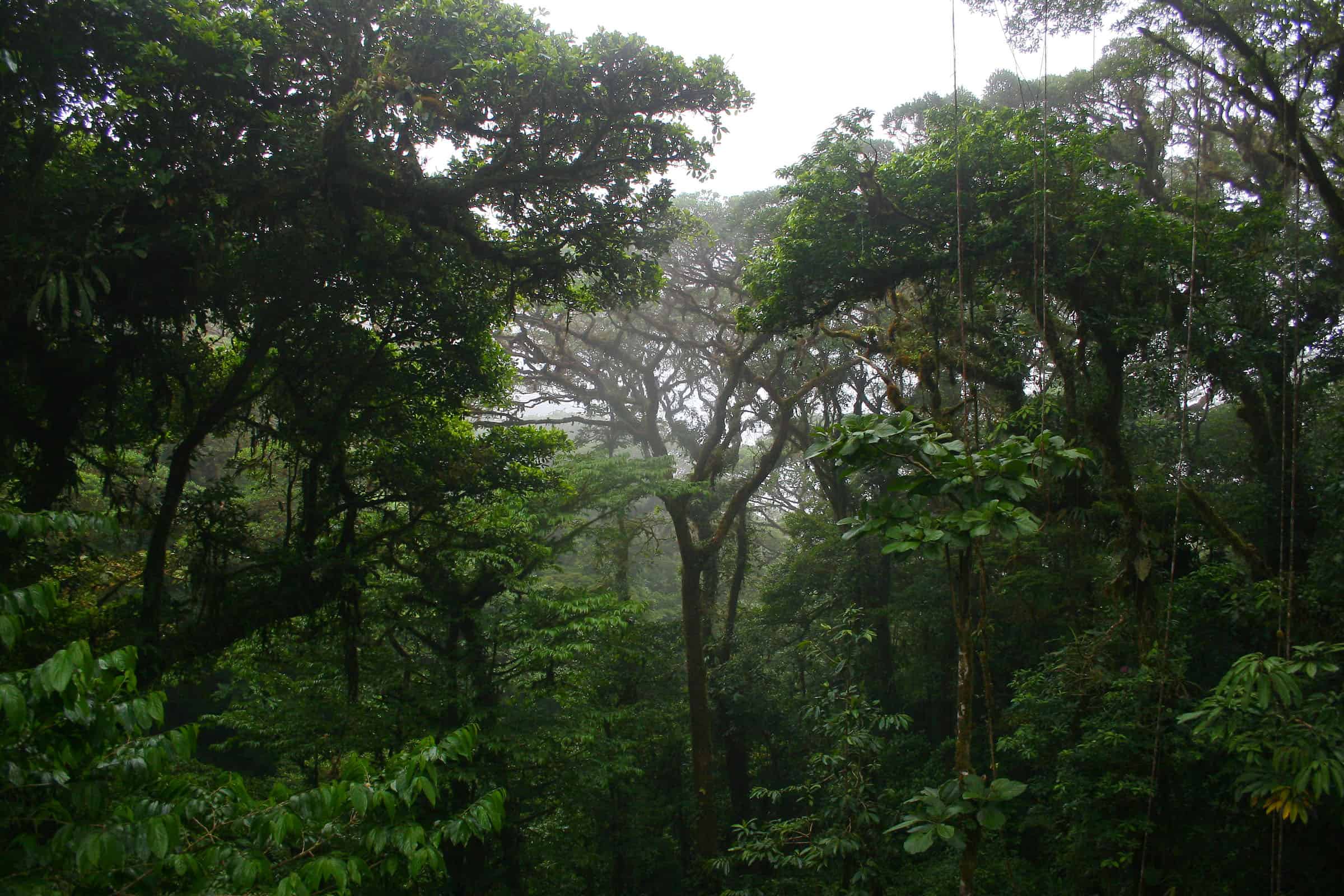
Costa Rica can count itself among the world’s most effective tropical forest conservationists, according to a surprisingly upbeat report from the Union of Concerned Scientists on reductions in global deforestation during the last decade.The report from the Cambridge, Massachusetts-based organization highlighted successes in reducing tropical deforestation in 17 countries in Central America and around the world, arguing that social and economic advancement does not necessarily mean accelerated loss of forest cover.
The report’s authors said that development in many countries actually led to improvements in efforts to reforest or reduce deforestation. “There is some success happening. Ironically, some of the less developed countries are having more success reducing their greenhouse gas emissions than the richest ones. That’s a story worth telling,” Doug Boucher, the report’s lead author and director of the UCS Tropical Forest and Climate Initiative, told The Tico Times.
“I think we’re starting to turn an old view on its head; that deforestation is something that can be reduced because people’s livelihoods are improving,” he added.
Boucher, who started his career in forest conservation in Costa Rica in 1971 working with the then-nascent National Park Service as a Peace Corps volunteer, said that Costa Rica has greatly improved its forest cover since the 1990s. Today, over 50 percent of Costa Rica’s land is covered with forest between national parks, reserves and indigenous reserves.
“Costa Rica bears out the prediction of substantial net reforestation based on a high level of the Human Development Index,” the report said.
President Luis Guillermo Solís toured the Osa Conservation Zone in the southern part of the country on Thursday. The Osa Peninsula is home to the rugged Corcovado National Park, celebrated as one of the most biodiverse places in Costa Rica. The president’s trip, as well as the UCS report’s release, coincided with World Environment Day on June 5.
The report’s findings highlighted Costa Rica’s success with eco-tourism; payment for ecosystem services, a system where land owners are paid to maintain their forests; and “reducing emissions from deforestation and forest degradation” (REDD+) programs, which provide financial and political support from the international community to protect forests.
While Costa Rica has seen success with eco-tourism, Boucher was hesitant that the model alone could protect large swaths of forest.
“You don’t need a whole lot of area for lots of people to share the same positive experience. It can work terms of preserving some areas but I’m not sure it can preserve really big areas in many countries,” he opined.
Brazil, however, was the report’s breakout success. Through a constellation of policies and changes in land use, Brazil cut its global warming emissions by one third, some 750 million tons of carbon dioxide, between 2001 and 2011. Only a decade ago, Brazil – Latin America’s largest economy – was the world leader in deforestation and ranked behind the United States and China as the world’s third largest source of global warming emissions.
“I think very few people, including few Brazilians, would have expected that rate of success,” said Boucher.
Brazil’s dramatic reductions are due in part to moratoriums on cattle ranching and soy bean production, expanding indigenous reserves and other protected areas, and a REDD+ agreement with Norway, among other measures. Brazil, which will host the World Cup this month, has set a goal of reducing CO2 emissions by 80 percent by 2020.
“There’s a lesson here that sometimes we’re too cynical or too accustomed to the status quo that things can’t change much or very quickly. Well, sometimes they do,” he said.
The lead author said he was disappointed to hear that Solís’ administration decided to push back Costa Rica’s ambitious goal to become the world’s first “carbon-neutral” country by 2021. Boucher said that many programs do not work as intended but that the accumulated results have still made significant improvements.
“Worrying about if it works in the manner it was exactly planned isn’t as important as just moving ahead,” said Boucher.





