

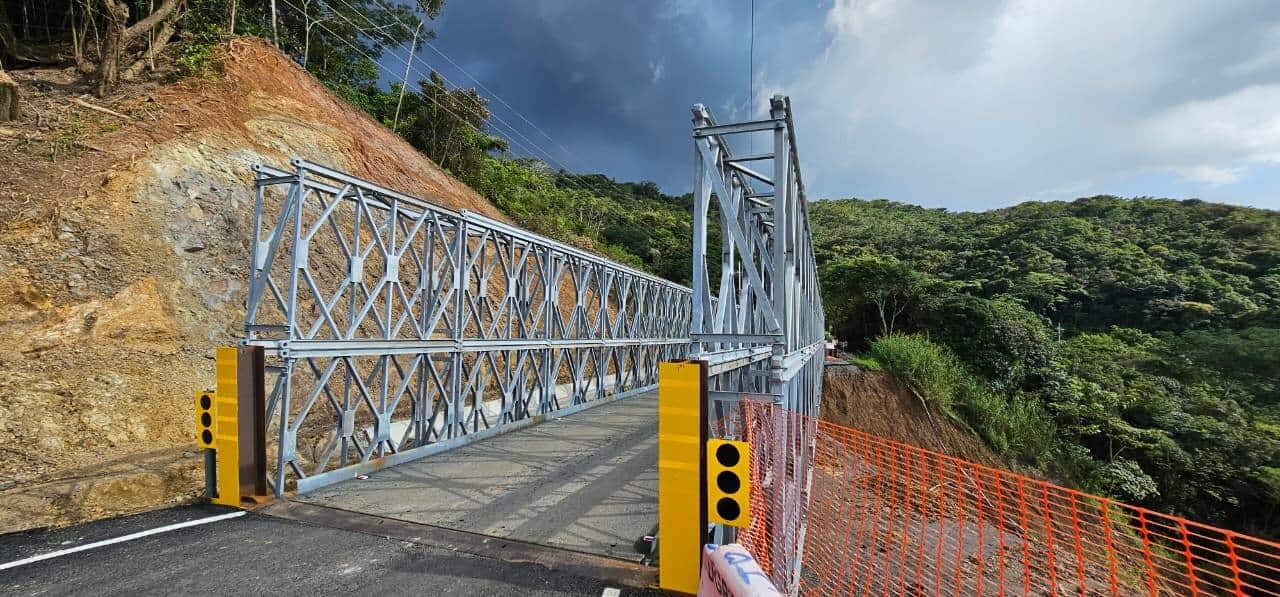
Costa Rica has reopened the Cambronero section of Route 1, restoring an important highway connection between the Central Valley and the Pacific coast after nearly two months of closure caused by damage to a temporary bridge. The Ministry of Public Works and Transport (MOPT) confirmed that traffic resumed on Sunday at approximately 5:30 p.m., following repairs to the modular bridge at kilometer 71 of the Inter-American Highway between San Ramón and Esparza.
The reopening comes as welcome news for drivers, freight companies and travelers who have been forced to use alternative routes since September 7, when a tractor-trailer struck the bridge and caused extensive damage to its metal structure. The accident forced authorities to close the crossing while engineers assessed the damage and determined how to repair the bridge safely.
The closure disrupted one of Costa Rica’s main road connections between the Central Valley and the northwestern Pacific region, sending additional traffic onto Route 27 and other roads. According to MOPT, the repairs cost approximately ₡380 million and involved a complicated process of removing damaged components, reinforcing the bridge and reinstalling it.
Before workers could replace the affected sections, they had to construct a temporary support structure capable of holding the bridge’s weight. Crews then removed portions of the bridge deck, moved sections of the metal framework and replaced damaged pieces before returning the structure to its original position.
The work also included reinforcing the bridge and making additional improvements intended to increase safety for motorists. MOPT and the National Road Council (Conavi) said the repairs allowed them to reopen the route earlier than initially expected. Although vehicles can once again travel through Cambronero, authorities emphasized that the repairs are temporary and do not resolve the underlying instability affecting the hillside.
The modular bridge provides a single-lane crossing while the government prepares a permanent solution to restore the original two lanes. Drivers should continue using caution when approaching the bridge, following posted traffic controls and allowing additional time for possible delays.
Some additional work will continue in the area, although authorities have indicated that these activities should not require another prolonged closure. The government is moving forward with a larger project intended to stabilize the hillside and restore the highway to its original configuration.
MOPT and Conavi have received eight bids from companies interested in carrying out the permanent work. Officials expect to evaluate those proposals during the remainder of 2026, with construction potentially beginning during the second quarter of 2027. The project would address the ground instability that originally made the modular bridge necessary and eventually allow the temporary structure to be removed.
However, the timeline will depend on the government completing the contracting process and selecting a company to perform the work. Public Works Minister Efraím Zeledón has also discussed the possibility of eventually adding a third lane in the area, although that idea remains under evaluation and is not part of an approved construction plan.
Cambronero has experienced repeated problems with landslides and unstable terrain over the years, particularly during periods of heavy rainfall. The mountainous section of the Inter-American Highway has steep slopes and difficult geological conditions, making repairs and maintenance especially challenging.
The reopening should provide relief for motorists traveling between San José, San Ramón, Esparza and destinations farther along the Pacific coast. During the closure, drivers were directed toward alternative routes, including Route 27 between San José and Caldera and Route 3 through the Monte del Aguacate.
Those detours increased travel distances and created additional expenses for businesses transporting goods between the Central Valley and northwestern Costa Rica. The disruption was particularly significant for trucks and commercial vehicles, which faced additional fuel costs, tolls and longer journeys.
Tourists driving between San José and destinations in Puntarenas and Guanacaste also had fewer options for reaching the Pacific coast. With Cambronero reopened, drivers once again have access to the Route 1 connection, although the temporary bridge means the crossing has not returned to normal two-lane operations.
For now, the government is asking motorists to drive carefully through the area and respect traffic controls while work continues. The immediate road connection has been restored, but the larger challenge of permanently stabilizing this vulnerable section of Costa Rica’s Inter-American Highway remains unresolved.





