

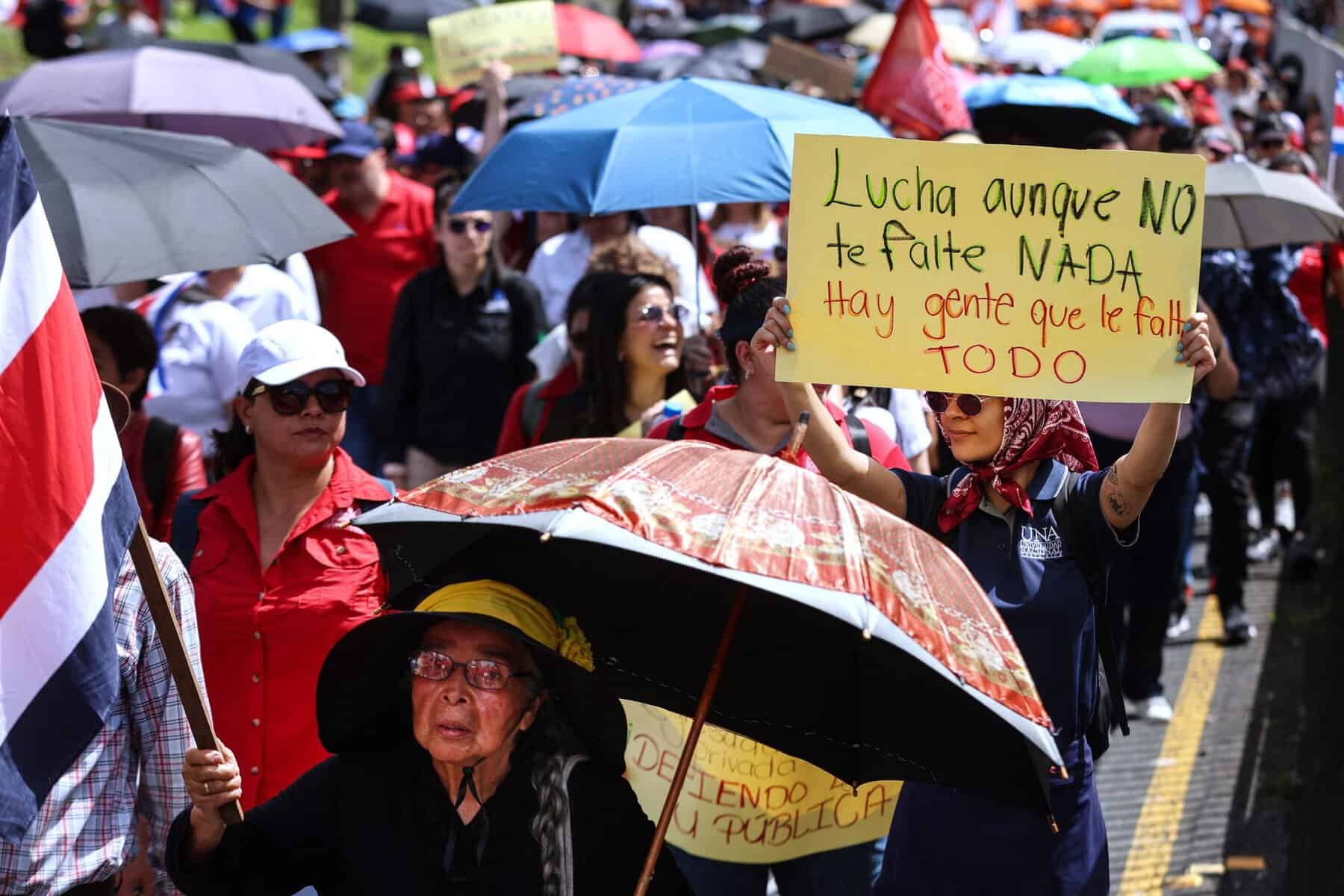
Thousands of students, university staff, union members and social activists marched through San José yesterday against cuts to public university funding. Late that night, the Legislative Assembly’s budget committee approved the 2027 national budget with an ₡8.05 billion ($17.7 million) reduction to the universities still in it.
The march, called by the National Council of Rectors (Conare), left the Fuente de la Hispanidad roundabout in San Pedro de Montes de Oca yesterday morning and ended at the Plaza de la Democracia, across from the Legislative Assembly. The rectors of all five public universities walked alongside students, professors and administrative staff, joined by delegations from regional campuses and groups representing health, agriculture, electricity and culture workers.
Marchers filled all four lanes of the road between San Pedro and downtown San José, forcing partial closures around the roundabout and in the city center. Rain fell over the final stretch, but demonstrators stayed for cultural activities and a vigil at the plaza that ran into the night. Former president Luis Guillermo Solís joined the crowd before it set off. He called public education a pillar of Costa Rican democracy and accused the government of systematic attacks on the public universities and the Judicial Branch.
The dispute centers on the Special Fund for Higher Education, known as FEES, which finances the University of Costa Rica, the National University, the Costa Rica Institute of Technology, the Distance State University and the National Technical University. Negotiations between the government and the universities over the 2027 fund ended without agreement.
The executive branch proposed keeping the fund at its 2026 level of ₡593.5 billion ($1.31 billion), a 0% increase. The universities had asked for 2.94%, leaving lawmakers to settle the figure as part of the national budget. The cut the committee approved comes from motion 16, filed by the ruling Pueblo Soberano party (PPSO).
It moves ₡8,048 million in deferred FEES funds, which the government and the universities had agreed in November 2025 to set aside for capital investment, to the Education Ministry to cover overdue employer contributions to the teachers’ pension board, Jupema. The motion was first rejected on Monday after PPSO lawmaker Kattia Ulate voted with the five opposition members against her own party’s proposal. Ulate later said in a video that she had voted by mistake.
That night, committee chair and PPSO caucus leader Nogui Acosta brought the motion back for review, and the university cut passed 6-5 on a second vote. Two further PPSO motions, numbered 104 and 105, sought nearly ₡10 billion ($22 million) more from university operating budgets and from the science fairs and math olympiads run by the University of Costa Rica. Neither reached a vote. Under legislative rules, debate on pending motions closed at 11:30 p.m. yesterday and the remaining proposals were discarded.
The committee then approved the ₡12.4 trillion ($27.3 billion) budget 6-5, with the six PPSO members in favor and the five members of the National Liberation Party (PLN) and the Broad Front opposed. A separate PPSO proposal to trim about ₡8.9 billion ($19.6 million) from the universities remains pending in the second extraordinary budget for 2026.
Conare has warned that the reductions would hit student scholarships, admission slots for new students and the operation of regional campuses that allow young people outside the Central Valley to earn a degree without moving away from home. Jorge Herrera, Conare president and rector of the National University, said the march was meant to defend access to higher education for people living in the country’s regions.
University of Costa Rica rector Carlos Araya said the cut is unconstitutional because it alters FEES funds agreed in the Liaison Commission, where the government and the universities negotiate the fund. Araya said the universities would take legal action if they receive no response, and that they would return to the streets as many times as necessary.
Student leaders made the same pledge. Mariel Rojas, president of the University of Costa Rica student federation, and María Ortega, president of the Distance State University student federation, said students would keep pressing the government to deliver the funds owed to education.
Acosta, responding to the march, said everyone has the right to protest. Tensions had already risen last week when Education Minister Leonardo Sánchez accused Costa Rica Institute of Technology rector María Estrada of political extortion for warning that the cuts could force a technical closure of the institute’s Limón campus. Estrada rejected the accusation, saying capital and surplus funds cannot legally be used to cover the campus’s operating costs.
Opposition lawmakers from the PLN and the Broad Front stepped out of the Assembly building during the protest to show support, while the rectors spent the afternoon in the committee gallery asking the ruling party to reconsider. PLN caucus leader Álvaro Ramírez said his party would keep fighting to stop the cuts.
The budget now moves to the full Legislative Assembly, which must debate and vote on it before the end of November. The committee also approved restrictions on the Judicial Branch’s budget, cutting ₡10.5 billion and freezing nearly ₡30 billion more pending audits and reports. Yesterday’s protest was the second large march over university funding this budget season. Students also took to the streets on Sept. 1, when the government formally presented the 2027 budget to lawmakers, in a protest against the proposed university funding freeze.





