

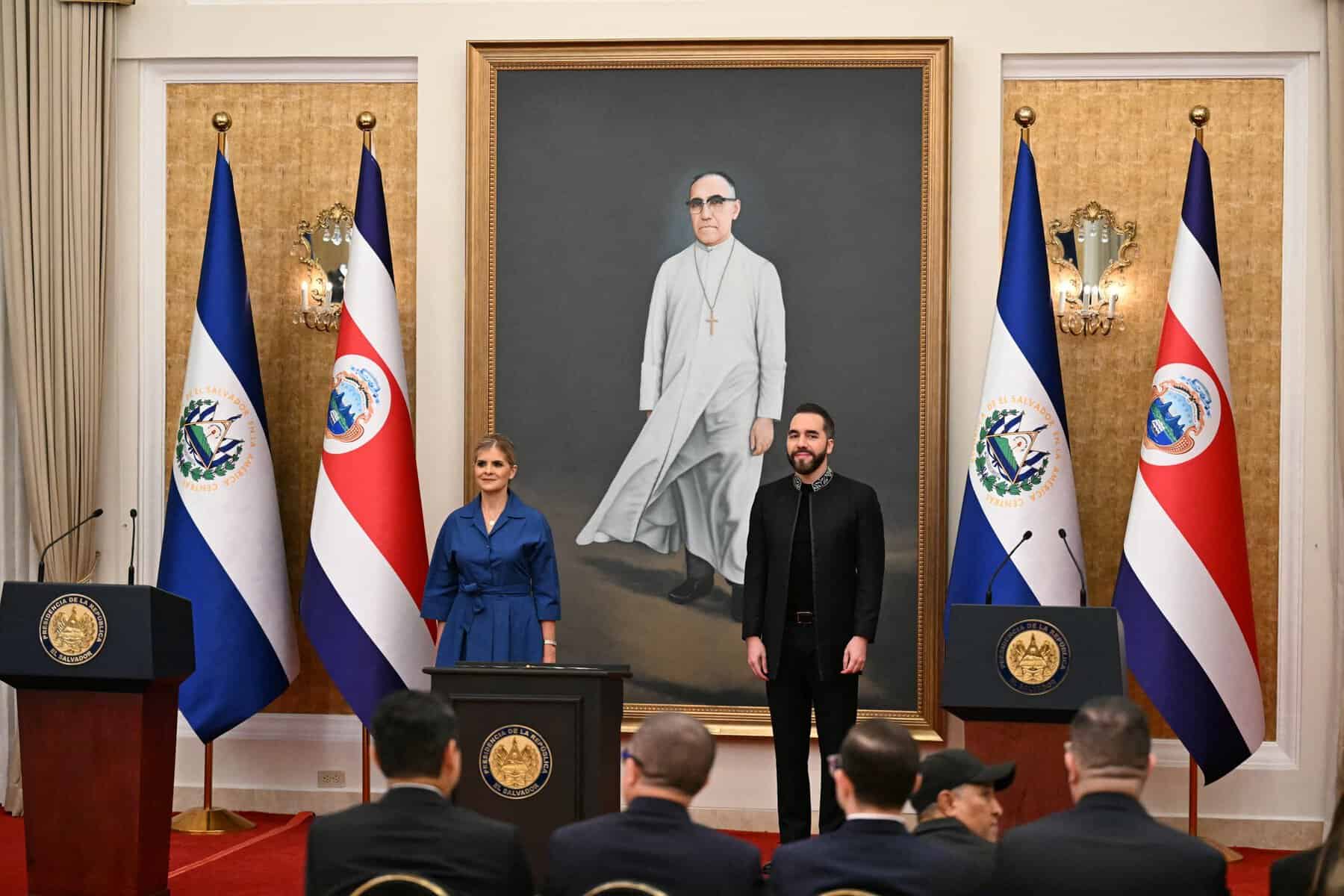
Costa Rica and El Salvador have signed a new security agreement aimed at strengthening cooperation against organized crime, as President Laura Fernández moves to deepen ties with Salvadoran President Nayib Bukele on policing and prison security. The agreement was signed yesterday during Fernández’s official visit to El Salvador, where she also toured the massive CECOT prison and met with Bukele.
Costa Rican Security Minister Gerald Campos and Justice Minister Gabriel Aguilar signed the agreement alongside El Salvador’s Justice and Public Security Minister Gustavo Villatoro. Fernández and Bukele attended the signing. The agreement is intended to improve cooperation between the two countries in fighting criminal organizations that operate across borders, including groups involved in drug trafficking and other forms of organized crime.
Exactly how that cooperation will work remains unclear. The governments have described the agreement in broad terms, but the full document and detailed operational measures had not been publicly released following yesterday’s signing. That means it is not yet clear whether the deal will include new intelligence-sharing systems, joint investigations, police training, prison-management cooperation or other specific measures.
The agreement comes as Costa Rica faces growing concerns over drug trafficking and organized crime. Authorities have increasingly linked the country’s high homicide numbers to disputes between criminal groups over drug markets and trafficking routes. Costa Rican police have also carried out several major operations this year targeting organizations accused of drug trafficking, money laundering, cargo theft and killings.
Fernández has made security one of the central issues of her administration. Her government has also developed increasingly close ties with El Salvador, where Bukele’s aggressive campaign against gangs has attracted considerable attention across Latin America. The Costa Rican president spent part of yesterday touring the Centro de Confinamiento del Terrorismo, better known as CECOT, the high-security prison built by Bukele’s government to hold alleged and convicted gang members.
Fernández toured cells, medical facilities, exercise areas and other parts of the prison. She said Costa Rica is interested in learning from measures that have helped El Salvador reduce criminal violence but stressed that it would maintain its own legal system and commitment to human rights.
The visit came just two days after Costa Rica inaugurated its own new high-security prison in San Rafael de Alajuela. The Centro de Alta Contención y Crimen Organizado (CACCO), has space for approximately 5,100 inmates and was designed with technical assistance from El Salvador.
The facility is located within the La Reforma prison complex and is intended primarily for prisoners considered a high security risk, including people linked to organized crime, drug trafficking and contract killings. Costa Rican officials say one of CACCO’s main objectives is to prevent criminal leaders from continuing to run their organizations from inside prison.
The first inmates are expected to be transferred to the new facility later this month. During her meeting with Bukele, Fernández said Costa Rica needs stronger controls inside its prisons and more effective tools for dismantling criminal organizations. Bukele argued that governments cannot limit their response to arresting individual criminals and instead need to target the entire structure of criminal organizations, including their leadership, finances and communications.
El Salvador’s security strategy has produced a dramatic decline in its reported homicide rate and has made Bukele one of Latin America’s most prominent political figures. The strategy has also drawn criticism from international human rights organizations. More than 90,000 people have been arrested in El Salvador since the government introduced a state of emergency in 2022. Human rights groups have documented allegations of arbitrary arrests, due process violations, mistreatment and deaths in custody.
Fernández said Costa Rica is not abandoning its traditional protections for human rights. She argued that tougher prison controls and respect for legal protections do not have to be mutually exclusive and said the government also has an obligation to protect victims of crime and families living in communities affected by violence.
The closer relationship with El Salvador comes as Costa Rica searches for ways to respond to increasingly sophisticated criminal organizations. Costa Rican authorities have expanded cooperation with the United States and other countries on drug trafficking investigations, extraditions and maritime interdictions.
The new agreement with El Salvador adds another regional partnership to that effort. For now, however, the significance of yesterday’s agreement will depend on what happens after the ceremony. The governments have confirmed their intention to work more closely against transnational organized crime, but they have not yet provided enough detail to show what changes Costa Ricans will see in police operations, intelligence gathering or prison management.
Those details will determine whether the agreement becomes primarily a political statement of cooperation or leads to new joint operations and security policies between the two countries.





