
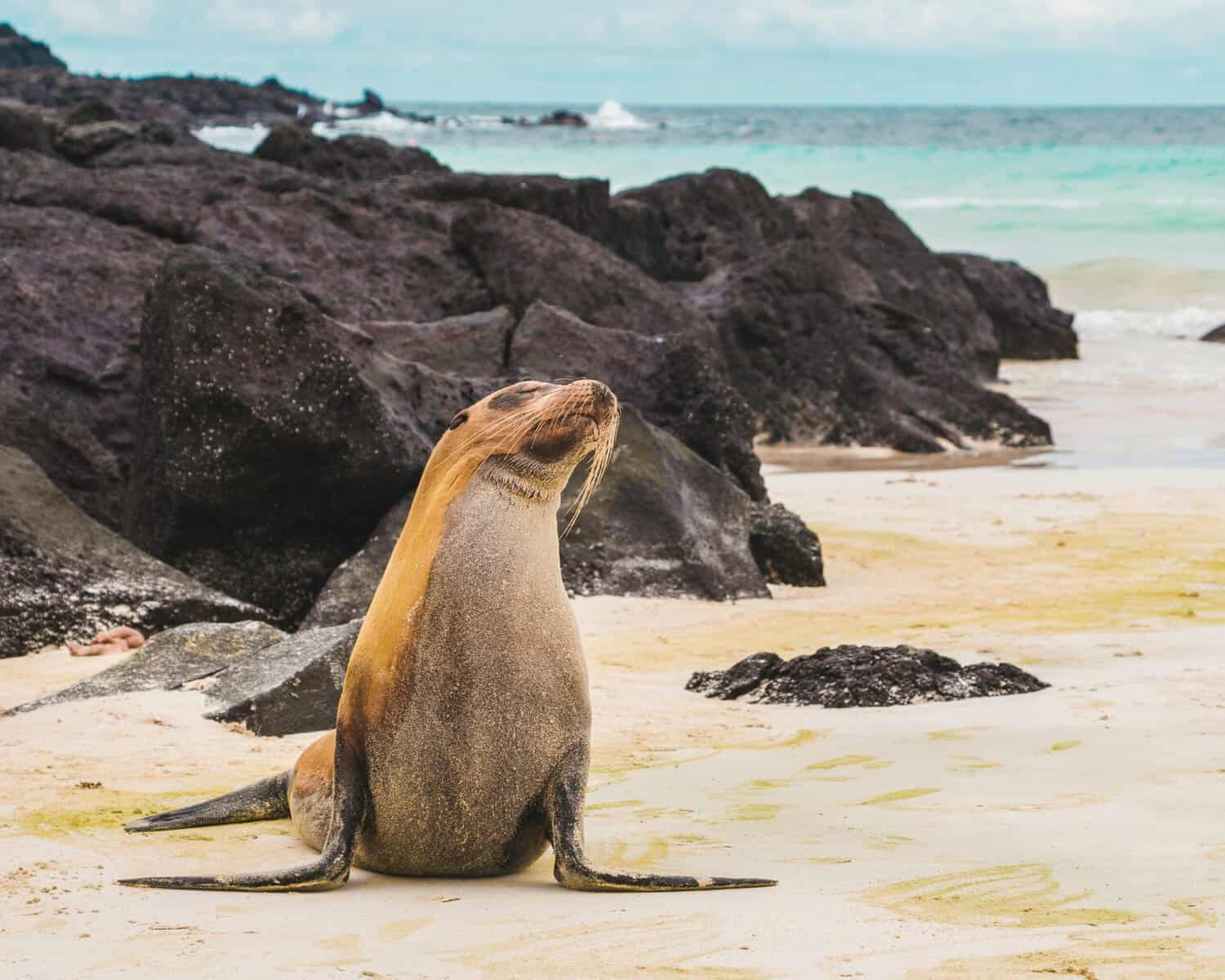
A Galápagos sea lion spent several hours resting on the southern end of Playa Flamingo this week, drawing crowds of onlookers to a stretch of Guanacaste sand where the species is almost never seen. Photographer Arturo Soto, who lives in nearby Playa Potrero, said the first images of the animal began circulating in a neighborhood chat group on Wednesday morning. He and his daughter Catalina drove out to look for it and found the sea lion still in the same spot hours later.
The animal was calm as long as the crowd kept its distance, Soto said, lying placidly on the sand while dozens of people watched and filmed. That changed when people pushed in closer. Soto said some visitors came within roughly a meter (about three feet) of the animal, which visibly unsettled it, and that he and others nearby began warning newcomers to back off.
By late afternoon several dogs had arrived with their owners and started barking at the sea lion from a distance. The animal grew agitated, hauled itself up and returned to the ocean. Soto, who has lived on this part of the coast for 33 years, said sightings like this are uncommon but not unheard of, and that he has seen several sea lions over the decades.
He connected the Flamingo animal to two other recent sightings in the area, one in Potrero bay weeks earlier and another at Playa Minas just south of Flamingo days before, and said he believes from its appearance that it may be the same animal working its way along the coast.
Biologists Soto consulted identified the animal as a Galápagos sea lion and said the species can range well outside its usual waters when ocean currents shift or when feeding conditions draw it elsewhere. A biologist based at the Flamingo marina examined the animal in person and reported that it appeared to be in good health. The Coast Guard and the tourist police both monitored the scene, and the sighting was reported to the Environment Ministry, MINAE.
The appearance is not isolated. Biologist Rodolfo Vargas has said Costa Rica records one or two of these animals in a typical year, some traced to Galápagos populations and others to colonies in South America. According to Vargas, sea lions can cover distances of up to about 2,000 kilometers (roughly 1,240 miles), and individuals have been recorded swimming between 100 and 200 kilometers (about 60 to 125 miles) in a single day, which means an animal on a Costa Rican beach is not necessarily lost or in trouble. In many cases, he said, it is simply following food into waters where conditions happen to be good.
The National Animal Health Service, SENASA, confirmed two separate sightings within a single week in late August, a sea lion in Golfo Dulce on the south Pacific coast and a Galápagos fur seal at Ostional on the north Pacific. The sea lion seen days later at Playa Minas was suspected to be the same animal recorded in Golfo Dulce, suggesting one individual had covered a long stretch of coastline in a matter of days.
For Soto, the detail that stayed with him was the sheer size of the animal at close range. He said he had seen sea lions before but never this near, and described its bulk as considerably bigger than he expected and its presence imposing whenever it propped itself up on its front flippers.
Specialists give the same advice in every case. Keep well back, do not attempt to touch or feed the animal, and use a phone’s zoom rather than closing the gap. Sea lions generally keep their distance from people, but they are large, powerfully built animals with a bite capable of causing serious injury, and one that feels cornered can react adversely.
Anyone who spots a sea lion showing wounds, bleeding or signs of illness should alert SENASA so it can be assessed, and sightings anywhere along the Pacific coast should also be reported to SINAC, which uses the reports to track how often these animals reach the country and where they travel.