

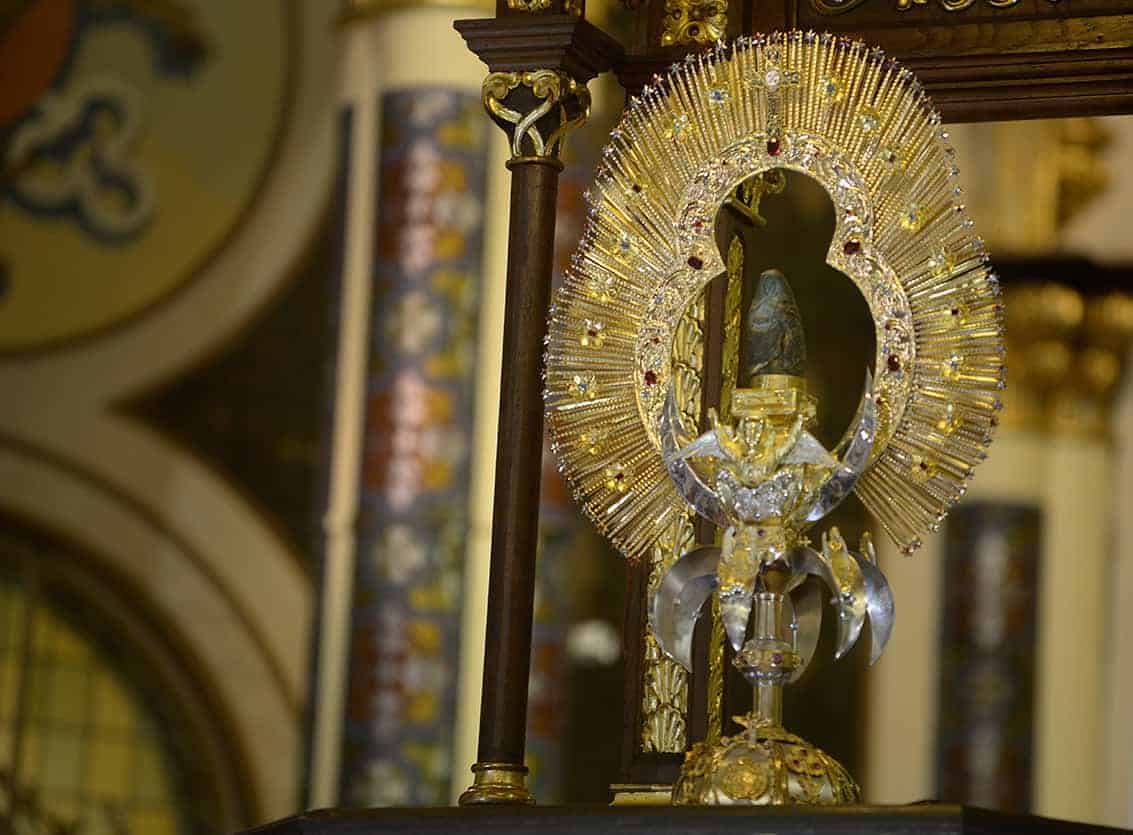
It is Aug. 2, and thousands of pilgrims are setting out on foot to join in the celebrated 22-kilometer walk from San José to the Basílica Nuestra Señora de los Angeles (at right) in Cartago, east of the capital.
Actually, people can start the pilgrimage, or romería, from anywhere they want, and some walk from as far away as the northwestern province of Guanacaste or the Panama border. A few, to demonstrate their piety, will even crawl for kilometers on their hands and knees. They come to offer thanks to or request a favor from a small statue no larger than a fist. Why?
The undocumented story goes that on Aug. 2, 1635, an Indian girl went to wash clothes at a spring on the outskirts of Cartago. On top of the stone from which the waters issued, she found a small image of the Virgin, crudely sculpted in black granite, which she then took home to her poor hut.
The next morning, she found that the statue had disappeared. She went again to the spring and, to her surprise, found it once more on top of the stone. When others learned of the miraculous return of the statue to the stone, they began to believe that the image was that of Our Lady of the Angels, and that it was her wish that a temple be built there.
End of story? Not by a long shot. Just wait till you read this.
The following information is taken from “The Costa Rica Reader” by Steven Palmer and Iván Molina, which contains a chapter titled “La Cofradía de los Angeles” (“The Brotherhood of the Angels”), from the book “Crónicas Coloniales” (“Colonial Chronicles”) by Ricardo Fernández Guardia (San José, 1921).
According to the editors, in this chapter, “Fernández Guardia rediscovers the carnivalesque moment in which the lowly origins of the cult attracted the Cartago elites to the dark depths of the lower orders’ sanctuary for a pagan feast replete with bulls, drunkenness, dances of African origin, fornication and miscegenation.”
The first documents of the era indicate that by 1639 the construction of a hermitage was under way on the site, and, in 1653, the Bishop of Nicaragua and Costa Rica approved the statutes of La Cofradía de los Angeles.
Initially, only the lower classes – the Indians, blacks and mulattoes – worshipped the image, but, in time, the whites also became followers of the little black statue, sometimes affectionately called La Negrita (The Little Black One) or Reina de Cartago (literally, Queen of Cartago). In 1679, a church to replace the primitive hermitage was under construction, and by 1722 the work was completed. Ultimately, a government decree established La Virgen de los Angelesas the official patron of Costa Rica.
In the 18th century, Governor Diego de la Haya Fernández built, at his own expense, a large hall for the festivities. In time, as the fame of La Negrita grew and more and more people flocked to the sanctuary, new rooms were added, creating the great house known as The Congregation.
It was here, in the month of August, that the celebration of great festivities took place, festivities that degenerated to the point of taking on a disgraceful character. According to Fernández:
“Over the course of more than 20 days, and under the pretext of devotion, Cartago gave itself up to a shocking licentiousness … In the morning, the religious functions were celebrated, followed by a succulent luncheon; in the afternoon, a bullfight, refreshment, and a substantial meal, comedies and main courses; in the nighttime, a splendid supper and a dance that generally lasted until dawn.
All of this was accompanied by a great deal of rosoli (spirit scented with cinnamon and anise) and other liquor that made men and women lose their head.”
Later, in an investigation into the disreputable nature of the festivities, one witness testified that “… the place where these celebrations took place deserved the name ‘House of the Congregation of Iniquity and Lodgings of Everything in Hell,’ because, being so large and with so many rooms, people closed themselves in during the nights of fandangos and committed unheard of evils.”
The public prosecutor wrote that “the house of Our Lady of the Angels has become a school for learning how to dance, love and … But the prosecutor does not dare say that which 30, 40 or a hundred imprudent souls dare to carry out in that sacred house under cover of devotion and feasting.”
The scandalous festivities of La Cofradía de los Angeles went on until 1782, when the bishop put an end to it by creating La Pasada, or the procession of the statue from the sanctuary to the main church, by declaring that feasts and dances must take place in private homes, and by establishing a grammar school in the house of The Congregation.
Today, except during the August festivities, the statue rests on the original stone in the painted sanctuary below the magnificent basilica, the history of past iniquities all but forgotten amidst the devotion of the arduous pilgrimage.
Author Kate Galante





