

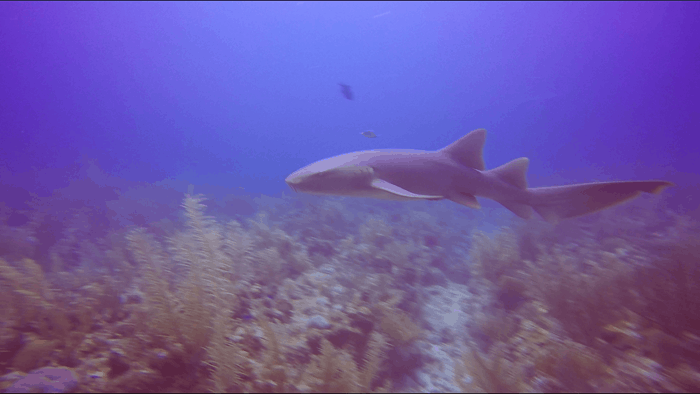
Scientists at the University of Costa Rica have strapped small cameras to nurse sharks in a protected Guanacaste bay, and what the animals are showing them is upending the long-held idea that this species barely moves. The work is happening in Bahía Santa Elena, a bay on the northern Pacific coast inside Santa Rosa National Park, near the Nicaraguan border.
A team from UCR’s Centro de Investigación en Ciencias del Mar y Limnología (CIMAR), has been studying Pacific nurse sharks there for about a decade using underwater listening stations, and is now adding wearable cameras and drones that measure the animals from the air. Mongabay Latam accompanied the team on a field trip and published an account of the work on Monday.
The species itself is a recent addition to science as until about 10 years ago, biologists lumped Pacific and Caribbean nurse sharks together as one animal. In 2015, Latin American researchers showed they were different, splitting off the Pacific version, Ginglymostoma unami, which has a shorter, stockier body, flat teeth and a higher tolerance for cold water than its Caribbean relative. It is listed as endangered by the International Union for Conservation of Nature, and much of what was assumed about it was borrowed from studies done in Florida and the Bahamas on the other species.
Mario Espinoza, a researcher and professor at CIMAR, drives roughly six hours from San José to the bay every three or four months to work on the animals. The camera his team is now using was designed by engineering students at Stanford University. An earlier version had to be drilled into the shark’s dorsal fin; the current design uses a small chest harness instead, and costs eight to 10 times less to build than comparable commercial devices. The July trip was the first time the UCR team fitted one without the engineers on hand.
The cameras record video, but they also carry sensors that log water temperature, depth and swimming speed. They stay on the animal for an hour or two, then release automatically and float to the surface, where a radio transmitter lets the team find them. “The idea of this project with cameras is to have the sharks as mobile monitoring platforms,” Espinoza said. “They’re going to be our eyes underwater.”
The routine on the water is quick. Researchers drop a bottom line with 19 hooks near a mangrove where the sharks are known to gather. On the July trip they expected two animals and had four — three females and a male — within an hour. Each shark stays in the water alongside the boat while the team inserts or checks a small identification chip, measures it and draws blood. Turning a shark belly-up puts it into a temporary, trance-like state called tonic immobility that researchers use as a natural sedative.
The movement data is where the picture has changed most. A first analysis of acoustic tracking from 2018 to 2022 showed Pacific nurse sharks spend more than 40% of their time inside the bay, with females staying far longer than males. Some individuals almost never leave; others come and go, or disappear for years and return.
The peer-reviewed version of that work, published in Marine and Freshwater Research in 2024, documented a 176-centimeter male that covered more than 390 kilometers in 46 days along the North Pacific coast — a round trip Espinoza described as more than 400 kilometers. The team has also filmed groups of 40 to 50 animals in the mangroves, which contradicts the assumption that the species is solitary and sluggish.
The bay works as a natural laboratory for a second reason. Trade winds between December and May pull cold, nutrient-rich water up from the deep, a seasonal process called upwelling. Espinoza said water that sits at 28 to 29 degrees Celsius (82 to 84 Fahrenheit) in July has been recorded as low as 14 C (57 F) during that window. Because Costa Rica has no fishery targeting the species, researchers can watch how the animals handle those swings without commercial fishing pressure muddying the results — useful for predicting how they will respond to a warming ocean.
The project also leans on two local boat captains, brothers Minor and Steven Lara from the nearby town of Cuajiniquil, who have turned a family adventure-tourism business into a year-round support operation for the science. They recently logged a large lemon shark in the bay, a sign it may serve as a nursery for other threatened species including blacktip and bull sharks. Visitors who snorkel or dive with them get a briefing on what the researchers are looking for, and often come back reporting unusual sightings





