

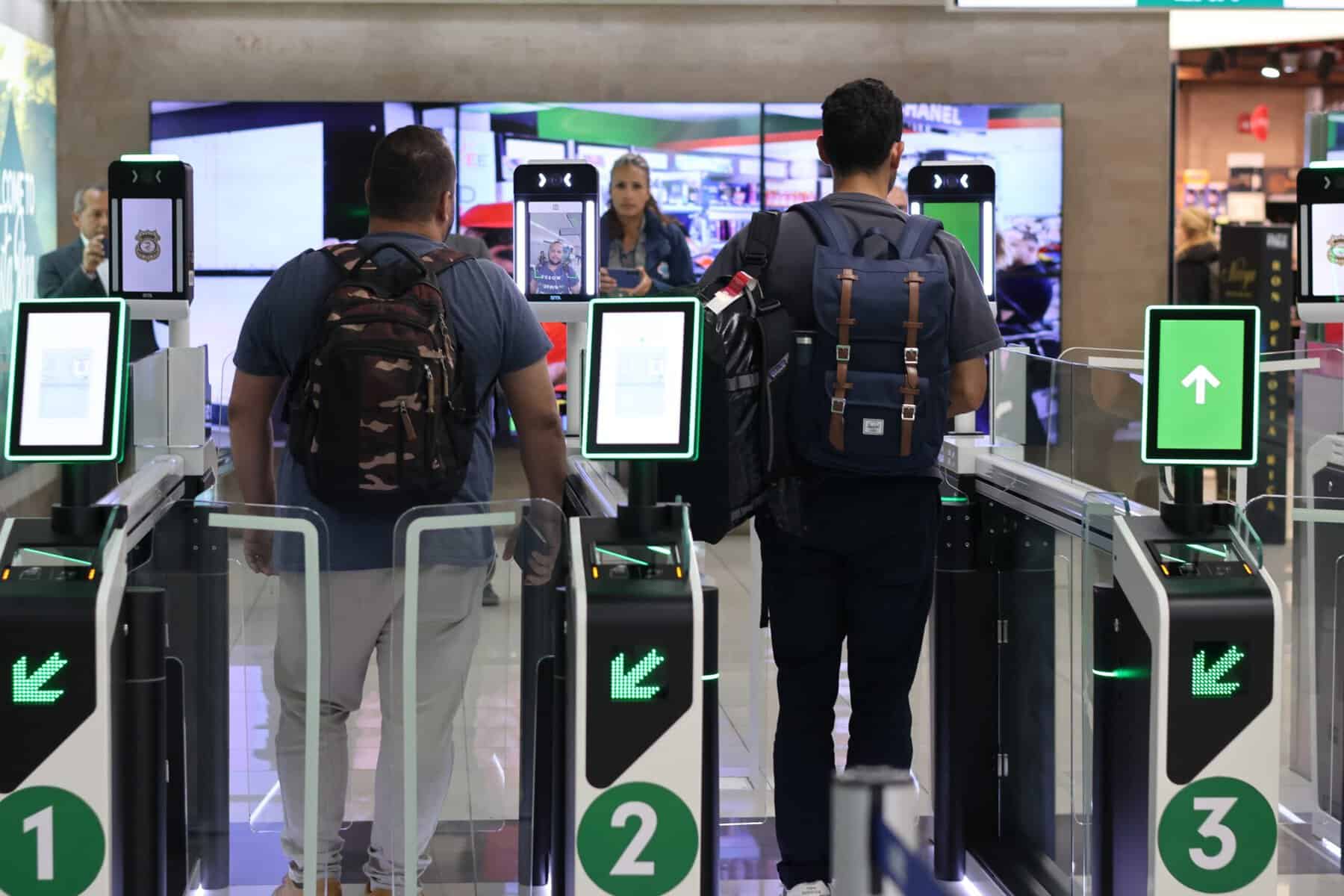
If you are flying through Juan Santamaría International Airport on a Costa Rican passport, you can now clear immigration without talking to an officer. Automated biometric gates went live at the terminal today. The catch matters for a lot of our readers as, at least for now, the gates work only for Costa Rican citizens over 18 who hold a valid biometric passport.
If you are a tourist, a foreign resident, or a Costa Rican traveling on a non-biometric passport, you still line up at the regular counters. Using a gate takes between 17 and 22 seconds, according to Aeris, the company that runs the airport. You place your passport on the reader, look at the camera on the screen, and wait for the light. Green means the gate opens and you walk through. If something does not match, an officer from the Dirección General de Migración y Extranjería handles you in person.
There is nothing to sign up for in advance as Costa Rican passport holders do not need to register, pay anything, or enroll their face beforehand. The chip inside the biometric passport already carries the facial data the machine compares against. Aeris says the first phase covers four gates in the arrivals area and two on the departures side, and that the company will add capacity as it learns how travelers use them. Ricardo Hernández, Aeris’ executive director, said Costa Rica is the first country in Central America to switch on the technology.
The reason foreigners are excluded at launch is not a policy preference so much as a data problem. The gate can only wave you through if it can read a chip it trusts and match it against a face it has on file, and the system was built around the Costa Rican passport first. Berny Barquero, deputy director of Migración y Extranjería, said a next stage is under evaluation that would open the gates to other nationalities, with United States and Canadian travelers first in line. Migración has indicated the extension is coming, but no date has been set.
That expansion is the part worth watching since around two thirds of arrivals at Juan Santamaría are foreign passengers, so a Costa Rican-only system moves a minority of the queue. The immediate benefit for everyone else is indirect — every citizen who uses a gate is one fewer person ahead of you at the manned booths.
Security officials framed the change as a control measure as much as a convenience. Gerald Campos, the Minister of Public Security, said the automated read closes off passport forgery in a way manual inspection could not, and lets officers concentrate on passengers flagged for entry problems. Hernández said the gates query databases held by Migración, the Justice Ministry, the judiciary, and Interpol, so alerts surface before a passenger reaches the arrivals hall rather than after.
Barquero said that when the system detects someone with an entry issue, it generates an alert and professional migration police step in to supervise the process. The gates arrive in the middle of a broader overhaul at Juan Santamaría. Aeris is expanding the northern terminal, building a multi-level parking structure, and adding tomography scanners to the security line, work that has been running through 2026 with completion targets extending into next year. The airport handled more than six million passengers last year and expects roughly 6.4 million in 2026.





