

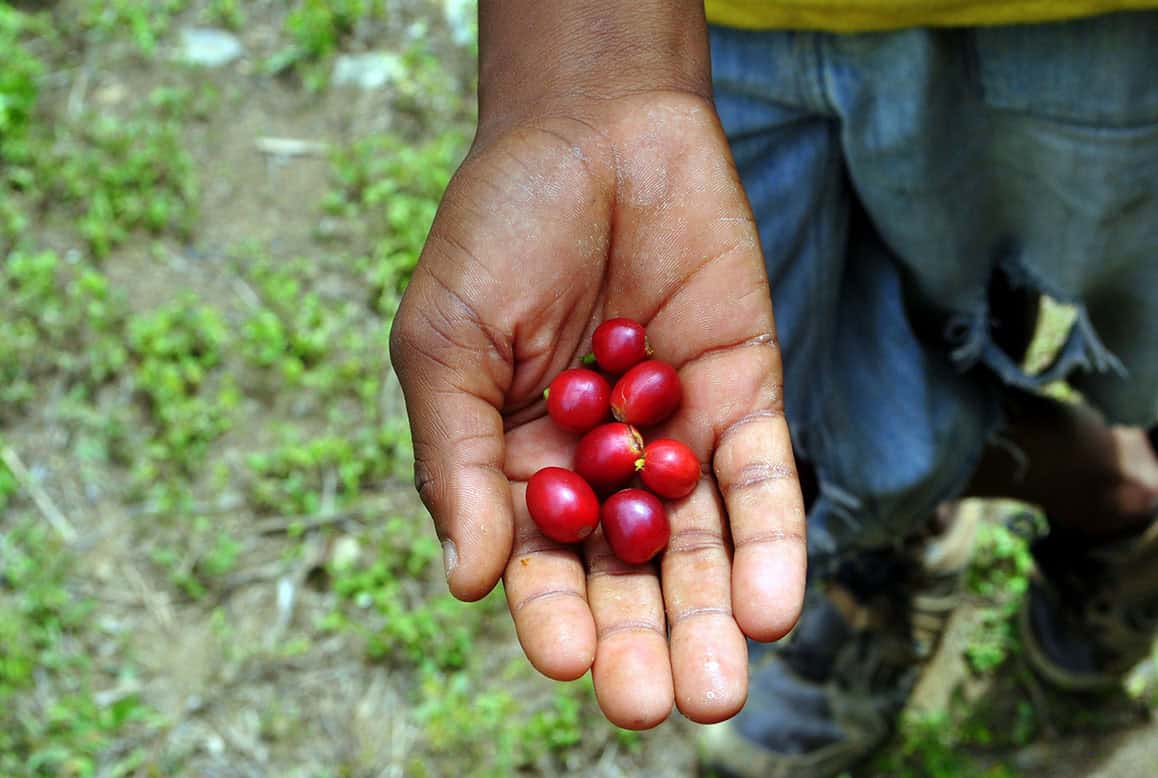
A Forbes travel feature about how a cup of coffee came to cost $60 spends most of its reporting not in a Brooklyn café or at a Panamanian auction, but on a dirt road in the hills southwest of San José, at a farmers association that few people outside the coffee trade have heard of.
The article, published by contributor Jennifer Leigh Parker, traces specialty coffee from the counter back to the tree. It moves through a Bushwick coffee bar where rare Panamanian Geishas sell for $40 to $100 a cup, through the auction market that sets those prices, and then to Aprocetu, the Asociación de Productores de Cerro de Turrubares.
Aprocetu was founded 24 years ago in San Rafael de Turrubares. It began with 17 members and now brings together 44 small producers. Some work roughly half a hectare (about 1.2 acres). The largest farms run three to 3.5 hectares (roughly 7.4 to 8.6 acres). Arnoldo Guerrero, one of the founders and the association’s current president, farms at about 915 meters (3,000 feet) in cloud forest.
He told Forbes that the area was noticeably cooler a decade ago and that increasing heat has made the work harder. Weeks of insufficient rain in March concerned him less than the temperature. Humidity brings a second problem. Ojo de gallo, a fungal disease known in English as American leaf spot, attacks coffee leaves and can strip a plant of its ability to feed itself. Warmer, wetter conditions favor it.
During the December and January harvest, picking depends on workers from eight Indigenous communities in the surrounding area, who hand-pick roughly 240 kilograms (about 530 pounds) a day. It is physically punishing work, and conditions for Indigenous coffee workers have drawn scrutiny from labor advocates in recent months.
What follows the picking is just as demanding as the coffee is spread in the sun and raked through every hour of daylight, a process that takes about 36 hours when conditions cooperate. Parker picked up a rake herself in roughly 35 degrees Celsius (95 Fahrenheit) heat and lasted ten minutes.
Only five people handle the drying and the hand sorting that quality control requires. The association roasts on site. The result is a bright, citrusy arabica called San Isidro. Most of the production goes to the United States and England, with smaller microlots reaching Spain and Italy.
The line from the Forbes article that has circulated most widely concerns what that coffee is worth. Parker reported that a sack of Guerrero’s coffee sells to retailers such as Starbucks for about $800 and ends up in a $7 latte. Guerrero has since clarified that Aprocetu does not sell directly to Starbucks.
The association has collaborated with the company on genetic improvement work, he said, but he believes the $800 figure most likely reflects a transaction involving an intermediary or a buyer further along the chain rather than a direct sale. The distinction matters more than it might appear. Specialty coffee moves through green buyers, brokers who source and sample unroasted beans and who effectively set premium prices between farmers and roasters. A price quoted at that stage can bear little relation to what a producer association receives.
The wider market context is unusually volatile. Forbes noted that the past two years have produced the most expensive coffee market in five decades, with arabica setting a record above $4.37 per pound in October 2025 amid tariffs and climate disruption in Brazil and Vietnam. At the top of the market, a 20-kilogram washed Gesha lot from Panama’s Hacienda La Esmeralda sold at auction for $604,080.
Costa Rica’s regulatory structure is comparatively protective. ICAFE rules require that producers receive 80 percent of the FOB export price, a floor that does not exist in most producing countries. Even so, as the Forbes piece observes, the bulk of the value in specialty coffee accumulates at the roasting and retail end rather than in the growing regions.
That gap has been visible domestically too. A Costa Rican lot sold for $200 a pound at this year’s Cup of Excellence auction, while Starbucks opened its 33rd store in the country in August. The same bean supports both ends of the market.
The route Parker took to reach the farm is itself worth noting. Her guide was a 29-year-old on his first tour, working for the neighboring Santa Lucía Jungle Hacienda in Tárcoles, an Autograph Collection eco-resort. Origin visits of this kind are becoming a product in their own right, aligning with the country’s push toward higher-spending travelers over volume tourism.
The regional calendar reinforces the trend. Panama hosts the World of Coffee event and the World Barista Championship this October, the first time either has been held in Latin America. Guerrero has said the association was created partly to generate opportunities for producer families in an area that was losing them. Living conditions improved after Aprocetu built its own mill, and some families that had left for the cities or abroad came back.
Holding onto that gain is the harder problem now. Younger people are not necessarily interested in staying in agriculture, and the association faces the same generational question as much of rural Costa Rica. It is the quiet thread running under a story about $60 coffee. The premium is real, the auctions are real, and the ritual at the counter is real. Whether anyone will still be raking beans in the sun in Turrubares in twenty years is a separate question, and nobody has answered it yet.





