
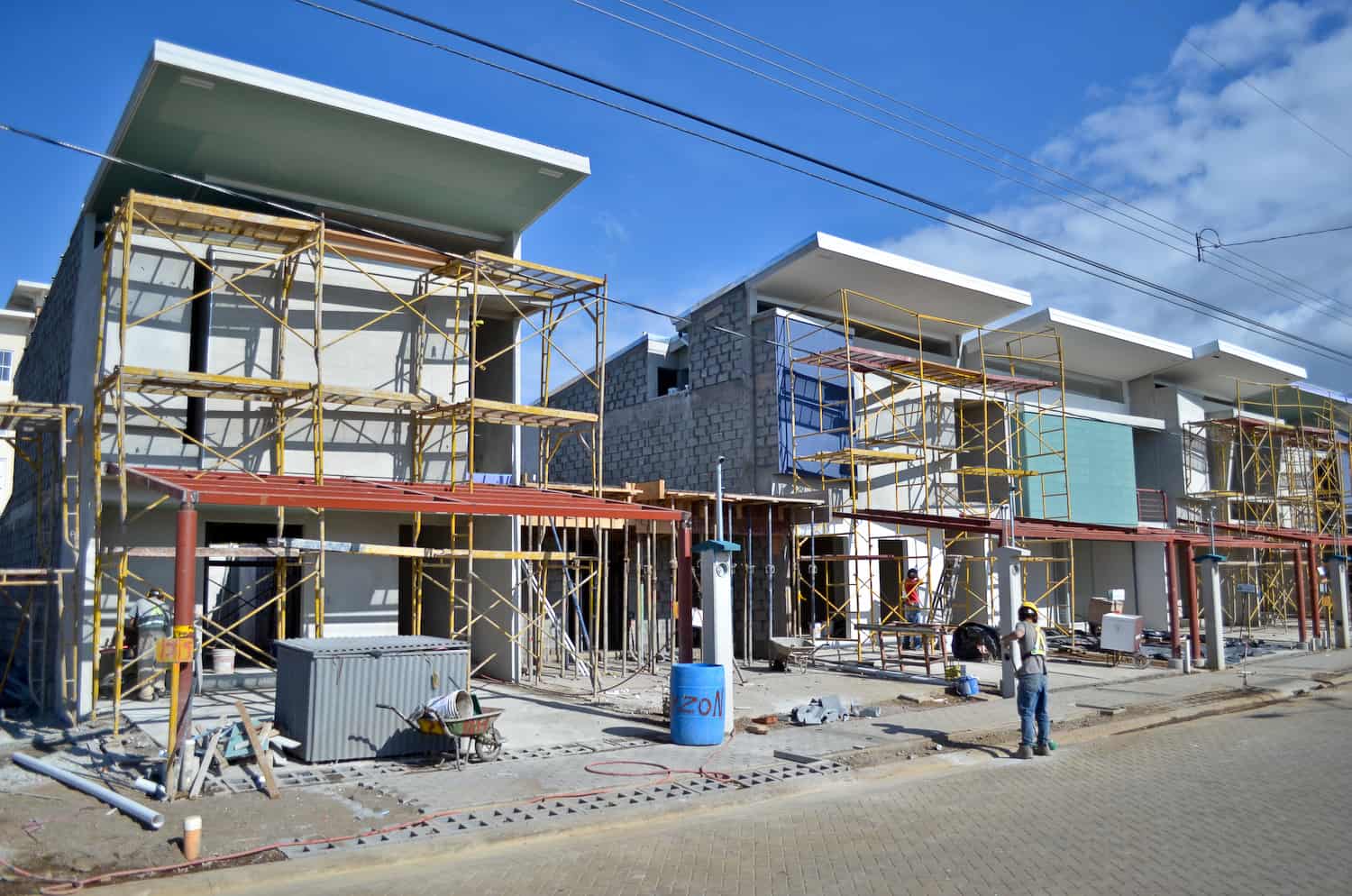
If you are looking to buy land in Costa Rica, the document that will decide your purchase is not the title study. It is a one-page letter confirming that water can reach the lot. That letter has become the hardest thing to get. Roughly one in four development projects requesting a water availability determination is now turned down, and the head of AyA, the national water utility, has said there are zones where existing systems can no longer support new availability letters at all.
For buyers arriving with a checklist built around location, topography, and road access, that reorders everything.
Why the water letter outranks the view
Without a valid availability letter, your municipality will not issue a construction permit. Without that permit, you cannot register plans with the CFIA, and you cannot get an electricity meter installed. A beautiful lot with no water letter is, in practical terms, a lot you cannot build on. It is also a lot you may struggle to resell to anyone who understands this.
The letters expire. A positive determination generally holds for about twelve months, and if you have not started construction in that window, the water board can require a fresh inspection — under conditions that may have tightened since.
Where the pressure is worst
Guanacaste is the clearest case. Two decades of hotel, condominium, and second-home construction ran ahead of the aqueducts serving them, and some coastal systems can no longer add connections at any price. Others can, but only through infrastructure investment the developer pays for.
This is not only a coastal or rural problem. The San José metro area — the ring of cities and suburbs across the Central Valley where roughly half the population lives — has aqueducts running at a deficit too. Water use there has been running 10% to 20% above normal through a dry season that stretched longer than usual, and forecasters expect a strong El Niño this year.
That combination is what drives the rationing schedules that hit the capital and surrounding towns in recent years. Relief exists on paper. The PAAM project would add 2,500 liters per second (about 660 gallons per second) to the Central Valley, and PAACUME would bring potable water to more than half a million people in Guanacaste. Neither is expected to operate before 2030.
What a private well actually requires
Groundwater in Costa Rica is national property. That single legal fact governs everything else. A hand-dug or artesian well used exclusively for domestic purposes, on the same farm where it sits, does not need a concession — but it does need to be registered. Anything beyond that threshold, including any development, condominium, or rental operation, requires a full concession from the Dirección de Agua at MINAE.
The sequence runs in this order. You apply for a drilling permit, which is exploratory only and confers no right to use the water. After drilling, you submit hydrogeological and pumping-test studies. SENARA reviews the aquifer data and issues its technical criteria, SETENA handles environmental viability, and only when the concession is finally granted can you legally extract.
Operating without one is not a paperwork problem. Penalties include fines, stop-work orders, sealing of the well, and seizure of the works. So “the property has a well” is not an answer. The questions are whether a concession exists, whether it is current, whether it is registered to the seller, and whether it covers the use you actually intend. A residential concession does not authorize a boutique hotel.
The solar line item most buyers miss
Costa Rica’s solar grid is genuinely clean — 98.6% of electricity came from water, geothermal, wind, biomass, and sun in 2025. But that figure fell to 89.4% in 2024 and 91.3% in 2023, when drought cut reservoir levels and thermal plants burned bunker fuel to keep the lights on. A renewable grid is not a drought-proof one.
Electricity is also cheaper than it was. Rates dropped between 4.93% and 16.44% on January 1, 2026, taking a typical 250 kWh CNFL household from ₡19,843 to ₡17,014 — roughly $44 down to $38 at current reference rates. Costa Rica remains expensive by regional standards, but the trend line is not the one the solar sales pitch usually describes.
Then there is the charge that catches people out. Under Ley 10086, anyone who installs panels and stays connected to the grid pays an access tariff — informally the impuesto al sol — set at a maximum of roughly ₡16 to ₡30 per kilowatt-hour depending on your distributor. Since late 2024 it is billed on what your panels generate rather than on everything you consume, which helped, but it did not disappear.
The reasoning is that a solar household still draws on the grid at night, in bad weather, and whenever production falls short, and the regulator treats that standby capacity as something to be paid for. Whether you accept that logic or not, it belongs in your payback calculation. Costa Rica counted about 3,528 distributed generators at the end of 2023, most of them signed up before 2021, and installations have grown slowly since the tariff took effect.
What to ask before you sign
Ask for the water availability letter and check its issue date, not just its existence. Ask which entity issued it — AyA or a local ASADA — and whether that system is currently accepting new connections. If there is a well, ask for the concession number and pull its status. If there is solar, ask which distributor serves the property, what access tariff they charge, and what the interconnection cost and timeline look like.
If the answer to any of these is a shrug, treat that as the finding. Utility independence is a real advantage in a place where a quarter of projects get turned away at the water stage. It is not a free one, and the price is easier to see before the deed transfers than after.