

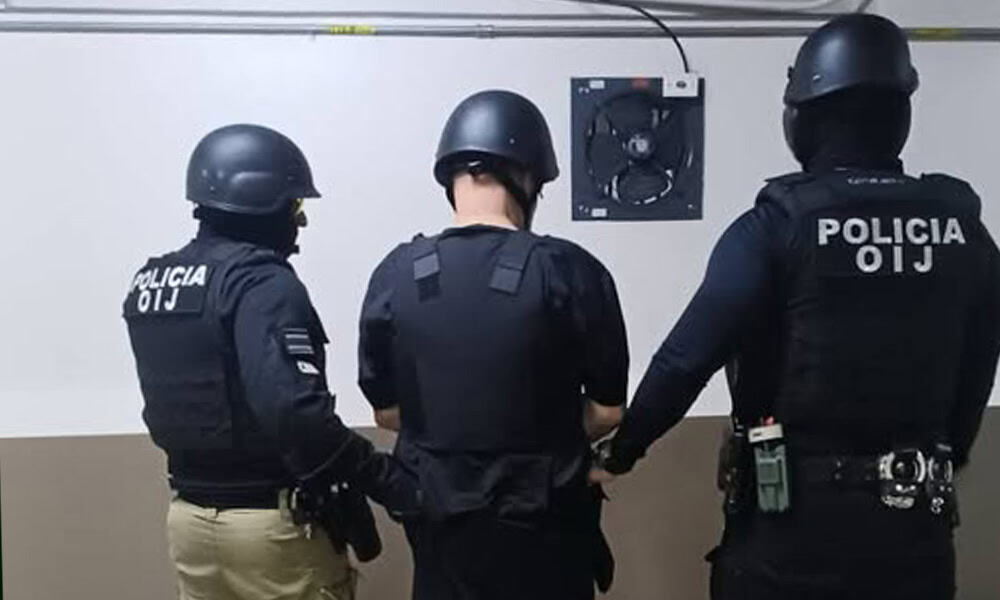
Costa Rica has authorized the immediate extradition of Gilberth Bell Fernández, the Limón businessman known as “Macho Coca,” clearing the final judicial hurdle for his transfer to the United States to face federal drug-trafficking charges in New York. The latest development came after a judge in Limón determined that the United States had satisfied the conditions Costa Rican courts placed on Bell’s extradition.
The ruling means his transfer can now proceed once Costa Rican and U.S. authorities agree on the date, flight and security arrangements. No departure date had been publicly announced as of this morning. The United States provided formal diplomatic guarantees that Bell will only be prosecuted for the offenses covered by the extradition request, will not face the death penalty and will not receive a prison sentence exceeding Costa Rica’s 50-year maximum. U.S. authorities also agreed not to seek an irrevocable life sentence.
The guarantees removed what had become the final obstacle in a months-long court fight over whether Bell could be sent abroad. The Tribunal Penal de Limón initially rejected his extradition in March, largely because the alleged criminal activity occurred before Costa Rica amended its Constitution in May 2025 to permit the extradition of Costa Rican citizens accused of international drug trafficking or terrorism.
Prosecutors appealed, arguing that extradition is a mechanism of international judicial cooperation rather than a retroactive criminal punishment.An appeals court reversed the key portion of that decision on June 2 and allowed the extradition to move forward, provided the United States supplied the required guarantees. A separate Costa Rican case against Bell involving the alleged theft of fuel from the state-owned refinery Recope was subsequently suspended to remove another potential obstacle to the transfer.
Bell is wanted by the U.S. District Court for the Southern District of New York. U.S. authorities allege that he led a criminal organization involved in storing and moving large quantities of cocaine from Costa Rica toward the United States between 2022 and 2023. Investigators allege that Bell dealt with undercover agents, including negotiations involving a proposed shipment of 700 kilograms of cocaine to New York.
The U.S. Treasury Department sanctioned Bell in November 2023, identifying him by his full name, Gilbert Hernan de Los Angeles Bell Fernandez, and his alias “Macho Coca.” Treasury officials described him as a major Costa Rican narcotics trafficker based in Limón and accused him of playing a significant role in moving cocaine through Costa Rica to markets including the United States and Europe.
Attention now turns to how and when Bell will leave Costa Rica. Fiscal General Carlo Díaz said U.S. authorities could send a DEA aircraft, as they have in previous extraditions, or transport Bell aboard a commercial flight. The decision will depend partly on aircraft availability and other operational considerations. Under the extradition process, the requesting country has up to two months to execute the transfer, although Díaz said such transfers are normally completed much sooner.
The Organismo de Investigación Judicial (OIJ), is already preparing the security operation. Once the flight is scheduled, the agency’s tactical SERT unit is expected to transport Bell from prison to Juan Santamaría International Airport. At the airport, Costa Rican authorities will formally turn him over to U.S. agents under judicial supervision.
Bell would become the fourth Costa Rican citizen extradited following the constitutional change. Former magistrate Celso Gamboa and Edwin López Vega, known as “Pecho de Rata,” were extradited to the United States on March 20. Johnny Angulo Fernández, alias “John Cadenas,” was extradited to Italy on April 27. Bell would therefore be the third Costa Rican sent to the United States under the new rules.
The distinction is important because Costa Rica historically prohibited the extradition of its own citizens. The constitutional reform has fundamentally changed how the country handles high-profile international organized crime cases and has already resulted in several Costa Rican suspects being handed over to foreign governments.
Once Bell arrives in New York, he is expected to enter U.S. federal custody and appear before the court handling the criminal case. The accusations against him remain allegations unless proven in court.





