

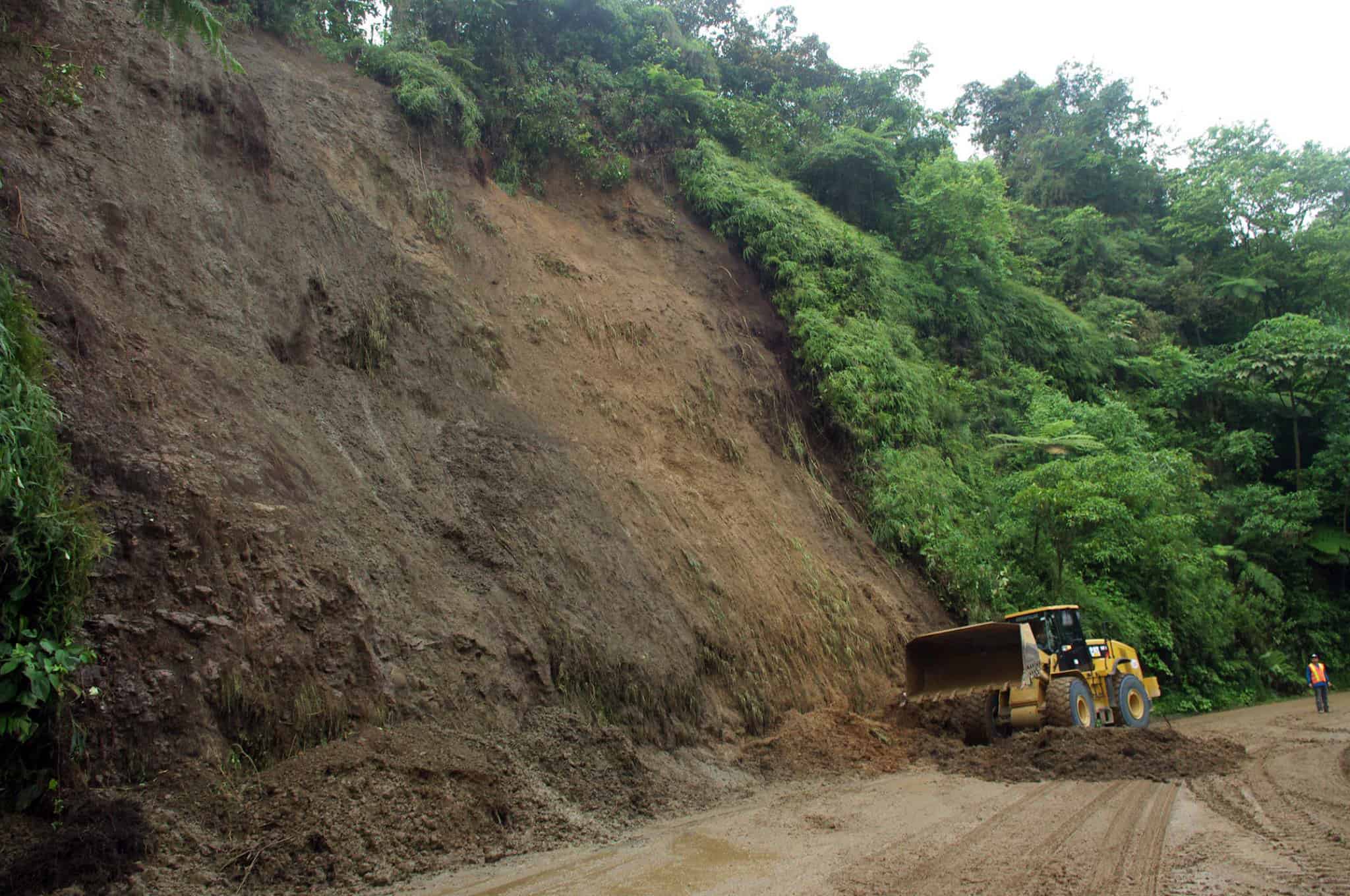
If you are driving to the Caribbean this holiday weekend, plan for the possibility that you will not get there the way you intended. Route 32, the fast link between San José and Limón, closed again on Thursday afternoon after material came down near the Zurquí tunnel. That was the second slide on the road that day, following one at Río Hondo in Pacuarito de Siquirres in the morning.
The road has opened and shut repeatedly since Monday, sometimes twice in a day, and crews rarely give a reopening time because they cannot know how much more soil is going to move. Check the road status before you load the car, then check it again before you commit to the climb over the Zurquí. A closure that catches you on the mountain does not mean a detour. It means hours parked.
Three alternates exist, and none of them is a clean substitute.
- Route 10 through Turrialba, between Siquirres and Turrialba. This is the main workaround for heavy vehicles, but it sits on the same saturated slopes and closed briefly on Monday for the same reason Route 32 does.
- Route 126 through Vara Blanca, light vehicles only. No trucks, no buses, no loaded trailers. It is narrow, steep and slow in rain.
- Bajos de Chilamate–Vuelta de Kooper, open to all vehicle types. The catch is that it runs through Sarapiquí, which is the worst-hit area in the country right now, and roads in that canton have been cut by water this week.
Add hours to whatever your map application tells you, and do not attempt any of these three routes after dark this weekend. A second tropical wave is expected to reach us on Sunday, the twenty-fifth of the season, arriving directly behind the one that caused this week’s flooding. The problem is not the volume of rain in the forecast. It is that the ground in the Northern Zone and along the Caribbean has nowhere left to put it.
Soils in Sarapiquí, Pococí, Guácimo and Siquirres have been absorbing water since Monday and are now saturated, which means rainfall that would ordinarily soak away instead runs straight into rivers and down hillsides. Six-hour totals of 60 to 85 millimetres (2.4 to 3.3 inches) were recorded in Horquetas, Pococí and Cariari earlier this week, and similar accumulations are possible again. On saturated ground, a moderate afternoon downpour can close a road that held up fine under a heavier one in May.
Saturday itself looks wetter than dry but calmer than the past several days. Expect thunderstorms near the Limón coast early, then afternoon showers across the mountain ranges, the Northern Zone lowlands, the western Central Valley and around the Osa and Nicoya peninsulas.
More than 1,100 people are still in shelters across the Caribbean and Northern Zone, and roughly 1,690 food parcels have gone out to families who cannot get home or cannot get to a shop. Sarapiquí alone counted 932 people across seven shelters and logged 208 flood incidents between 20 and 23 July.
Yesterday, 369 schools stayed closed — 138 in Sarapiquí, 116 in Guápiles, 110 in Sulá and five in Limón. Monday is a normal workday and school day this year, since the holiday falls on Saturday and is not moved, so if you have children in a Caribbean or Northern Zone school, expect the decision about Monday classes to come late in the weekend rather than in advance.
Several riverside communities are still reachable only by boat. Access remains difficult to Barra del Colorado in Pococí and to Barra del Pacuare and Parismina in Siquirres, and communities in the Cureña district of Sarapiquí — Fátima, Delta, Costa Rica and Cureñita — have been without road access.
If you have a Tortuguero or Barra del Colorado booking, contact your lodge directly today rather than relying on a confirmation email sent last week. Boat transfers on high, debris-laden rivers get cancelled at short notice, and the launch points themselves are in the flood zone.
One specific hazard is worth knowing about if you are anywhere near the Sarapiquí river. Crews are checking a possible landslide dam in the channel. If a blockage like that gives way, the river below it rises fast and without warning — not over hours, but in minutes. Do not camp, park or wade near that riverbank this weekend, and do not stop on low bridges to take photographs.
Two smaller things. Wells in Siquirres have been contaminated by floodwater and drinking water is being trucked in, so if you are staying in that area, use bottled or delivered water rather than the tap until you are told otherwise. And on the Caribbean beaches, expect brown water, floating timber and strong pull near river mouths for days after the rain stops, because everything the rivers picked up upstream has to come out somewhere.
The pattern is now familiar to anyone who has spent a July here. The rain arrives, the hillsides above Route 32 give way, the road shuts, and the canton at the bottom of the watershed absorbs the damage. What makes this week different is the timing — a second system landing on ground that has not had a single dry day to recover, at the start of a long weekend when traffic to the coast is at its heaviest.





