
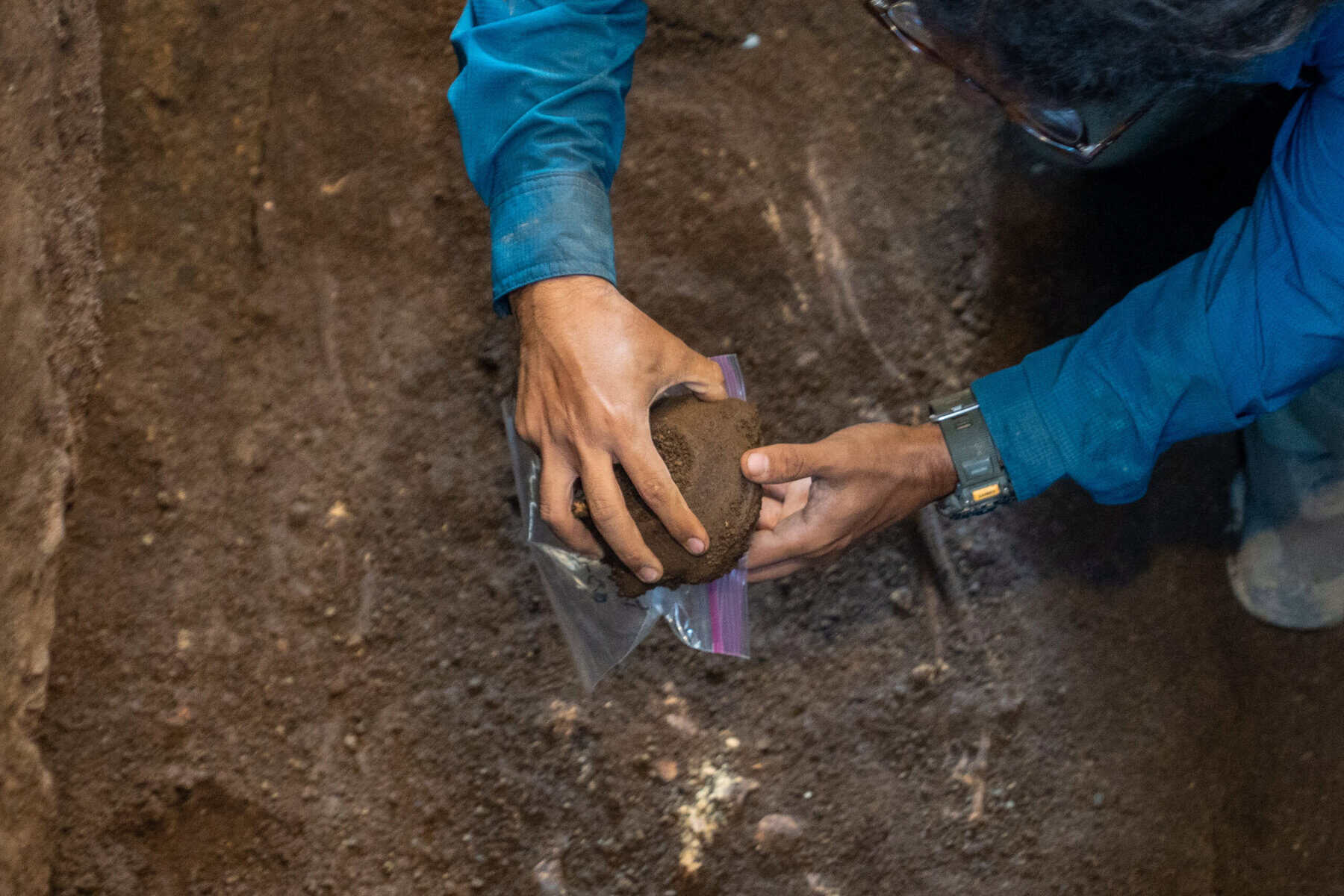
Archaeologists exhumed human remains estimated to be nearly 3,000 years old on the outskirts of San Salvador, the Ministry of Culture said in a statement. The remains form part of a pre-Hispanic burial discovered at the Pasaje 4 archaeological site in Antiguo Cuscatlán, a district in the metropolitan area of San Salvador (municipality of La Libertad Este). Officials estimate the remains date to around 850 B.C.
The burial also contained a small Usulután-style ceramic vessel shaped like a sea turtle. Excavators additionally uncovered two ancient cassava (yuca) cultivation furrows preserved beneath layers of volcanic ash from eruptions in different periods — one associated with the Plan de la Laguna eruption around 850 B.C. and another linked to the Ilopango Caldera eruption between approximately 431 and 539 A.D.
The human remains were found face down (in a prone position, oriented about 17 degrees east of north). They will undergo radiocarbon testing to confirm their exact age. DNA analysis will also be conducted to help determine the individual’s sex and other biological details. Archaeologist Carlos Flores Manzano, a doctoral candidate at Yale University who directed the excavation under the supervision of the National Directorate of Cultural Heritage, noted that the burial appears to have been prepared before the volcanic event rather than resulting from it.
According to the official report, the area may hold a similar number of remains to those found at Structure E3-7 at the Chalchuapa archaeological site in western El Salvador. There, salvage excavations in 1977–1978 recovered the remains of 33 individuals, widely interpreted as evidence of human sacrifice and among the earliest such documented cases in the Mesoamerican region.
That assemblage included 26 complete skeletons, four partial skeletons, and three isolated skulls. Many were found face down; some showed signs that hands or feet had been bound or were absent, along with evidence of mutilation and decapitation. The individuals whose sex could be determined were adult males, and researchers have suggested they may have been war captives.
The Antiguo Cuscatlán finds build on earlier archaeological work in the same zone, including a 1987 rescue excavation by Paul Amaroli and Gregorio Bello-Suazo. Further laboratory analysis of the newly recovered remains and associated materials is expected to refine the dating and provide additional insight into pre-Hispanic occupation and agricultural practices in the region prior to major volcanic events.