

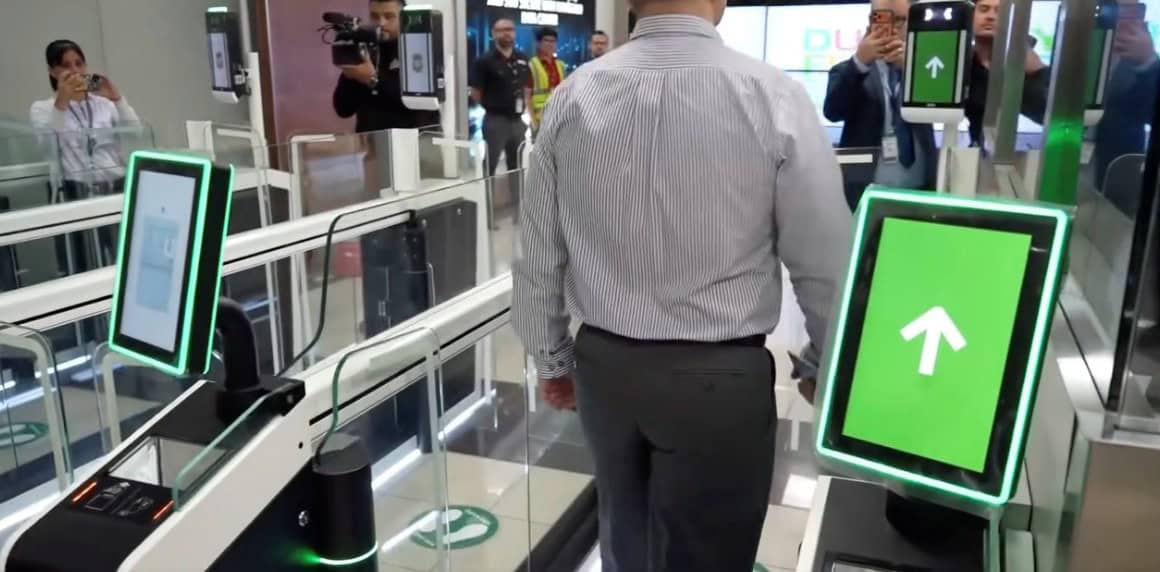
If you hold a US or Canadian passport, the immigration line at Juan Santamaría may soon stop being the worst part of arriving in Costa Rica. Omer Badilla Toledo, who runs the Dirección General de Migración y Extranjería, said Monday that the airport’s automated passport gates are in their final round of testing and will open to travelers within days or weeks.
They go live first for Costa Ricans. But Badilla said access will be extended soon to citizens of the United States and Canada, the two countries that send more visitors here than any other. President Laura Fernández went to the airport on Monday to watch the system run.
That is a real change from where this stood last week. When the gates were first laid out, foreign travelers were a vague later phase with no date attached, and residents and tourists were told to keep queuing as usual. Badilla naming American and Canadian passports specifically is the first solid signal that the people who actually fill those lines will get to skip them.
The gate itself is simple. You walk up, scan your passport, and the machine checks you against the biometric data stored on the chip inside it. If everything matches, the gate opens and you keep walking. If anything looks off, you get sent to an officer, exactly as you would today. This is not a way around immigration control. It is a faster way through it for travelers whose documents are clean. The first stage puts four gates in arrivals and two in departures, with room to add more if demand justifies it.
Now the part worth holding onto. “Soon” is the government’s word, not a date. Badilla did not give one for the foreign phase, and until Migración publishes the rules on which passports qualify, nobody outside the agency knows whether your particular document will work on day one. Most US and Canadian passports issued in the last decade carry the small gold symbol on the cover that marks a biometric chip. If yours does not have it, assume the gate is not for you yet.
It is also worth remembering that this project has been promised before. Aeris said in January 2025 that gates would start going in that July, with immigration checks down to 15 seconds. Eighteen months later, they are still in testing. A cautious traveler plans for the line and treats the gate as a bonus.
Then there is the question nobody has answered. On Sunday, passengers flying out of Juan Santamaría and Daniel Oduber in Liberia hit long delays when the system officers use to check for exit impediments failed. Migración reported the outage at 10:45 a.m. and it was repaired inside two hours, but processing stayed slow well past that, and Migration Police pushed staffing to the maximum at both terminals to dig out. It was the second failure of its kind this year.
An automated gate does not obviously solve that. If the gate still has to query the same court database before it lets anyone through, then automation speeds up a good day and does nothing at all for a bad one. Whether the e-gates break that dependency, or simply inherit it, is the thing to ask Migración before the ribbon gets cut. It is the difference between a genuine fix and a faster front door on the same broken plumbing.
Until the gates open to foreign passports, nothing changes for you. Use the regular lines. Give yourself three hours before an international departure rather than the usual two, especially on a Sunday in July, when the airport is moving school-holiday crowds. Check your flight status with the airline before you leave the house, not after you reach the terminal. Keep your passport out of your bag and in your hand.
We will update this story when Migración confirms a date for US and Canadian access, and when it answers the question about the court system.





