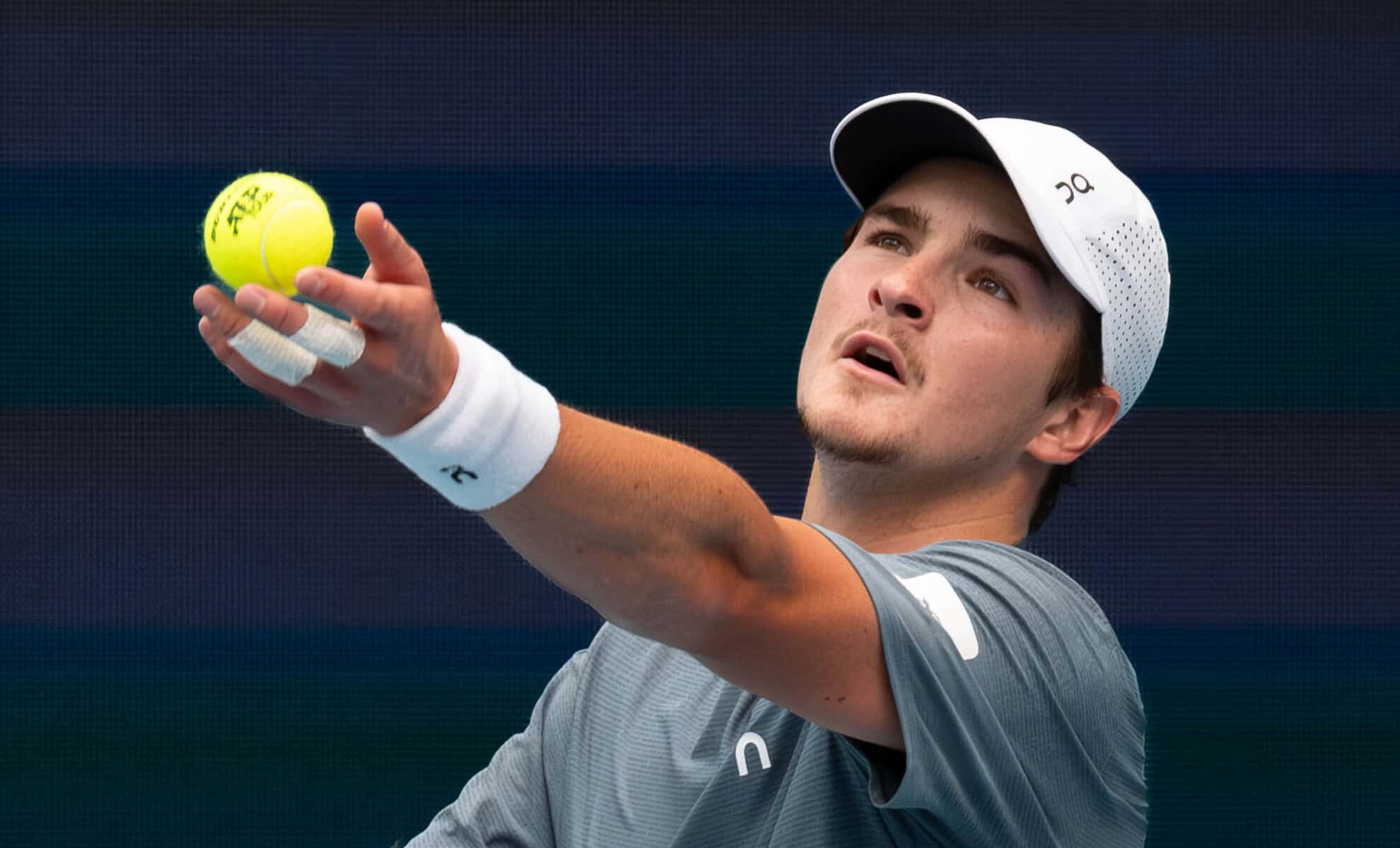
Francisco Cerúndolo has given Latin American tennis its clearest grass-court statement of the summer, turning a historic Queen’s Club title into a broader Wimbledon storyline for a region better known for clay than lawns.
The Argentine arrives at Wimbledon as one of the most dangerous seeded players outside the top tier after winning the biggest title of his career at Queen’s Club. Cerúndolo defeated Tommy Paul in a three-set final, rallying from a set and a break down to win his first ATP 500 trophy and become the first Argentine champion in the tournament’s long history.
For Latin American tennis, the timing matters. Wimbledon begins June 29, and the men’s draw will include a notable group of seeded players from the region: Cerúndolo, Brazil’s João Fonseca, Argentina’s Tomás Martín Etcheverry, Chile’s Alejandro Tabilo and Peru’s Ignacio Buse.
That does not make Latin America a favorite bloc at Wimbledon. Grass remains the least natural surface for many players raised on clay courts. But this year’s pre-Wimbledon stretch has been different. The region is not arriving only with hopeful qualifiers or clay specialists trying to survive the first week. It is arriving with seeds, recent breakthroughs and a genuine headliner.
Cerúndolo is the centerpiece. His Queen’s run was not a soft landing. He had to fight through four three-set matches, then beat Paul in a final that lasted just over three hours. The win also backed up his earlier grass success at Eastbourne in 2023, making it harder to dismiss him as a clay-court player who simply caught a hot week.
His game translates better to grass than the old stereotypes suggest. The forehand is heavy enough to rush opponents, the movement has improved, and his willingness to attack under pressure was clear at Queen’s. The question now is whether he can reset quickly after an emotional title week and carry that level into best-of-five matches.
Fonseca brings a different kind of intrigue. The 19-year-old Brazilian has become one of the sport’s most watched young players, and Wimbledon will test both his shotmaking and his body. He withdrew from Eastbourne because of right shoulder discomfort, calling the move precautionary as he tries to be ready for the All England Club.
That makes Fonseca one of the more complicated Latin American stories entering the tournament. His ceiling is high, and his ranking has already moved him into the seeded group. But a shoulder issue before Wimbledon is not a small detail, especially on grass, where serve rhythm and first-strike tennis can decide matches quickly.
Buse has added one of the more surprising regional subplots. The Peruvian beat former world No. 3 Stefanos Tsitsipas in Mallorca, a major grass-court win for a player still building experience on the surface. He later lost to Vit Kopriva, but the week still showed that his rapid rise is not limited to clay.
Tabilo’s Wimbledon preparation was less convincing. The Chilean fell in Mallorca to Fabian Marozsan, a match that exposed the thin margins of grass-court tennis when serve numbers dip. Still, Tabilo’s left-handed game gives him tools that can be awkward on faster courts, and his seeding keeps him away from the very top names in the opening round.
Etcheverry is another Argentine seed with something to prove. His power and physicality are not in question, but Wimbledon often punishes players who need extra time to set up from the baseline. For him, the first week will be about serve efficiency, quick adjustments and avoiding long defensive patterns.
On the women’s side, Colombia’s Emiliana Arango gave the region a smaller but meaningful grass-court result at Eastbourne, where she defeated defending champion Maya Joint for her first tour-level victory on grass. She then lost to Caty McNally in the next round, but the win still matters in a regional context. Latin American women have had fewer grass-court headlines this month, and Arango’s result offered a reminder that progress on the surface can come in steps rather than title runs.
The broader theme is clear: Latin American tennis is entering Wimbledon with more depth and variety than usual. Argentina has multiple seeded men. Brazil has one of the sport’s most compelling teenagers. Peru has a rising player who has already beaten a former Grand Slam finalist on grass. Chile still has a seeded presence. Colombia has a recent women’s breakthrough on the surface.
Wimbledon will quickly separate momentum from staying power. Cerúndolo’s Queen’s title raises expectations, but it also makes him a player others will study more closely. Fonseca’s health is a real question. Buse, Tabilo and Etcheverry must show that their games can hold up when grass rewards first-strike precision and punishes hesitation.
Still, this is not a routine Latin American Wimbledon preview. The region is not just trying to adapt. It is arriving with players capable of shaping the draw.