Costa Rican authorities have turned to Interpol to locate two women linked by investigators to the Riverside case, including the wife of extradited alleged drug figure Edwin López Vega, known as “Pecho de Rata,” after both left the country before one of the largest organized-crime operations in Costa Rica’s history.
The Organismo de Investigación Judicial (OIJ) confirmed that Jeydi Smith De la O, López Vega’s 29-year-old wife, and Chonta Mullins, a former Miss Costa Rica and Miss Universe Costa Rica contestant, are believed to be in Switzerland. Both are wanted by Costa Rican judicial authorities as part of the Riverside investigation, which targets an alleged criminal network tied to drug trafficking and money laundering.
The OIJ said Interpol alerts were issued to help locate and detain both women. The alerts are intended to notify international police authorities if either woman makes a migration movement, allowing Costa Rica to begin the legal steps needed to bring them before the courts.
Smith De la O left Costa Rica on June 17, just days before the Riverside raids were carried out. Immigration records show that Mullins left the country on March 23, three days after López Vega was extradited to the United States on drug-trafficking charges.
The timing has become one of the most closely watched parts of the case. Smith De la O married López Vega on February 17 while he was detained and awaiting extradition. López Vega was sent to the United States on March 20, along with former magistrate Celso Gamboa Sánchez, in one of Costa Rica’s first extraditions of citizens under the constitutional change allowing nationals to be sent abroad in drug-trafficking and terrorism cases.
Authorities allege that Smith De la O was a trusted person within the structure. Investigators attribute to her apparent roles related to asset management, money deposits, administration of funds and safeguarding resources allegedly obtained through illegal activity. Mullins is described by investigators as an alleged front person who helped manage or protect high-value assets tied to the group.
The Riverside case centers on an alleged criminal organization that authorities say operated mainly from Limón, especially the Caribbean coast around Cahuita. The OIJ says the group was involved in national and international drug trafficking, money laundering, bringing drugs into prisons, transport and storage of drugs, marijuana production, deprivation of liberty and other crimes.
According to the OIJ, investigators identified more than 90 people believed to be part of the organization. During the investigation, authorities seized 960 kilos of cocaine and 3,207 one-kilo packages of marijuana. The OIJ also said the group controlled assets valued at about ₡2.6 billion, including six hotels, a restaurant, rental homes listed through online platforms, a gym and cattle farms.
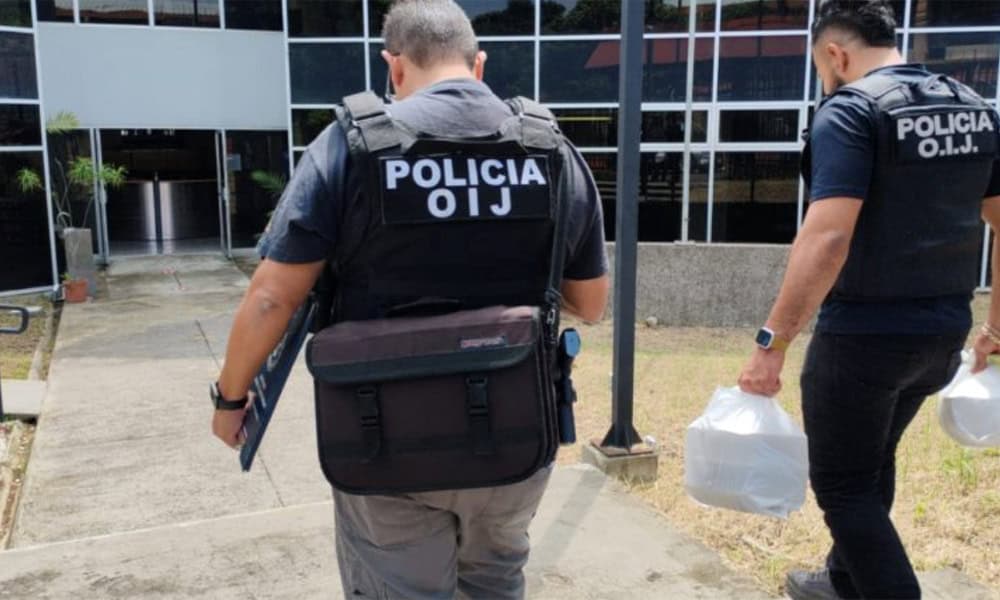
The operation involved raids on 98 properties containing 142 structures, with actions in Limón, Cartago, Heredia, Turrialba, Tres Ríos and two areas of La Reforma prison. The OIJ said 1,500 judicial agents and officers, 70 judges and 100 prosecutors took part in the deployment.
Investigators also allege the organization had links with a Colombian criminal group known as “Los Costeños” and that drugs were brought by sea from Colombia into Costa Rica. The case has reinforced official concerns that Costa Rica is no longer only a transit point for international drug trafficking, but also a country where criminal groups build local logistics, property holdings and business fronts.
The international search now adds another layer to the case. Although Switzerland is sometimes viewed publicly as a difficult place from which to secure extraditions, a Costa Rican criminal lawyer consulted by CRHoy said the absence of a bilateral extradition treaty does not automatically prevent Costa Rica from pursuing the return of a suspect. Costa Rican law and the principle of reciprocity between states may still allow a request to move forward.
For now, Costa Rican authorities have not publicly detailed every allegation against Smith De la O or Mullins. Both should be considered suspects unless and until proven guilty in court.
But the case already carries broader importance. It combines migration records, luxury travel, international police cooperation, alleged money laundering, prison contacts and the extradition of a Costa Rican citizen accused of international drug trafficking. For a country facing growing pressure over organized crime, Riverside has become a test of whether Costa Rica can follow suspects and assets beyond its own borders.