
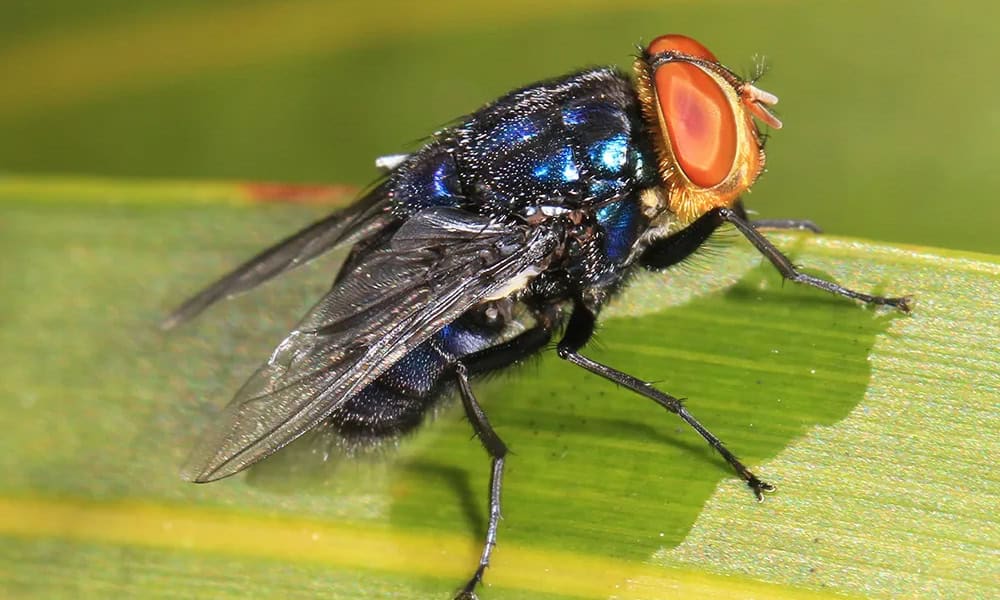
For decades, a small facility in Panama stood between the United States cattle industry and one of the most destructive parasites in the Western Hemisphere. That barrier has now been breached. A couple of days ago, the U.S. Department of Agriculture confirmed the first locally acquired livestock detection of New World screwworm in the United States in 60 years. It was found in a three-week-old calf in Zavala County, Texas, roughly 50 miles from the Mexican border.
A 20-kilometer quarantine zone was immediately established. Canada announced import restrictions within days. And questions began circulating about how a pest that had been successfully contained for generations managed to reach a Texas ranch in 2026. The answer involves science, geography, foreign aid, budget decisions, and a timeline of cascading failures that stretches back three years.
The New World screwworm is a fly whose females lay eggs in the open wounds of warm-blooded animals. The larvae that hatch do not feed on dead tissue. They feed on living flesh, burrowing deeper as they grow and causing wounds that widen and intensify until the animal dies if left untreated.
Livestock, pets, wildlife, and occasionally humans are all potential hosts. The USDA has estimated that a full outbreak in Texas could cost the state’s livestock industry $1.8 billion annually in today’s dollars. The United States eradicated the pest in 1966 using a technique called the Sterile Insect Technique, which involves breeding massive numbers of male flies, sterilizing them with radiation, and releasing them into the wild to mate with females.
Because female screwworm flies mate only once in their lives, mating with a sterile male produces no offspring. By continuously flooding the wild population with sterile males, the wild population collapses and dies out over time. The eradication effort was methodical and eventually pushed the screwworm progressively southward through Mexico and into Central America over the following decades.
By 1994, the barrier had been moved to Panama’s Darién Gap, the narrowest point of the land bridge connecting Central and South America. A joint facility operated by Panama’s Agriculture Ministry and the USDA’s Animal and Plant Health Inspection Service, known as COPEG, was established there to produce sterile flies and maintain the biological barrier.
The facility, completed in 2006, had the capacity to produce up to 100 million sterile flies per week. For nearly two decades, it worked. USDA estimated in 2025 that its investment in COPEG had saved the American cattle industry $2.3 billion every year. In 2023, annual screwworm detections in Panama jumped from roughly 25 cases to more than 6,500. The barrier that had held for a generation began to fail.
The pest spread northward through Costa Rica, Nicaragua, Honduras, Guatemala, Belize, and El Salvador in rapid succession. By November 2024, it had crossed into southern Mexico near the Guatemalan border. By June 2026, it was in Texas. The question of why the Panama barrier collapsed does not have a single clean answer, but several contributing factors have been identified by scientists and investigators.
The COVID-19 pandemic disrupted sterile fly program operations across Central America during a critical period. Increased movement of livestock and people across the region created new vectors for spread. Favorable weather conditions helped the fly population thrive in areas where it had previously struggled to establish itself.
COPEG’s Panama facility had been listed as one of USDA’s three highest-priority facilities in need of repair as far back as 2023. A request for an additional $3.6 million for fiscal year 2025 to address aging infrastructure and rising operational costs was in the pipeline.
In March 2025, USDA cut funding for animal disease control and prevention across several programs, including screwworm, reducing support to the Food and Agriculture Organization of the United Nations, which had been funding more than 180 outbreak investigations and building laboratory capacity in 22 countries.
The FAO’s global health security program subsequently reduced its screwworm surveillance operations as U.S. funding was withdrawn. Critics pointed directly at this sequence of events, noting that the cost of maintaining the Panama barrier was almost certainly a fraction of what it will now cost to respond to an active outbreak on American soil.
The USDA pushed back on the narrative, pointing to $109.8 million in emergency funding allocated in 2023, $165 million more in 2024, and an $850 million plan announced in mid-2025 that included $750 million to build a new sterile fly production facility in southern Texas.
U.S. officials acknowledged that models had predicted the screwworm would enter the country in 2025, arguing that the administration had bought time. Whether that time was used wisely, and whether the budget reductions in early 2025 cost more than they saved, is a question that congressional agriculture committees are now examining.
For Costa Rica and Panama, the loss of the biological barrier is not an abstract concern. Both their countries spent years dealing with a parasite that was supposed to stay south of their borders, watched it move through livestock herds, and are now managing ongoing screwworm activity that places additional pressure on agriculture in regions already dealing with extreme weather and economic volatility.
This reporter has seen the infection firsthand. It smells horrific, and the animals suffer. The facility Panama hosted and largely depended on others to fund has been overwhelmed. A second confirmed Texas case has since been reported.
It is unlikely to be the last.