
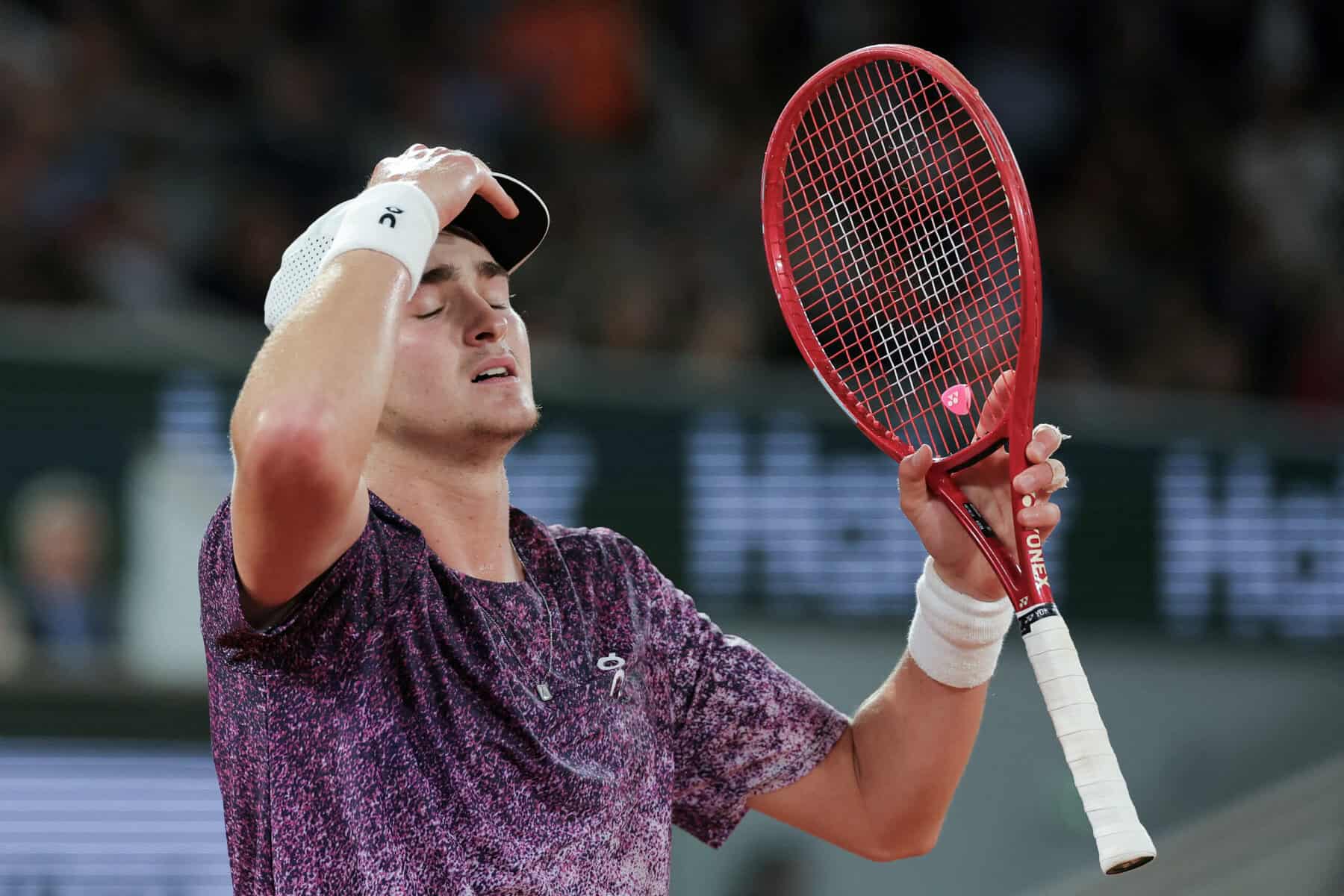
João Fonseca’s electric debut run at Roland Garros ended Tuesday, as Czech 26th seed Jakub Mensik beat the 19-year-old Brazilian 6-4, 6-3, 7-6(3) to reach his first Grand Slam semifinal on Court Philippe Chatrier.
The straight-sets defeat closed the curtain on a fortnight that had already made Fonseca the toast of Latin American tennis. Even in defeat, the quarterfinal marked the best Grand Slam result of his young career — and made him the first Brazilian man to reach the last eight in Paris since three-time champion Gustavo Kuerten in 2004.
Mensik, 20, controlled the match with his serve, firing 11 aces and repeatedly stretching Fonseca on the Brazilian’s own delivery. The Czech converted five of his 21 break-point chances, while Fonseca managed just two breaks from five looks. Fonseca pushed back in a tense third set, even leading by a break, but Mensik clawed level and pulled away in the tiebreak, sealing the win 7-3 after the Brazilian had held several game points earlier in the set.
It was a more clinical performance than the scoreline of a tiebreak suggests. Mensik, who had survived two grueling five-setters earlier in the tournament — including a 13-11 final-set tiebreak against Mariano Navone in which he collapsed with cramps — looked the fresher and more decisive player when the rallies grew long.
Fonseca arrived in the quarterfinals as the story of the tournament. He rallied from two sets down to stun Novak Djokovic in the third round, then dispatched two-time finalist Casper Ruud in four sets. Kuerten, the Brazilian icon known across Latin America simply as “Guga,” watched from the front row, and Fonseca had called him “an idol for our sport, for our country, for his charisma.” Fans in the neon-yellow shirts of Brazil’s national soccer team chanted Fonseca’s name after every big point throughout his run.
The two young stars had met once before, with Fonseca winning a five-setter at the 2024 Next Gen ATP Finals, but this was their first meeting on clay and on the sport’s biggest stage.
Mensik now advances to face second seed and former finalist Alexander Zverev for a place in the final. The Czech is the youngest of his nation to reach this stage in Paris in decades, continuing a tournament that has scrambled the men’s draw, with Djokovic, Jannik Sinner and an absent Carlos Alcaraz all out of the picture.
For Fonseca, the loss stings but does little to dim a star turn. At 19, he leaves Paris with his ranking set to climb and his status as the standard-bearer for a new generation of Latin American tennis firmly established. The next Grand Slam stage looks less like a question of if than when.