

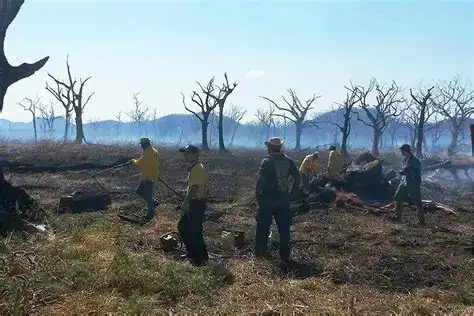
A wildfire sparked by a lightning strike has burned roughly 4,000 hectares — about 40 square kilometers, or 20% of Palo Verde National Park — in just over three days, and crews had not brought the blaze under control as of Monday, environmental authorities said.
Alexander León, regional director of the Arenal Tempisque Conservation Area (ACAT), confirmed Monday that the burned area represents approximately 20.2% of the park, one of Costa Rica’s most ecologically important protected zones for its wetland ecosystems and biodiversity. “As of Monday, it has still not been controlled,” León said, describing a fire that has advanced aggressively through dry, highly combustible vegetation.
The fire began the night of Thursday, May 28, when a lightning strike from a dry thunderstorm ignited the blaze inside the park, according to the Ministry of Environment and Energy (MINAE). The lightning hit a stand of typha (Thypha domingensis), an invasive wetland plant that becomes highly flammable when it dries out and accelerated the spread of the flames.
The scale of destruction has escalated rapidly. The 4,000 hectares now affected are roughly ten times the 200-to-400-hectare estimate from just three days earlier, and on Sunday, May 31, alone the fire expanded by more than 1,500 hectares. For perspective, the burned area is about 55 times the size of San José’s 72-hectare La Sabana Metropolitan Park.
The emergency has taken a toll on responders. On Sunday afternoon, the Costa Rican Red Cross evaluated 26 forest firefighters who experienced effects from smoke inhalation, though none required transfer to a medical facility after on-site assessment. Smoke columns reaching hundreds of meters high have been carried for kilometers by the wind, affecting communities well beyond the fire zone in Guanacaste.
Crews from the National System of Conservation Areas (SINAC), the Costa Rican Red Cross and the national fire-management system are working the perimeter, supported by public institutions and private companies covering costs such as personnel meals and vehicle fuel. The Cuerpo de Bomberos reinforced operations on Sunday, sending eight firefighters and three rapid-attack units; the institution noted it was the 233rd forest fire it had responded to in 2026. The park has been temporarily closed to protect visitors and assist containment efforts.
The losses carry weight beyond the acreage. Palo Verde, established in the 1970s and spanning more than 16,000 hectares between the Bebedero and Tempisque rivers, is a Ramsar site of international importance and one of Central America’s principal sanctuaries for biodiversity. Its seasonal wetlands draw thousands of migratory and resident waterbirds, and support endangered species such as the jabiru — the largest stork in the Americas — alongside felines, monkeys, deer and one of the country’s largest crocodile populations.
Authorities say the fire fits a worrying 2026 pattern. León noted that Guanacaste has already seen major fires this year at the Lomas de Barbudal Biological Reserve and Santa Rosa National Park, and warned that the blazes are far more aggressive than in previous years — a direct reflection of climate variation. An April 2023 fire in the same park consumed more than 3,000 hectares, with smoke reaching communities in Nicoya, Santa Cruz, Bagaces and Hojancha.





