

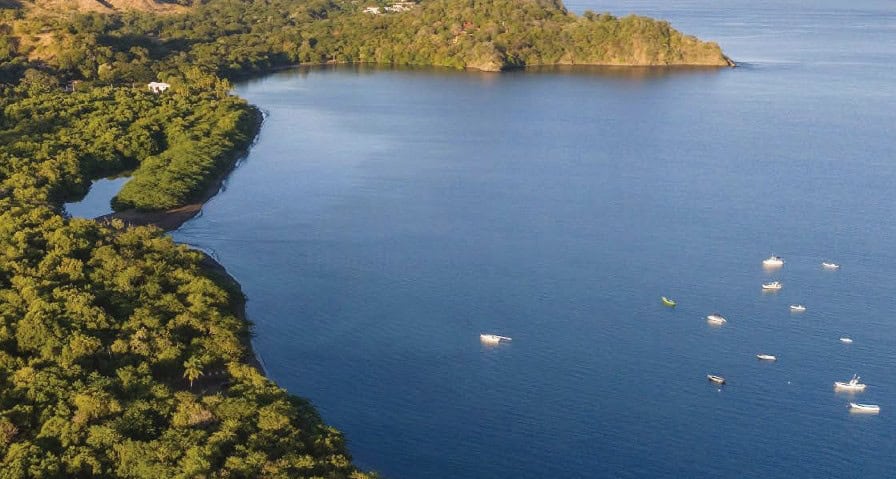
The Association of Developers of the Papagayo Gulf Tourism Complex (Asopapagayo) is attempting to overturn the Constitutional Court’s decision to suspend logging and construction permits in the Bahía Papagayo development. The group issued a statement expressing “concern and alarm” following Judge Fernando Cruz’s ruling, which establishes a total moratorium on logging permits and the suspension of construction authorizations in that area while the merits of the case are resolved.
The pending lawsuit challenges amendments made to the Regulations of the Law for the Development and Implementation of the Papagayo Gulf Tourism Project. That preliminary injunction was granted after it came to light that Enjoy Hotels & Resorts had already obtained authorization from the National System of Conservation Areas (Sinac) to begin cutting down 748 trees in the area of its project.
Asopapagayo requests that the resolution imposing the precautionary measures be declared “absolutely null and void” and that those provisions, which suspend logging and other administrative actions related to the project, be immediately lifted.
The Association also requests the recusal of Judge Cruz, meaning that he be removed from the case currently being heard by the Chamber. The business group asserts that there are “procedural errors” and that Judge Cruz lacked the authority to grant precautionary measures unilaterally, without the review of the other members of Chamber IV.
According to the group, the suspension causes “extremely serious and irreversible harm to the country” by halting a project in which $2.2 billion has been invested and which has created 15,000 jobs. It further asserts that it jeopardizes future investments. “This isn’t just about putting a project on hold; it’s about calling into question the country’s legal certainty,” said Rodrigo Castro, Executive Director at Asopapagayo.
Castro asserted that any “abrupt change in its rules directly affects legal certainty, undermines investor confidence, and jeopardizes the stability of a model that has been successful and has generated tangible results for the entire country.” The business group argued that the Papagayo Gulf Tourism Hub is the result of a public policy spanning more than 50 years, “grounded in laws, technical planning, and decisions by the Costa Rican government.”
Asopapagayo mentioned that development in the area is crucial for the surrounding communities, as it provides employment and opportunities. “The suspension is not affecting just one project; it is impacting an entire socioeconomic ecosystem and entire communities, whose opportunities are being curtailed without any real alternative,” they added.
The project has sparked a great deal of controversy on social media, as many people are concerned about its environmental impact. Organizations such as the Savage Lands Project and Salvemos Playa Panamá, as well as influencers, have shared content highlighting the consequences of cutting down trees to build the hotel complex.
“Here in Guanacaste, Costa Rica, there are far too many development projects that are destroying the forest. In Playa Panamá, one of the projects had a permit to cut down 700 trees, and the local community, along with some NGOs, have joined forces to defend the ecosystem for the well-being of everyone,” said Savage Lands Project.
The organization stated that “the forest isn’t just scenery; it’s a shield against what’s coming: more heat, drought, and a collapse of biodiversity,” which is why they’re asking the community to join a protest to defend the forest. Today at 4:00 p.m. in Playa Panamá, those who oppose the project will gather to defend the forest and support conservation initiatives.
Costa Rica Developers Challenge Court Ruling Halting Tourism Project in Papagayo
The Association of Developers of the Papagayo Gulf Tourism Complex (Asopapagayo) is attempting to overturn the Constitutional Court’s decision to suspend logging and construction permits in the Bahía Papagayo development. The group issued a statement expressing “concern and alarm” following Judge Fernando Cruz’s ruling, which establishes a total moratorium on logging permits and the suspension of construction authorizations in that area while the merits of the case are resolved.
The pending lawsuit challenges amendments made to the Regulations of the Law for the Development and Implementation of the Papagayo Gulf Tourism Project. That preliminary injunction was granted after it came to light that Enjoy Hotels & Resorts had already obtained authorization from the National System of Conservation Areas (Sinac) to begin cutting down 748 trees in the area of its project.
Asopapagayo requests that the resolution imposing the precautionary measures be declared “absolutely null and void” and that those provisions, which suspend logging and other administrative actions related to the project, be immediately lifted.
The Association also requests the recusal of Judge Cruz, meaning that he be removed from the case currently being heard by the Chamber. The business group asserts that there are “procedural errors” and that Judge Cruz lacked the authority to grant precautionary measures unilaterally, without the review of the other members of Chamber IV.
According to the group, the suspension causes “extremely serious and irreversible harm to the country” by halting a project in which $2.2 billion has been invested and which has created 15,000 jobs. It further asserts that it jeopardizes future investments. “This isn’t just about putting a project on hold; it’s about calling into question the country’s legal certainty,” said Rodrigo Castro, Executive Director at Asopapagayo.
Castro asserted that any “abrupt change in its rules directly affects legal certainty, undermines investor confidence, and jeopardizes the stability of a model that has been successful and has generated tangible results for the entire country.” The business group argued that the Papagayo Gulf Tourism Hub is the result of a public policy spanning more than 50 years, “grounded in laws, technical planning, and decisions by the Costa Rican government.”
Asopapagayo mentioned that development in the area is crucial for the surrounding communities, as it provides employment and opportunities. “The suspension is not affecting just one project; it is impacting an entire socioeconomic ecosystem and entire communities, whose opportunities are being curtailed without any real alternative,” they added.
The project has sparked a great deal of controversy on social media, as many people are concerned about its environmental impact. Organizations such as the Savage Lands Project and Salvemos Playa Panamá, as well as influencers, have shared content highlighting the consequences of cutting down trees to build the hotel complex.
“Here in Guanacaste, Costa Rica, there are far too many development projects that are destroying the forest. In Playa Panamá, one of the projects had a permit to cut down 700 trees, and the local community, along with some NGOs, have joined forces to defend the ecosystem for the well-being of everyone,” said Savage Lands Project.
The organization stated that “the forest isn’t just scenery; it’s a shield against what’s coming: more heat, drought, and a collapse of biodiversity,” which is why they’re asking the community to join a protest to defend the forest. Today at 4:00 p.m. in Playa Panamá, those who oppose the project will gather to defend the forest and support conservation initiatives.





