

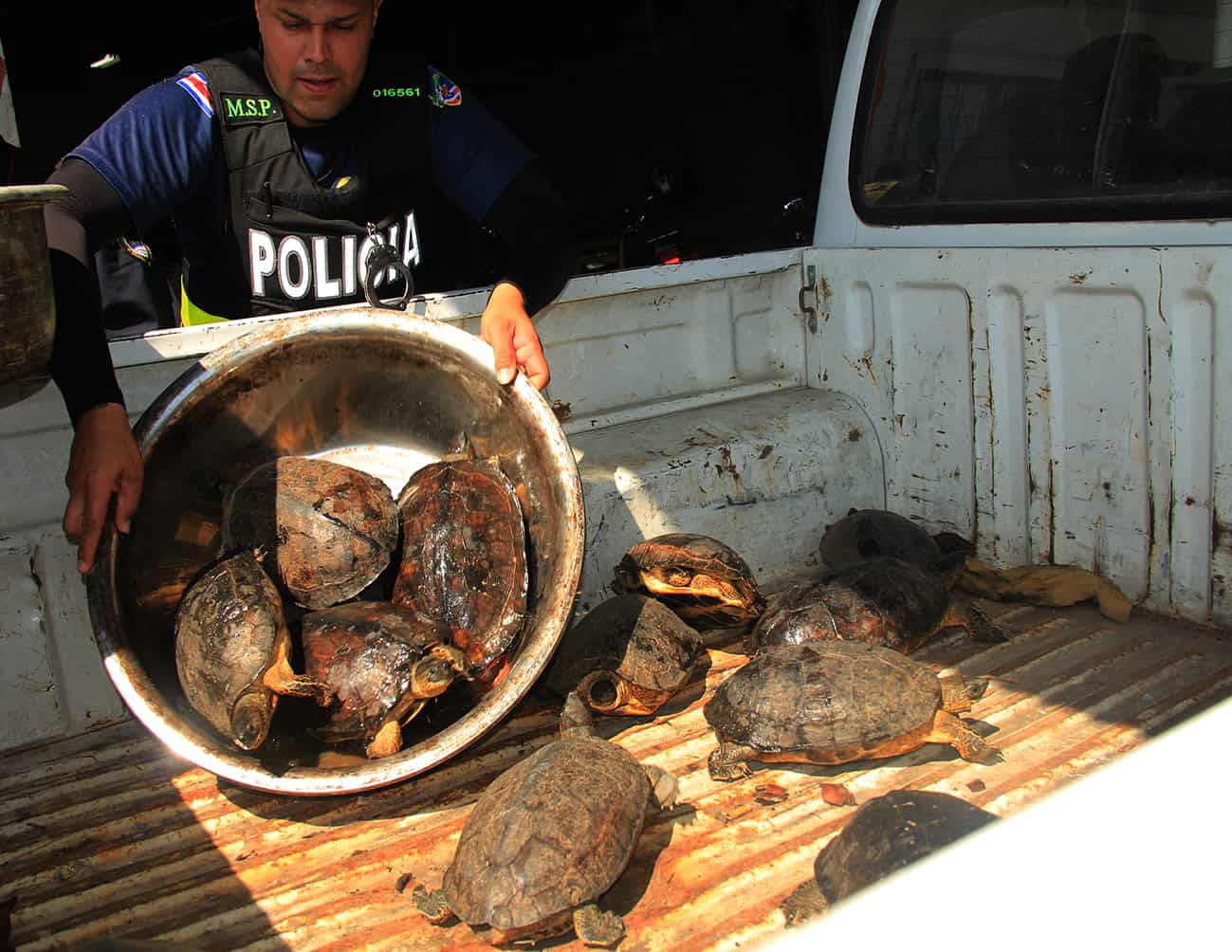
Humane World for Animals Costa Rica has partnered with Costa Rica’s National Environmental Security Commission to deliver a series of training workshops for government authorities responsible for handling wildlife rescued or confiscated in illegal trafficking cases.
The workshops are part of a broader project titled “Improving Costa Rica’s Capacity to Combat Wildlife Trafficking,” funded by the U.S. Bureau of International Narcotics and Law Enforcement Affairs. The Commission brings together four key agencies: the Public Prosecutor’s Office, the Judicial Investigation Agency (OIJ), the Ministry of Public Security, and the Ministry of Environment and Energy.
During the workshops, public officials learned how to properly handle seized or rescued wildlife, how to protect people involved in confiscation processes, and how to feed and transport wild animals. Participants also received guidance on a new online species identification guidebook, providing enforcement officers with information on legal protections, conservation status, and safe handling techniques for a wide range of animals.
According to the Judicial Police’s Specialized Section against Environmental Crimes, 534 wild animals were seized in Costa Rica between 2022 and 2023. “For the Attorney General’s Office, ongoing training and inter-institutional coordination are key to environmental law enforcement,” said José Pablo González, deputy environmental prosecutor and National Environmental Security Commission coordinator.
“Knowing how to properly manage seized wild animals, their products and by-products, is the best way to guarantee protection of these public domain assets and appropriate sanctions for those who are illegally hunting and trafficking them.”
Andrea Borel, executive director of Humane World for Animals Costa Rica, emphasized the welfare dimension of the work. “The majority of wild animals seized or rescued in police and judicial operations have experienced captivity, stress and abuse. That is why we seek to support law enforcement authorities so that they are prepared to handle these animals in a humane and safe way — not only thinking about the animals themselves, but also the safety and wellbeing of the people involved.”
Home to around 5% of the world’s plant and animal species, Costa Rica is one of the planet’s most biodiverse countries. That biodiversity also makes it a target. Latin America is a region with great species diversity, and Costa Rica in particular is considered “megadiverse” — a status that generates pressure on wildlife from human activity, with trafficking posing a considerable threat to the country’s biodiversity.
In recent years, Humane World for Animals has also worked to increase the penalties for wildlife crimes in Costa Rica and to better integrate wildlife offenses — such as illegal trade — into the broader legal framework around organized crime.





