

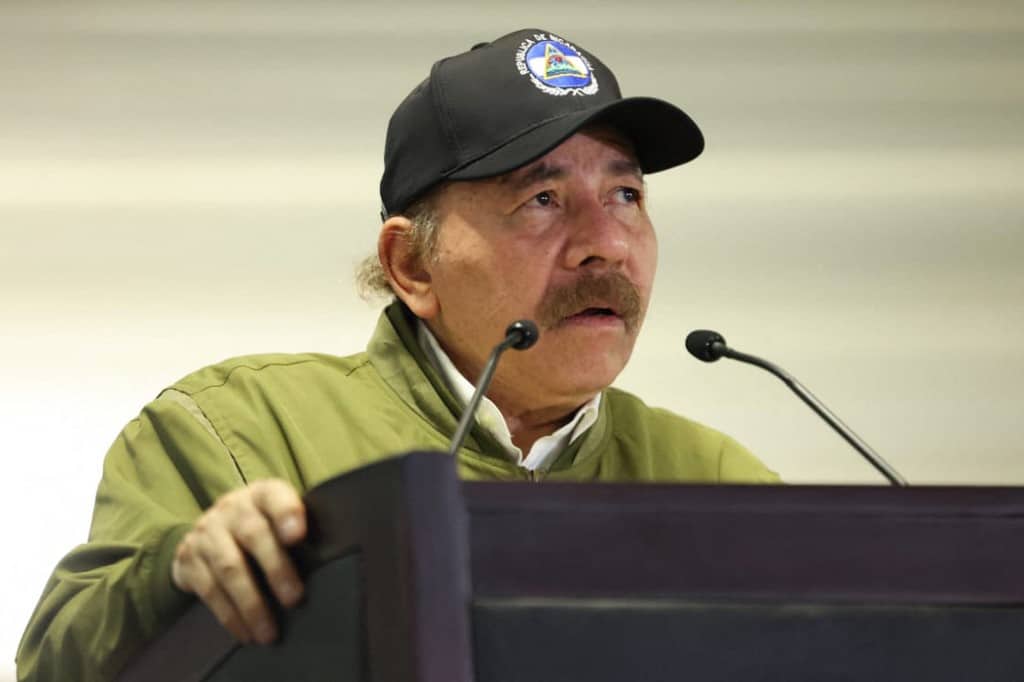
The United States Treasury Department imposed sanctions the two sons of Nicaraguan President Daniel Ortega and Vice President Rosario Murillo along with seven gold companies and several individuals operating in the country’s gold sector.
Maurice Facundo Ortega Murillo and Daniel Edmundo Ortega Murillo were designated for serving as officials in the Nicaraguan government. The sanctions also hit Vice Minister of Energy and Mines Santiago Hernan Bermudez Tapia and seven companies granted mining concessions by the regime: Exportadora de Metales S.A. (EMSA), Grupo Minero Xiloa S.A., Thomas Metal S.A., Nicaragua Xinxin Linze Mineria Group S.A., Brother Metal S.A., Zhong Fu Development S.A. and Santa Rita Mining Company S.A.
The action, announced by the Treasury’s Office of Foreign Assets Control (OFAC), targets the Ortega-Murillo government’s use of the gold sector to generate revenue and maintain political control. Gold remains Nicaragua’s top commodity export, with the regime restructuring the mining industry since 2020 through a network of companies and intermediaries.
The Treasury stated that profits from gold operations help equip, train and pay salaries linked to paramilitary groups and finance repressive activities. Several of the newly sanctioned companies received large mineral concessions directly from the government. Some, including Zhong Fu Development S.A. and Santa Rita Mining Company S.A., were involved in the forcible seizure of a U.S.-owned gold processing plant belonging to BHMB Mining Nicaragua S.A. in 2025, according to the Treasury.
No compensation was provided after the government rescinded the company’s license. Additional individuals designated include Feiwu Bian and Anibal Vladimir Matus Buitrago, president and legal representative of Zhong Fu Development S.A.; Nelson Francisco Sobalvarro, legal representative of previously sanctioned Compañía Minera Internacional S.A. (COMINTSA); and Lester Matus Tamariz, a notary whose services helped expedite concession transfers.
The sanctions block access to the U.S. financial system for those listed and prohibit U.S. persons from engaging in transactions with them. Treasury Secretary Scott Bessent said the Murillo-Ortega dictatorship has used gold companies and co-conspirators to confiscate American investments in Nicaragua and generate funds to maintain its political power.
The designations fall under Executive Order 13851, as amended, which addresses the national emergency related to the situation in Nicaragua. The move comes as the regime continues to concentrate economic and political power within the presidential family and close allies.
Family members of Ortega and Murillo hold key positions across government institutions, including the newly sanctioned roles in sports promotion and communications oversight. The gold sector has become a central pillar of foreign currency earnings for the government, with state-owned Empresa Nicaragüense de Minas (ENIMINAS) playing a role in allocating concessions and directing profits to private partners aligned with the regime.
Previous U.S. actions have targeted other gold-related entities and officials, but Wednesday’s sanctions expand the focus to additional companies and family members directly involved in oversight and operations. The Treasury noted that one sanctioned company, EMSA, collects unrefined gold from multiple sites across Nicaragua, smelts it in Managua and sells it in bulk, with proceeds sometimes transferred electronically in ways that support regime-linked groups.
Another, Grupo Minero Xiloa S.A., buys artisanal gold in cash, processes it and exports through allied networks, using the U.S. financial system to legitimize funds that later support repressive operations. The designations aim to disrupt these revenue streams without broadly affecting the entire sector.
As of today, the sanctioned individuals and entities face asset freezes and transaction prohibitions in the United States. No immediate response from the Nicaraguan government was detailed in the Treasury announcement. The action shows the ongoing U.S. efforts to limit the Ortega-Murillo regime’s ability to fund its operations through key export areas.





