

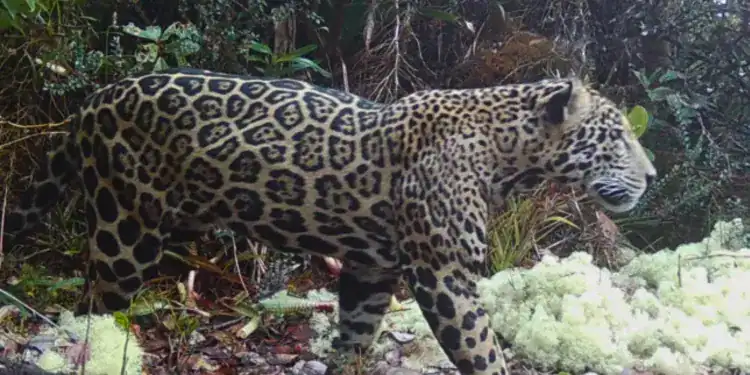
Camera traps have photographed a young male jaguar high in the Sierra del Merendón mountain range in northern Honduras. The images, captured on February 6, show the animal at an elevation of about 2,200 meters in high-altitude cloud forest. It marks the first confirmed detection of a jaguar in the range in 10 years.
The lone animal, referred to as a “cloud jaguar” because of its presence in cloud forest habitat, provides a positive sign for conservation in the area. Panthera, the wild cat conservation organization that operates the camera traps, shared the images.
Franklin Castañeda, Panthera’s Honduras country director, said deforestation and poaching remain the biggest threats to jaguars. “We have been working to tackle both,” he said. His team has stepped up ranger patrols, camera trapping, acoustic monitoring and prey reintroduction programs.
Honduras has lost about 1.5 million hectares of tree cover since 2001, representing 19 percent of its total, according to Global Forest Watch data. Much of the loss stems from permanent agriculture. The government has launched a Zero Deforestation Plan that aims to halt forest loss by 2029 and restore 1.3 million hectares. It deploys thousands of troops to support patrols.
Jaguars in Central America face fragmented habitat and reduced prey. The species has lost nearly half its historic range across the Americas, with populations outside the Amazon considered endangered or critically endangered by the International Union for Conservation of Nature.
The Sierra del Merendón forms a critical link in the Jaguar Corridor that connects populations in Honduras and Guatemala. The sighting suggests the male may be using the corridor to move between protected areas such as Pico Bonito National Park, which holds an estimated 20 to 50 jaguars, and others.
Castañeda noted that cloud forests in the range have been protected since 1987 primarily as watersheds. The last jaguar record there came in 2016 and helped spur the creation of the corridor with support from groups including the US Fish and Wildlife Service.
High-elevation jaguar records are rare in Honduras. Most jaguars live below 1,000 meters. Only a handful of such sightings have occurred in the country. Dr. Allison Devlin, Panthera’s jaguar program director, said it remains unclear whether jaguars are expanding their use of high-altitude areas or if the remoteness had simply hidden them before.
The Merendón range has shown recovery signs for other cats as well. Camera traps first detected pumas there in 2017 after 17 years without records, and multiple sightings have followed. Researchers have now documented all five of Honduras’ wild cat species in the area: jaguars, pumas, ocelots, jaguarundis and margays.
Panthera has worked in Honduras since 2009 and helped establish the jaguar corridor through camera traps, interviews and genetic sampling. The organization partners with the Instituto de Conservación Forestal and local communities. The new record comes as international efforts advance. Mexico reported a 10 percent increase in its jaguar population in recent years. At a recent UN wildlife conference, governments adopted a framework for jaguar protection across their range.
Castañeda described the sighting as awesome after 15 years of monitoring in the Merendón, with the last 10 years of continuous surveillance. Jaguars can travel long distances, up to 10 kilometers in a single night and hundreds of kilometers over time. Connectivity between habitats remains key for the species’ survival.
Devlin said protection of areas across all elevations is important for adaptable cats like jaguars and pumas. Panthera and partners are working on new protected areas, such as the planned Wildlife Refuge Guanales, to strengthen links between Honduran and Guatemalan parks.
Ongoing monitoring with camera traps and acoustic devices continues to help reduce poaching in the corridor. Officials hope the latest jaguar record encourages further efforts to maintain forest cover and prey populations.





