
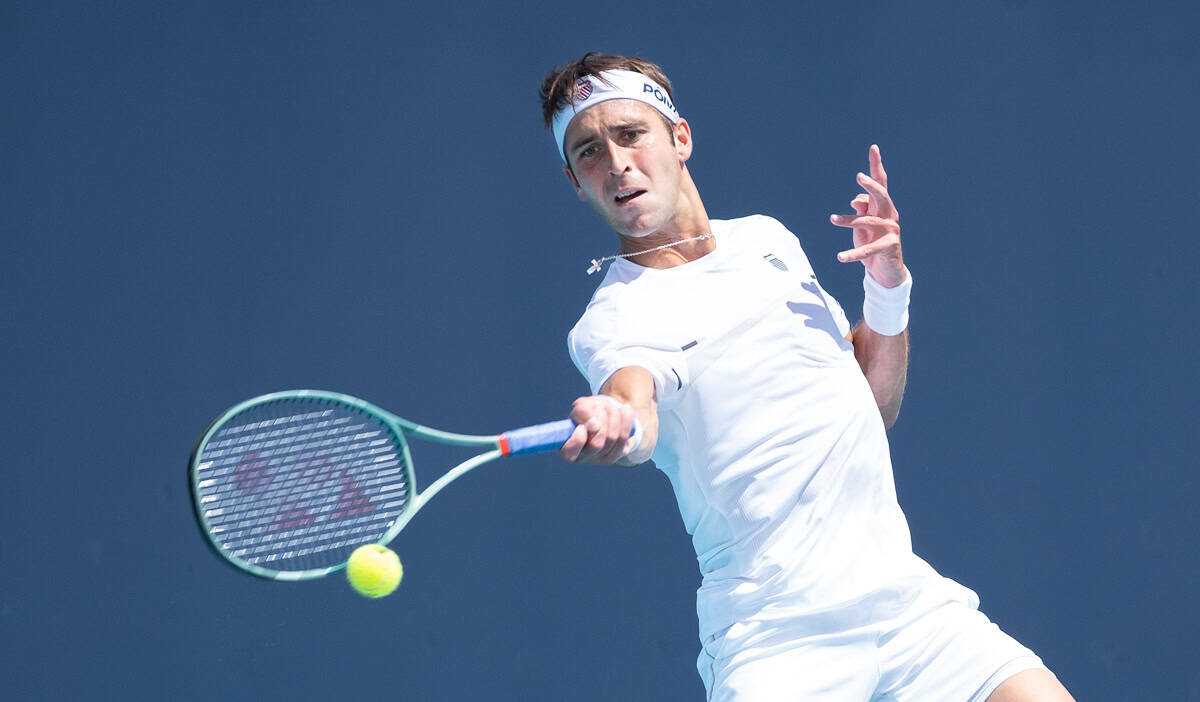
Tomas Martin Etcheverry arrived at the Monte-Carlo Country Club on Thursday carrying form that most players on the clay circuit could only envy. He left it having pushed the world number one to the edge of a major upset before falling just short. The Argentine’s 6-1, 4-6, 6-3 defeat to defending champion Carlos Alcaraz told only part of the story.
Alcaraz swept through the opening set in under twenty minutes, winning the first eight points of the match and breaking the Argentine’s serve three times without facing a single break point himself. It was, by his own assessment, close to perfection. “I was playing really well in the first set,” Alcaraz said on court afterwards. “I was feeling the ball 10/10.”
Then Etcheverry did what his game is built to do on clay. He slowed the match, absorbed the pace, and waited for the champion to tighten. The Rio ATP 500 title he won in February — earned across nearly seven hours of rain-disrupted tennis on a single Sunday — had been built on precisely this kind of attrition. He arrived in Monte Carlo with a 10-1 clay record for the season, having already beaten Grigor Dimitrov and Terence Atmane in back-to-back three-set matches just to reach Alcaraz.
The turning point In the second set, with Alcaraz spraying errors and the match shifting beneath him, a moment caught by the courtside microphones captured the situation plainly. The Spaniard turned to his coach Samuel López and said he had lost his feel for the ball. López’s reply was brief: “You have to hurt the ball, not the court. You’re not in a hurry.” From 0-1 down, Etcheverry reeled off four straight games, finished the set 6-4, and found himself level in a round of 16 match against the man who won this title a year ago and who has not lost on clay in fifteen matches.
Alcaraz committed 23 unforced errors in that second set alone — an unusually high figure for a player whose clay-court record over the past two years stands as the best on tour. He converted just one of four break point opportunities across the set and, as Etcheverry served it out, there was a question hanging over Court Rainier III about whether the Argentine might pull off one of the more significant results of the clay season.
The decider Alcaraz answered it quickly. He broke in the second game of the third set, a long and grinding exchange that seemed to reset the match’s momentum and moved to 3-0 before Etcheverry could respond. The Argentine was not finished — he saved a break point to briefly threaten at 5-2 — but the Spaniard closed it out on his third match point. Final score: 6-1, 4-6, 6-3 in two hours and twenty-four minutes.
“When you don’t take the opportunities at this level, you have to run back,” Alcaraz said of the second set. “He played more aggressive after that, but I would say it was a great fight in the end.”
For Etcheverry, ranked 30th in the world, it was the deepest run of his career at a Masters 1000 event in Monte Carlo, where his previous best had been a second-round exit in two prior appearances. The quarterfinal barrier remains unbroken at the top level, but the Argentine’s clay-court credentials in 2026 are not in doubt. A title in Rio, a 12-2 record on the surface before this match, and a set taken off the world number one in Monaco — the clay season is only just beginning.