

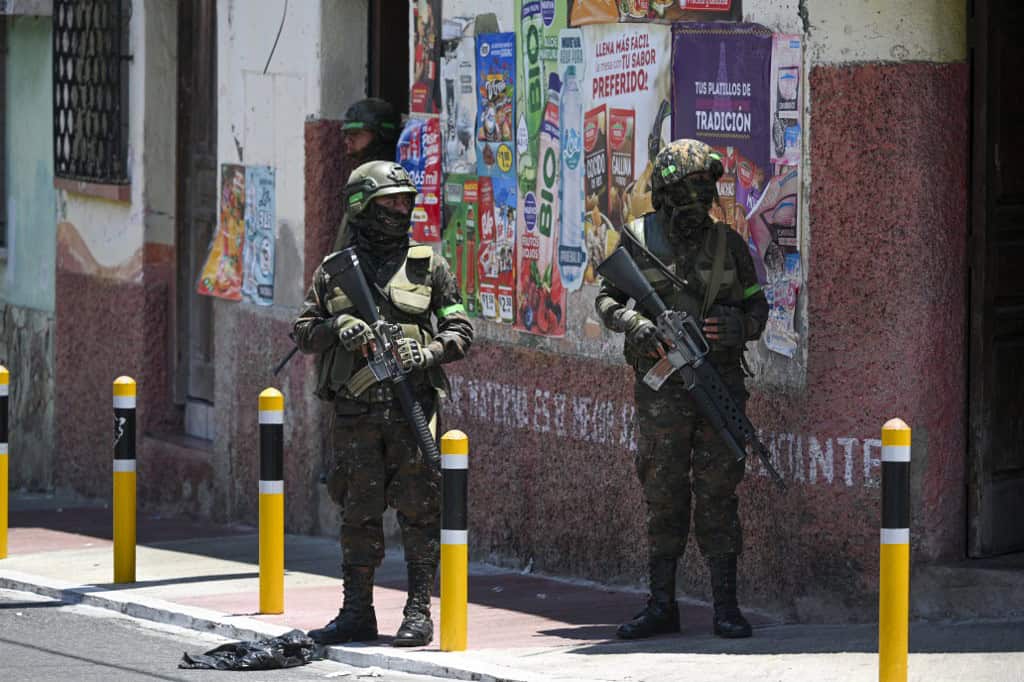
The recent spike in gang violence in Guatemala has exposed weaknesses in the country’s security apparatus, but it has also fueled allegations of a plot against the government aimed at shielding a long-denounced alliance between politicians and criminal networks. After ten police officers were killed over the weekend in retaliation for the state’s takeover of three prisons where gang members had taken dozens of hostages, President Bernardo Arévalo, a social democrat, declared a state of siege, the country’s second most severe emergency measure after a state of war.
There is “zero control” over the prison system, said former anti-gang prosecutor Juan Francisco Solórzano, who questioned why intelligence services failed to anticipate the attacks. The criminal offensive “is not accidental; it reflects deliberate operations driven by political-criminal networks,” argued former anti-corruption prosecutor Juan Francisco Sandoval, who has been living in exile in the United States since 2021.
Sandoval was removed by Attorney General Consuelo Porras, an adversary of President Arévalo who has been sanctioned by the United States and the European Union amid accusations that she protects corruption. Frequently cited by the government and NGOs as part of an alleged structure that protects criminals, Porras must be replaced in May by the president. Two years ago, Porras attempted to block Arévalo’s inauguration through legal maneuvers.
A breaking point
The wave of violence linked to the Barrio 18 gang, designated a terrorist organization by Guatemala and the United States, dates back to last July, when five of its top leaders were transferred to a maximum-security prison. Authorities said the leaders were still ordering killings, selling drugs, and extorting victims from behind bars.
After a series of prison riots, about 20 members of that gang escaped in October from another facility amid allegations of official complicity. The crisis led to the removal of the interior minister and other officials. What happened over the weekend “was already planned as part of a strategy” to “delegitimize” the government, Solórzano said.
The riot at Renovación I prison was led by Aldo Dupie, known as El Lobo, who demanded a transfer to a lower-security facility with better conditions, including air conditioning, a larger bed, and restaurant delivery service, according to the government. After he was subdued, authorities presented him publicly on his knees, handcuffed, and with blood stains. Soon after, the attacks began.
Pushing the president out
The violence comes as Guatemala approaches key institutional transitions: the upcoming replacement of the attorney general and the renewal of judges on the Supreme Electoral Tribunal and the Constitutional Court, the highest judicial body. In recent years, those institutions have been accused of acting to protect corruption networks.
“It’s a message” to Arévalo from “political opponents,” Sandoval said. “Barrio 18 feels protected today by Consuelo Porras… They want to push Bernardo out of power,” Solórzano said, though he also criticized Arévalo’s security policy. Arévalo is a 67-year-old diplomat and intellectual.
After two years in office, “excuses no longer hold,” Solórzano said. El Lobo, convicted of multiple homicides, is in a romantic relationship with a niece of opposition leader Sandra Torres, a former first lady who has lost the last three presidential elections in runoff votes.
Barrio 18 and its rival, Mara Salvatrucha (MS-13), are powerful criminal organizations that also operate in the United States, Honduras, and El Salvador. In El Salvador, the gangs have been severely weakened by President Nayib Bukele’s hardline strategy, which has been criticized for human rights abuses and alleged pacts with parts of organized crime, something Bukele denies.
Porras, who denies having ties to criminals, used the violence to attack Arévalo. “Be serious, Mr. President. Take responsibility and get to work,” she told reporters on Wednesday.
Risk of more attacks
Arévalo, who has the backing of the United States, warned on Wednesday that the attacks will not stop, describing them as a reaction from “criminal political elites” who fear losing control of a system built on corruption, impunity, and shady business dealings.
“They’re preparing us to legitimize an iron-fist approach” ahead of the 2027 general elections, Solórzano said. Adding to the concern, Interior Minister Marco Antonio Villeda told AFP that gangs have enough economic power to finance “campaigns or push their own candidates.”





