
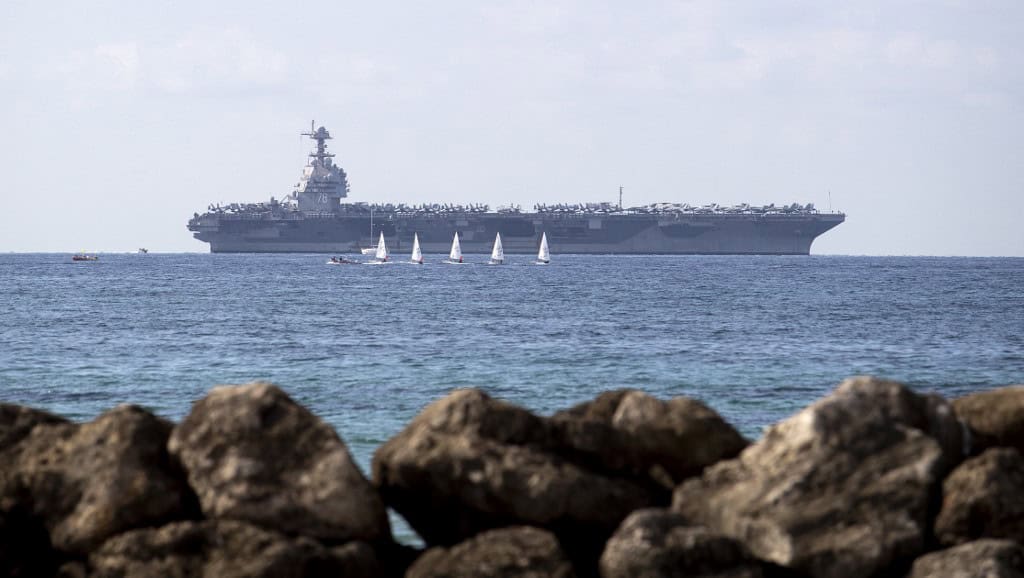
The world’s largest aircraft carrier joined on Tuesday the U.S. operation against drug trafficking from Latin America, which Venezuela insists is aimed at toppling President Nicolás Maduro. The arrival of the USS Gerald Ford in the region coincided with a new Venezuelan military deployment in response to “imperial threats” and with Russia’s condemnation of the bombings of boats allegedly carrying drugs.
The latest strike was Sunday in the Pacific. U.S. Defense Secretary Pete Hegseth reported the deaths of six people aboard two vessels. There have now been 20 boats bombed, with at least 76 people killed.
Since September, the United States has deployed warships, fighter jets, and thousands of troops in the Caribbean for these anti-narcotics operations, allegedly targeting trafficking from Venezuela and Colombia.
U.S. Naval Forces Southern Command said in a statement that the USS Gerald Ford, whose deployment was ordered nearly three weeks ago, has entered its area of responsibility, which covers Latin America and the Caribbean.
“It will strengthen the United States’ ability to detect, monitor, and dismantle illicit actors and activities that compromise the security and prosperity of U.S. territory and our security in the Western Hemisphere,” said Pentagon chief spokesperson Sean Parnell.
The United States has not yet presented evidence that the boats were being used for drug trafficking. CNN reported that Britain will not share intelligence with the United States on boats suspected of drug trafficking so as not to become complicit in these bombings, which sources cited by the network say are illegal. It is a rupture between two key allies.
Clashing with Donald Trump over the U.S. campaign in the Caribbean and the Pacific, Colombia’s President Gustavo Petro also ordered on Tuesday the “suspension” of intelligence sharing with Washington’s security agencies. “All levels of public-force intelligence are ordered to suspend the sending of communications and other dealings with U.S. security agencies,” Petro announced he often refers to these strikes as “extrajudicial executions.”
Russia—an adversary of the West and a key ally of Maduro—called the bombings “unacceptable.” “This is generally how lawless countries act, those that consider themselves above the law,” said Russian Foreign Minister Sergey Lavrov on television, calling the U.S. anti-drug rationale a “pretext” for the attacks.
Massive deployment
Venezuela early Tuesday activated new military exercises nationwide to respond to what it considers U.S. “imperial threats.” The government announced a “massive deployment of land, air, naval, riverine, and missile assets.”
State broadcaster VTV showed the mobilization of rifle-armed soldiers. Defense Minister Vladimir Padrino said 200,000 personnel took part in the exercise, although in cities like Caracas no military movement was observed. Such announcements are frequent and widely promoted by the government, though they do not necessarily translate into visible operations on the ground.
“Venezuela must know that there is a Venezuela that is guarded, protected, defended,” Padrino said, accusing U.S. service members of being “mercenaries.” “They are killing defenseless people, whether or not they are drug traffickers, executing them without due process,” he argued.
Maduro also signed a law to defend the country against the U.S. military deployment. Although its contents are not yet public, the president said it provides for the legal creation of “Integral Defense Commands.” “If we, as a republic and as a people, had to go to armed struggle to defend this sacred legacy of the liberators, we are ready to win,” he said. On Monday he asserted that his structure has the “strength and power” to respond to the United States.
Maduro has called for enlistment in the Bolivarian Militia, a component of the Armed Forces made up of civilians with a highly ideological profile. Donald Trump’s administration accuses Maduro of heading a drug-trafficking cartel and even authorized CIA operations in Venezuela.