

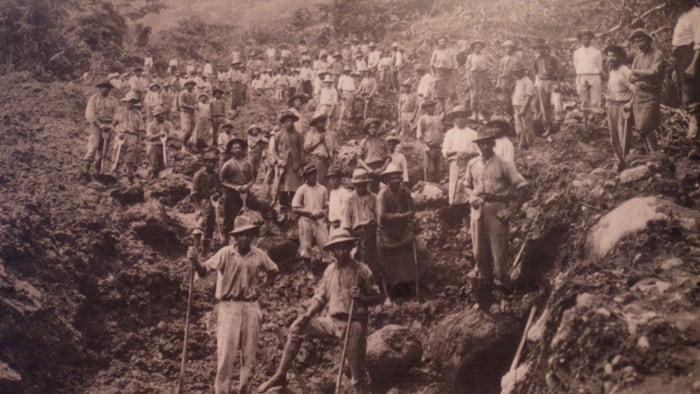
Few stories in Costa Rican history are as dramatic, costly, and consequential as the construction of the railroad connecting San José to the Caribbean port of Limón. It took nineteen years to build, claimed thousands of lives, transformed the country’s economy, and gave birth to one of the most powerful agricultural corporations in the history of the Americas. For more than a century, it carried passengers, coffee, and bananas across some of the most unforgiving terrain in Central America until a single earthquake brought it all to an end.
The project was born out of necessity. In the 1860s and 1870s, Costa Rica’s coffee industry, the lifeblood of its economy, depended on a painfully slow export route. Sacks of coffee were hauled by oxcart to the Pacific port of Puntarenas, then shipped around the tip of South America before reaching European markets.
President Tomás Guardia saw a railroad to the Caribbean as the answer. In 1871, the government signed a contract with American engineer Henry Meiggs, famous for building railroads through the Andes, to construct a narrow-gauge, steam-driven railway from Limón to Alajuela, passing through San José and Heredia.
Meiggs brought his young nephew, Minor Cooper Keith, then just 23 years old, from New York to help oversee the work. When Meiggs died in 1877, Keith took full control and with it one of the most grueling construction challenges of the nineteenth century. The terrain was merciless. Starting at sea level on the Caribbean coast, the route climbed more than 4,500 feet in roughly 50 miles, cutting through dense jungle, crossing enormous rivers, and navigating the volcanic highlands. Disease was rampant.
Within the first 25 miles alone, an estimated 4,000 men died, among them three of Keith’s own brothers. Workers were recruited from Jamaica, China, and Italy. To feed them, Keith began planting bananas along the rail corridor, a practical decision that would later change everything.
By 1882, the Costa Rican government ran out of money, and the project stalled. Keith traveled to England, secured new financing, and renegotiated the country’s debts with London banks. In exchange, he received a 99-year tax-free lease to operate the railroad and 800,000 acres of land along the route. Construction resumed, and on December 7, 1890, the first through train ran from Limón to San José.
The journey itself was unlike any other. The entire trip from San José to Limón took roughly 8 to 11 hours, with 55 stops, winding through some of the country’s most spectacular and remote landscapes. The train departed from the Estación al Atlántico near downtown San José and made its way through Cartago and Paraíso before descending into the Reventazón River valley. Key stops along the route included Tucurrique, Peralta, and Turrialba, each offering a welcome break about two hours into the journey.
From Turrialba, the tracks followed the river deeper into the lowlands, passing through the long Peralta tunnel, which cut through solid rock, and across dizzying trestle bridges suspended above jungle gorges. The train then rolled into Siquirres, roughly four hours from San José, the most celebrated stop on the entire line.
Vendors swarmed the cars carrying trays of sliced pineapple, mango, roasted cashews, corn tortillas, fresh juices, and cooked pejibayes, selling through the open windows during the fifteen-minute pause. From Siquirres, the train continued through La Junta and across the tropical lowlands, the heat rising steadily with each kilometer, until the blue waters of the Caribbean finally came into view and the train pulled into Limón.
The passenger cars themselves were simple and beloved. Wooden benches were bolted to the floors, and windows opened like those on old public buses, letting in the jungle air, the smoke from the engine, and the sounds of the forest. Passengers learned to shut their windows when entering tunnels to avoid being engulfed in locomotive smoke. The cars were always crowded with locals, merchants, and workers, all sharing the same wooden seats and the same long, unforgettable ride.
But even as the train became a beloved institution, Keith’s banana experiment had already grown into something far larger. The empty railcars returning from Limón were soon filled with bananas bound for the United States, where demand proved immediate and enormous.
In 1899, Keith merged his banana operations with the Boston Fruit Company, and the United Fruit Company was born, becoming one of the most powerful and controversial corporations of the twentieth century.
The railroad continued operating for a century. By the late 1980s, it was aging and financially struggling. Then, on April 22, 1991, a powerful earthquake struck the Limón area, severely damaging the rail lines, particularly along the Pacuare River. The tracks were never repaired. Service was shut down, bringing to an end a century of slow, remarkable journeys through the heart of Costa Rica to the sea.





