

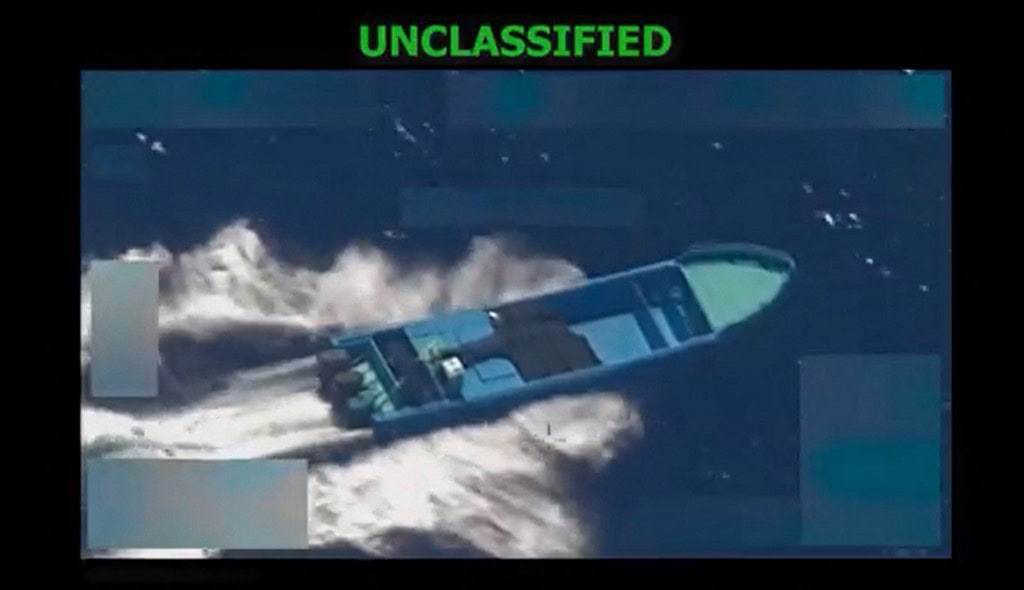
The United States military carried out its first strike in the Pacific Ocean against a boat suspected of drug trafficking, killing two people near Colombia’s maritime territory. This action marks a shift from previous operations in the Caribbean and heightens friction between Washington and Bogotá.
A source from Colombia’s armed forces confirmed to reporters that the incident happened close to the country’s maritime boundaries but did not enter its exclusive economic zone. The Pentagon described the vessel as part of narcotics smuggling networks, traveling a common route for such activities. Officials stated the boat held illegal drugs, though they released no immediate proof.
Defense Secretary Pete Hegseth shared details on social media, posting a short video that shows the boat speeding through open water before an explosion engulfs it in flames. He called the deceased “narco-terrorists” and linked the operation to broader efforts against groups the U.S. labels as terrorist organizations involved in the drug trade.
This strike brings the total fatalities from U.S. actions in the region to at least 34. Seven earlier attacks targeted boats in the Caribbean Sea, mainly off Venezuela’s coast, resulting in 32 deaths. Two survivors from one of those incidents, one from Ecuador and one from Colombia, received medical care and returned to their home countries. Ecuadorian authorities later freed their citizen, citing a lack of evidence for charges.
President Donald Trump’s administration launched this campaign in early September, deploying ships, aircraft, and troops to combat what it calls a threat to American security. The White House argues that certain cartels qualify as terrorists, allowing lethal force under laws for armed conflicts. Critics question the legal basis, pointing out that drug trafficking differs from traditional warfare and lacks judicial oversight for targets.
Colombian President Gustavo Petro responded sharply, labeling the strike as murder and a breach of international rules. “The attack on another boat in the Pacific killed people,” he posted online. “Whether in the Caribbean or Pacific, the U.S. government strategy breaks the norms of international law.” Petro has clashed with Trump over these operations, accusing them of harming civilians and straining alliances.
Trump fired back, claiming Petro encourages drug production despite U.S. aid. He halted payments to Colombia, saying the country failed to curb the flow of cocaine, which originates largely from there. Colombia produces most of the world’s cocaine, with much of it shipped via the Pacific to North America. Experts note that while the Caribbean sees some traffic, the Pacific handles about 75% of Colombian exports.
The move to the Pacific opens a new area in the operation. A second strike followed quickly on Wednesday, killing three more on another boat in the same region, pushing the death toll to 37. Hegseth confirmed both vessels operated by groups tied to smuggling and promised no safe haven for such networks.
This escalation worries regional leaders. Venezuela’s government protested earlier strikes near its waters, seeing them as attempts to destabilize President Nicolás Maduro. Colombia, a longtime U.S. partner in anti-drug efforts, now faces strained ties. Joint programs once focused on interdiction and eradication, but these unilateral attacks bypass cooperation.
Human rights groups raise alarms over the lack of transparency. The U.S. provides no names of the dead or detailed evidence of their involvement. Survivors’ repatriation avoids U.S. trials, leaving questions about accountability.
In Costa Rica, officials monitor the situation closely. The country sits between major production and transit zones, relying on international partnerships to fight organized crime. Local authorities report increased drug seizures in Pacific ports, highlighting the trade’s impact on Central America.
As tensions rise, diplomats call for dialogue. The U.S. defends the strikes as necessary to protect its citizens from overdose deaths, mostly from fentanyl but also cocaine. Yet the strategy draws fire for risking broader conflict in Latin America.
The Pentagon plans more operations, with forces positioned across both oceans. Observers watch for responses from affected nations, which could reshape security dynamics in the hemisphere.





