

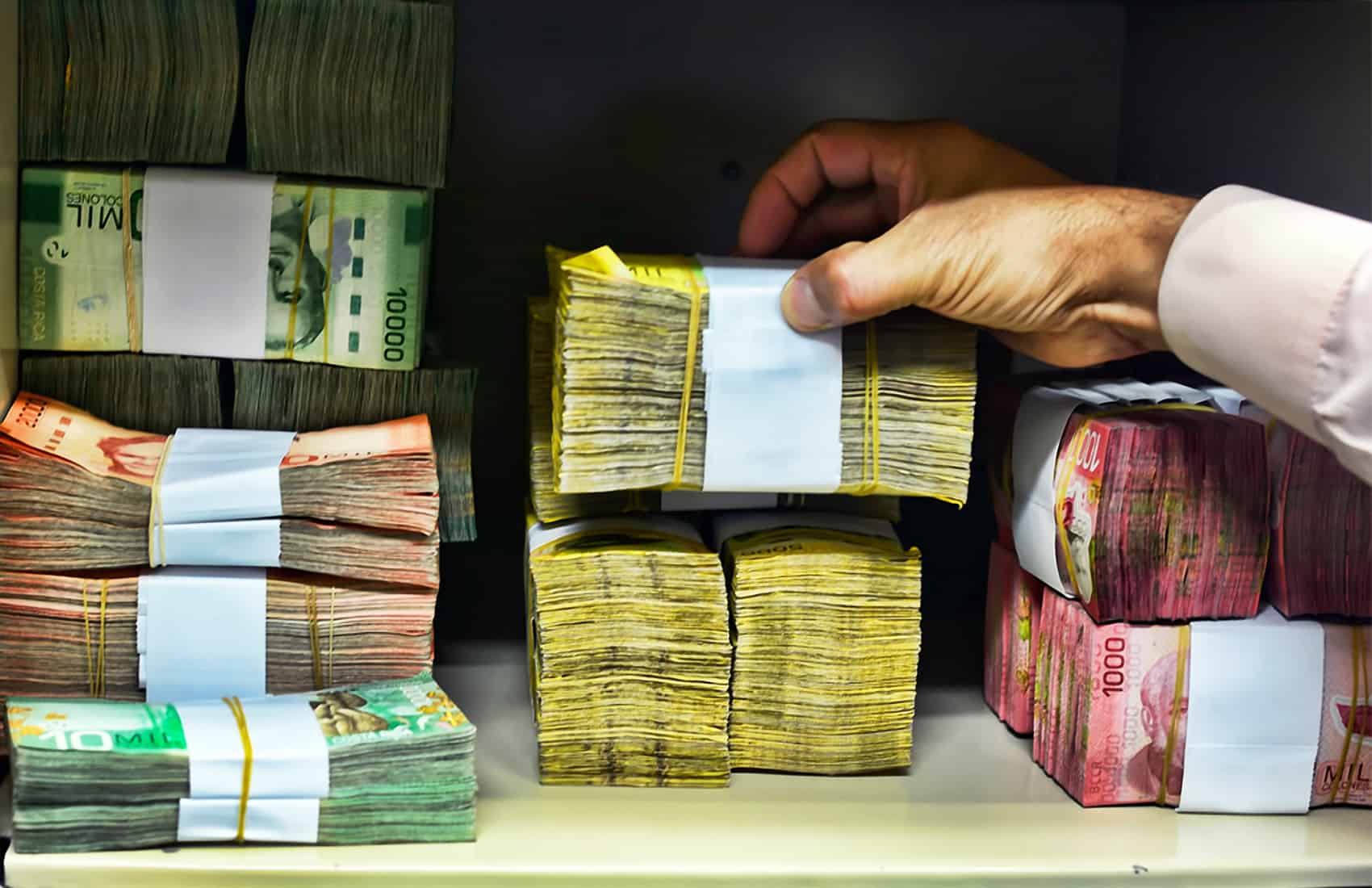
The exchange rate has been an important topic during the administration of President Rodrigo Chaves. The strong appreciation of the Costa Rican currency has brought a lot of uncertainty for different sectors.
Authorities at the Central Bank of Costa Rica (BCCR) have pointed out on several occasions that the dollar exchange rate has stabilized. Last year, the U.S. currency closed at ¢511.27, and as of July 23, 2025, the average value on the Foreign Exchange Market (Monex) was ¢506.20.
According to the BCCR, the country continues to record a surplus, meaning that supply exceeds demand. From January 1 to July 23, the average daily surplus was $28.5 million, $0.4 million more than in the same period in 2024. The cumulative surplus for those months reached $4,017.9 million.
However, the bank notes that it acquired part of that surplus ($3,295.1 million), which allowed it to increase its financial shield and meet the requirements of the Non-Banking Public Sector (SPNB). The bank acquired 60.2% of what was traded in the market up to July 23.
Experts have weighed in and shared their economic predictions regarding the exchange rate for the rest of the year.
The coordinator of the Economic and Social Observatory at the National University (UNA), Roxana Morales, estimates that the exchange rate will remain between ¢507 and ¢517 for the rest of the year. She pointed out that there are no absolute certainties in economics, and the exchange rate is no exception. She explained that multiple factors could generate pressure for the price of this currency to rise (upward) or fall (downward).
On the one hand, there could be fewer dollars in the market, and due to this lower supply, their price could rise. The lower flow of dollars could be due to fewer tourists and a decrease in Foreign Direct Investment (FDI). Both scenarios could occur because of economic uncertainty in the United States caused by the tariff changes imposed by President Donald Trump.
A third effect of tariffs is that exports could decline, as the United States is Costa Rica’s main trading partner. This would also reduce the amount of dollars in our country.
She mentioned are ongoing geopolitical conflicts that could raise the price of raw materials on the international market. This would mean that importers would need more dollars to bring in supplies. Faced with higher demand, the price could also rise.
A similar forecast is made by Adriana Rodríguez, general manager of Acobo Puesto de Bolsa. She believes that during the last quarter of the year, scheduled dollar sales will keep the exchange rate low, as it is currently. These events include tax payments and year-end bonuses, which require companies to bring in dollars to meet their obligations.
“There is a lower supply of dollars, which, although it is premature to draw conclusions, could be an indication of a less surplus market as a result of lower economic dynamism in certain foreign exchange-generating sectors,” Rodríguez said.
The economist also referred to the departure of semiconductor companies Intel (partial departure) and Qorvo (total departure). She explained that this situation has several impacts on the foreign exchange market: it reduces the inflow of dollars for payroll payments, which lowers the surplus in the foreign exchange market; it reduces the flow of dollars that previously existed as a result of semiconductor exports; and it will affect a chain of suppliers that will experience lower levels of activity depending on the currency in which they conducted their transactions.
Experts agree that the outlook may change in 2026, depending on the results of the upcoming election in February.





