

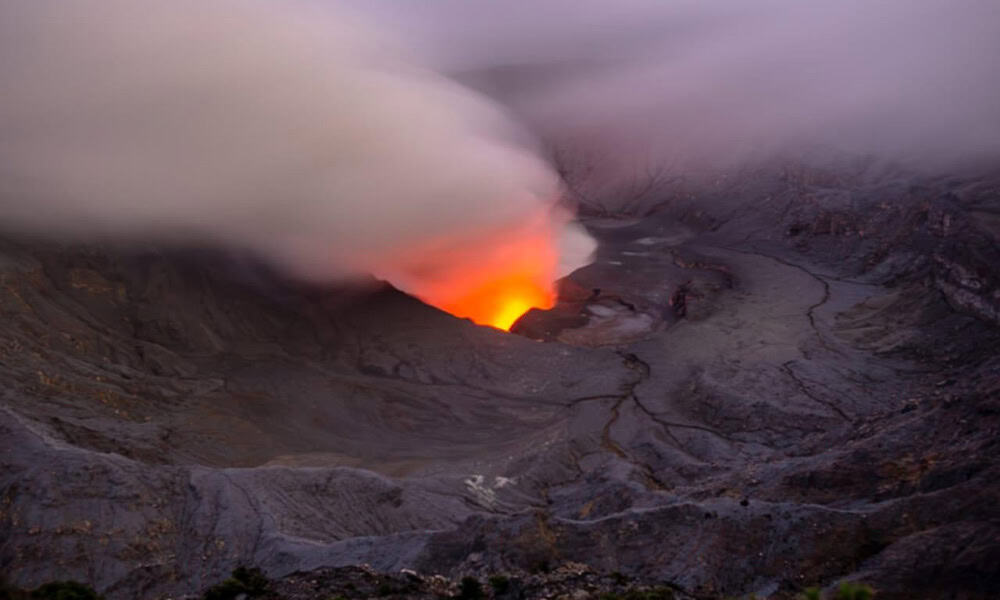
Mouth A of Costa Rica’s Poás Volcano continues to release gases so hot that incandescence is visible even during the day—a rare phenomenon not previously documented, according to the Volcanological and Seismological Observatory of Costa Rica (OVSICORI). This persistent activity, first observed in April, points to intense magmatic processes close to the surface.
Volcanologist Maarten de Moor of OVSICORI said he recently saw something unprecedented. “Last Thursday, I observed incandescence during the day for the first time, something we had never seen before. This indicates that the gases are extremely hot, and the rocks behind or in contact with them can reach temperatures of 800°C or more.”
Poás Volcano’s main crater is divided into several vents, known by scientists as “mouths,” and labeled alphabetically for monitoring purposes. These labels help researchers track activity at each vent, with Mouth A and Mouth C being the most active and closely observed. Mouth A is currently dry, allowing magmatic gases to escape freely without condensing. This vent is likely connected to a very shallow magmatic body, producing the high heat and rare visible glow.
In contrast, Mouth C contains the volcano’s acidic crater lake, which has an average temperature of around 60°C. From this vent, a prominent white plume of water vapor rises, easily visible from the park’s viewpoint. While gases from Mouth A are nearly transparent and visible mainly when carrying small amounts of ash, Mouth C’s plume remains a familiar sight for visitors.
In recent days, Poás experienced two minor eruptions. The first, on July 27 at 2:44 a.m., ejected incandescent fragments into the crater, landing less than 50 meters from Mouth A. The second, on July 30 at 4 p.m., produced a brief ash emission lasting under one minute and coincided with the reopening of Poás Volcano National Park.
Both eruptions followed a slight increase in seismic tremor, which later returned to normal levels. Monitoring systems now indicate stability in the volcano’s deformation, with even slight deflation suggesting a small decrease in underground volume.
De Moor noted that the volcano remains highly active in terms of degassing but emphasized that it is stable activity. He added, “Because of the high gas output, there’s always a risk of a blockage in the conduits, which could trigger an unexpected eruption.”
Despite the ongoing degassing, sulfur dioxide (SO₂) and sulfur oxides (SOx) levels at the viewpoint remain low thanks to strong winds dispersing the gases. De Moor explained that as long as strong winds continue, air quality should remain stable, but OVSICORI and park officials continue to monitor gas emissions closely and advise visitors to follow all park safety instructions.
The Ministry of Environment and Energy (MINAE), through the National System of Conservation Areas (SINAC), recently launched night tours at Poás Volcano National Park. These guided hikes allow visitors to witness the rare incandescence of Mouth A after dark, an experience never before offered at the park.
Franz Tattenbach, Minister of Environment and Energy, described the initiative as “a unique opportunity to promote scientific, responsible, and inclusive tourism in Costa Rica,” adding that such activities also help raise public awareness about volcanic processes and the value of the country’s protected areas.
Tickets for the first night hike sold out within hours of their announcement. SINAC has urged the public to avoid purchasing tickets from unauthorized operators and to rely only on official channels for future dates.
While Poás remains stable, experts emphasize that its activity is a reminder of the volcano’s power. Travelers planning a visit should check official updates from SINAC and OVSICORI, be prepared for possible changes in access if volcanic conditions shift, and take advantage of the new night hike program, which provides a safe way to view the crater’s incandescence.
Poás Volcano continues to offer a rare glimpse into Costa Rica’s dynamic geology, attracting both scientists and tourists eager to witness this extraordinary event.





