
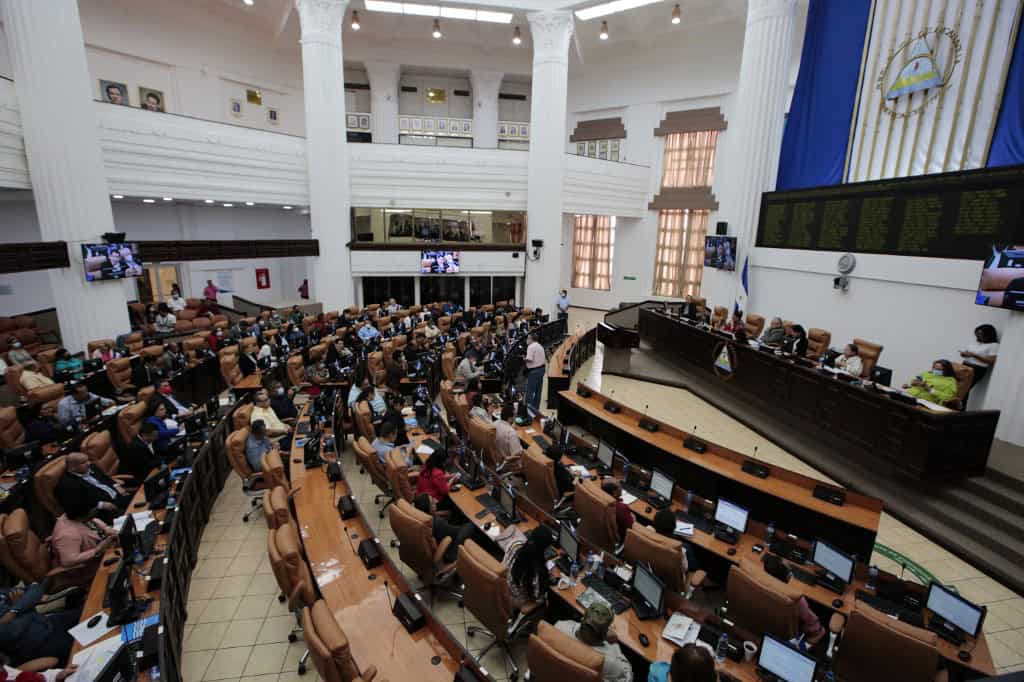
A package of legal reforms recently approved in Nicaragua is seen by experts and opponents as an attempt to “legitimize” the persecution of critics of President Daniel Ortega, both inside and outside the country. These reforms include changes to the Penal Code that allow for the prosecution of individuals who engage in actions against Ortega’s government abroad, as well as amendments to the cybercrime law, which open the door to convicting individuals for social media posts.
Two other laws were also reformed: one now requires churches to pay taxes, and the other restricts the work of NGOs, which can now only operate in joint programs with state entities. (Ortega has shut down approximately 5,500 NGOs and confiscated their assets.)
These initiatives “aim to create a legal framework that legitimizes new practices that violate human rights,” lawyer Camila Ormar, from the NGO Center for Justice and International Law (Cejil), said.
“These reforms could be used to further intensify persecution and repression of Nicaraguans, even those in exile,” said Christian Salazar Volkmann, representative of the UN High Commissioner for Human Rights.
In an annual report on the situation in Nicaragua, the High Commissioner’s office warned of a “severe” deterioration under the Ortega government and his wife, Vice President Rosario Murillo, with arbitrary arrests of opponents, and reports of torture and other ill-treatment of detainees.
This report, discussed in Geneva in September by the UN Human Rights Council, was rejected by Nicaragua’s Attorney General, Wendy Morales.
This is not the first time
Supporters of Ortega argue that this package of reforms strengthens institutions and allows the government to combat “transnational” crime. “These reforms are aimed at strengthening the work of our country’s institutions responsible for addressing organized transnational crime,” said pro-government lawmaker María Auxiliadora Martínez in a parliamentary session.
However, Cejil’s lawyer pointed out that “this is not the first time that laws in Nicaragua have been reformed to criminalize those considered to be opponents or dissenting voices.” “Laws adopted or reformed by Nicaragua must comply with human rights treaties recognized by the state,” Ormar emphasized.
Ortega’s government has intensified repression since opposition protests in 2018, which left over 300 dead in three months, according to the UN. Since then, thousands of Nicaraguans have gone into exile, and hundreds have been expelled, with their assets confiscated.
The 78-year-old former guerrilla who ruled Nicaragua in the 1980s and returned to power in 2007 claims that the protests were an attempted coup sponsored by Washington.
Gag Law
The reformed Penal Code includes sentences of up to 30 years in prison for those who commit “crimes against the State or its institutions,” whether in Nicaragua or abroad. Meanwhile, the cybercrime law imposes penalties for social media posts and smartphone apps that cause “alarm,” with sentences of up to 10 years in prison.
Such penalties “are incompatible with the principle of legality established in the American Convention on Human Rights,” according to Cejil. Prosecuting individuals outside the country will lead to “trials in absentia,” warned the Cejil representative.
Justifying abuses
The reform of the cybercrime law intensified a regulation in place since 2020, dubbed the “gag law,” which led to the prosecution and arrest of many Nicaraguan opponents and journalists for allegedly “spreading false news.”
“These laws have resulted in the denationalization of many people,” Nicaraguan lawyer Salvador Marenco, exiled in Costa Rica, said, referring to Ortega stripping 451 exiled opponents of their nationality. Marenco stated that this “policy of transnational repression” is Ortega’s response to sanctions from the United States and the European Union.
Former Nicaraguan Ambassador Arturo McFields said that with these reforms, Ortega is attempting to “justify his abuses and crimes and also give legal legitimacy” to his repressive actions.
“They first carry out these actions on the ground and then attempt to structure a legal framework,” added the former ambassador to the Organization of American States (OAS), who is exiled in the United States.