
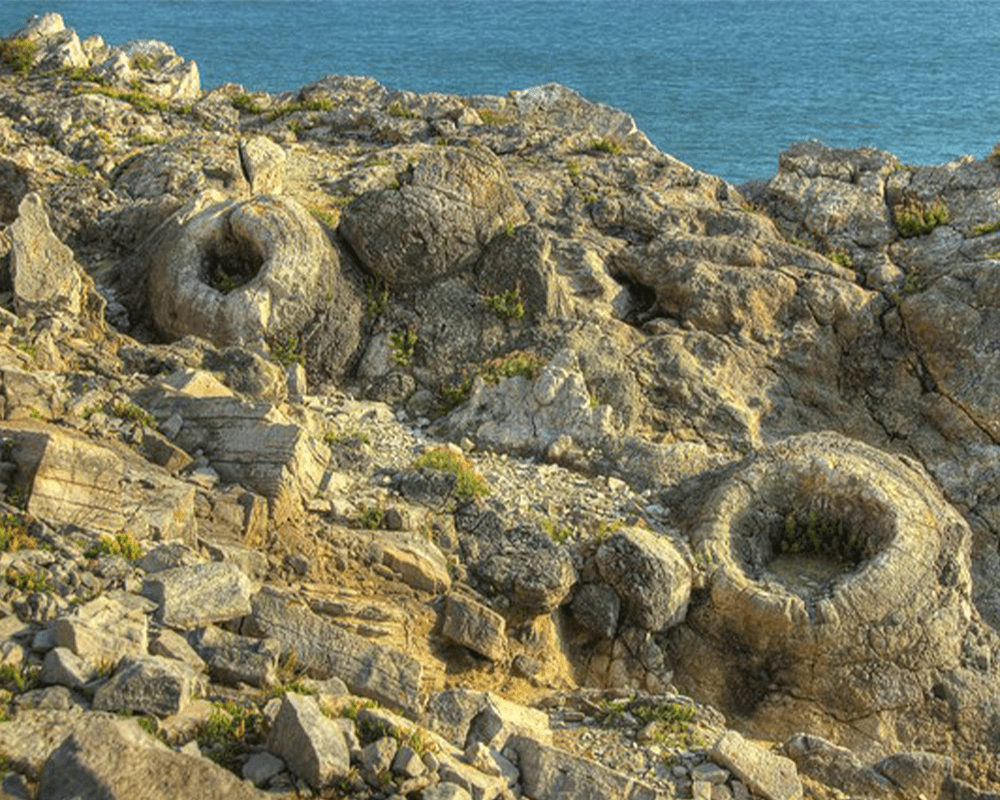
A team of researchers discovered a fossilized upright forest estimated to be 290 million years old in southern Brazil, considered a “window to the past” for the study of plant evolution.
The discovery of this set of 164 trunks of lycophytes (without fruits, flowers or seeds) of an extinct variety is “the most important in the southern hemisphere”, due to the quantity and quality of the preservation, explained Thammy Mottin, geologist and PhD from the Federal University of Paraná, who led the research with collaborators from the Federal University of Rio Grande do Sul and the University of California.
“With an estimated age of 290 million years, these plants represent very primitive forms in the history of the Earth,” said Mottin, who studies the post-glacial period, when the climate became warmer and more conducive to the emergence of dense forests like this one.
The discovery in the municipality of Ortigueira, in the state of Paraná, gives “access to the way the first plants colonized the environment, how they were distributed in space (…) and the interaction with the environment”, among other points, he said.
There were only two other similar findings in the southern hemisphere, but of smaller dimensions, in the Brazilian state of Rio Grande do Sul (south) and in Argentine Patagonia.
The Paraná forest was found at the end of 2018, when a road was opened in the area to give access to an industrial plant. Geologists went there to study the exposed rocks, but, to their surprise, they came across a fossilized forest.
Then, a long investigation began, published in February in the scientific journal “Palaeogeography, Palaeoclimatology, Palaeoecology”, of the Dutch group Elsevier, and recently published in the Brazilian press.
The peculiar preservation of this forest was possible because the trees “were quickly buried when they were alive, and were progressively covered by sediments, until they died by asphyxiation,” explained Mottin.
The event that “practically froze that forest the way it was” was a major flood of a river on whose banks the trees were located, the researchers determined.