

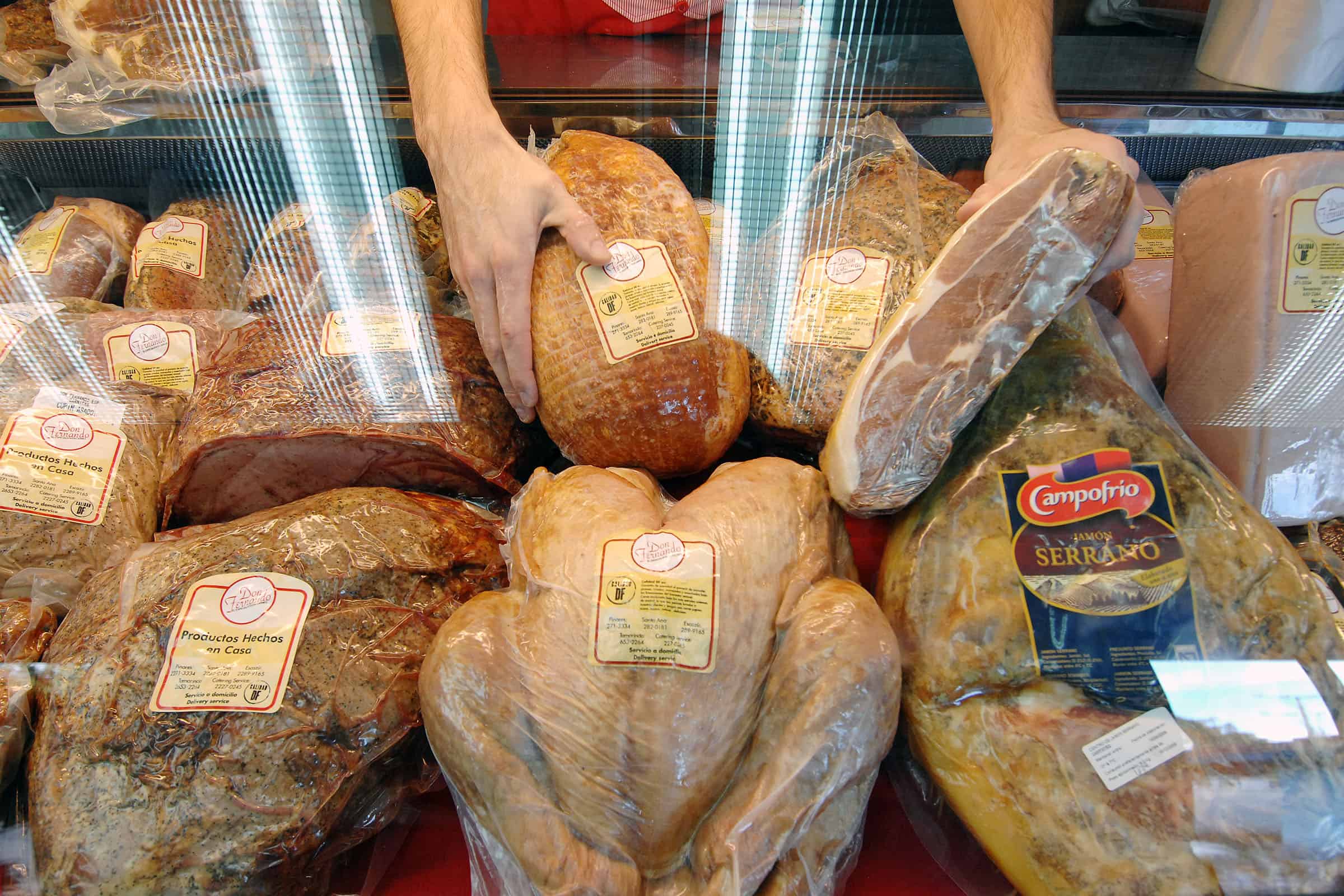
These days when people pack for a holiday in Costa Rica, they’re not likely to shove a frozen turkey in between the surfboard and camera. But some years ago, people coming from the United States in November or December may very well have had frozen turkeys hidden in their suitcases, evading the customs authorities who could make or break a traditional Thanksgiving meal.
Nearly every U.S. native who has lived here more than a couple decades has at least one story about a Butterball smuggling gone awry: missed or delayed flights resulting in the bird’s arrival outside of its best condition, or turkeys forgotten overnight in bags and not unpacked until the mess had already been made.
“One year, my friend’s daughter decided to raise turkeys in her backyard, but it turned out to be even more expensive than the really expensive imported turkeys you could sometimes find,” recalled Mindi Barbee, who has lived in Costa Rica with her husband for more than 30 years.
But the thrills and horrors of turkey smuggling are long gone. The decline of the pastime started more than a decade ago, when El Salvador began exporting affordable turkeys, Barbee said.
As more U.S. citizens have made Costa Rica their permanent home, the Thanksgiving celebration has grown: now, little is missing from the holiday feasts cooked here, although yams and fresh cranberries continue to be rare commodities. Today, restaurants throughout the Central Valley and in some beach areas offer Thanksgiving dinners as good as any that can be found in their U.S. counterparts.
“Things have certainly changed; you can get almost anything now,” said Mavis Biesanz, who first came to Costa Rica in 1942 and moved here permanently with her husband in 1971. Biesanz had recently came across old letters she wrote, in which she asked people coming here to bring a shopping list’s worth of ingredients for holiday feasts – cranberries, pecans, “all the goodies you couldn’t get at the time,” she said.
What Biesanz, Barbee and others couldn’t find, they improvised, using squash for pumpkin pie or blackberries for cranberry sauce.
Regardless of the recipe, they gave thanks just the same.
“We try to maintain the tradition…when my children were little, it was a way to remind them a little bit of American customs. We didn’t get back there too often when they were growing up, so it was a really nice way to remind them, and of course a nice holiday to say thank you for everything,” Barbee said.
The early celebrations of Thanksgiving in Costa Rica may have been closer to the original feast on which the more than- 300-year-old holiday is based. Pilgrims in 1621 likely didn’t have sweet potatoes, pumpkin pie, corn on the cob or cranberry sauce, either. However, the first feast probably included wild turkey, goose, lobster, clams, walnuts, acorns and carrots, all seasoned with olive oil, leeks and parsnips, according to historians at Plimoth Plantation in Plymouth, Massachusetts.
Historians have tried for ages to distinguish between fact and fiction regarding what is considered the first Thanksgiving in 1621. As the story goes, after the Pilgrims landed on Plymouth Rock on Dec. 11, 1620, they were devastated during their first winter. By the following fall, more than 40 of the original 102 passengers on the Mayflower had died. That season’s harvest was bountiful, and the Pilgrims celebrated with a feast, inviting dozens of natives who had taught them farming techniques.
The holiday was not repeated annually right away, although similar feasts of thanks were held periodically. In October 1777, all 13 colonies joined in a thanksgiving celebration for the first time, but it was a one-time event. Since then, various U.S. Presidents declared days of thanksgiving, but it was not until 1863, when President Abraham Lincoln proclaimed a national Thanksgiving Day to be celebrated on the final Thursday in November, that it began to be celebrated every year.
Prior to the mid-1800s, Thanksgiving had nothing to do with the 1621 harvest celebration, Pilgrims or native people, according to historians at Plimoth Plantation. Thanksgiving was a holiday to celebrate family and community based on Puritan days of fasting and rejoicing, declared by the governor of each colony every autumn.
The notion that Pilgrims and natives feasted together in 1621 stood in sharp contrast to the battles between pioneers and indigenous groups that raged across the frontier, resulting in the slaughter of masses of indigenous people.
“The association between Pilgrims, natives and Thanksgiving became stronger after 1890, when the census revealed the western frontier to be closed, and the ‘Indian Wars’ ended,” according to the Plimoth Plantation Web site.
In 1939, U.S. President Franklin D. Roosevelt declared Thanksgiving to be the next-to-last Thursday of November, rather than the last, in order to give merchants a longer time to sell goods before Christmas and help the country, which was suffering during the Depression, according to online encyclopedia Wikipedia.com.
The change was not popular among everyone, and in 1941 the U.S. Congress resolved the problem by establishing that the holiday would be the fourth Thursday in November, making it sometimes the last and sometimes the second-to-last Thursday.
For Thanksgiving 2021 we looked back on a 2005 piece that, in turn, looked back on Thanksgivings past in Costa Rica.





