
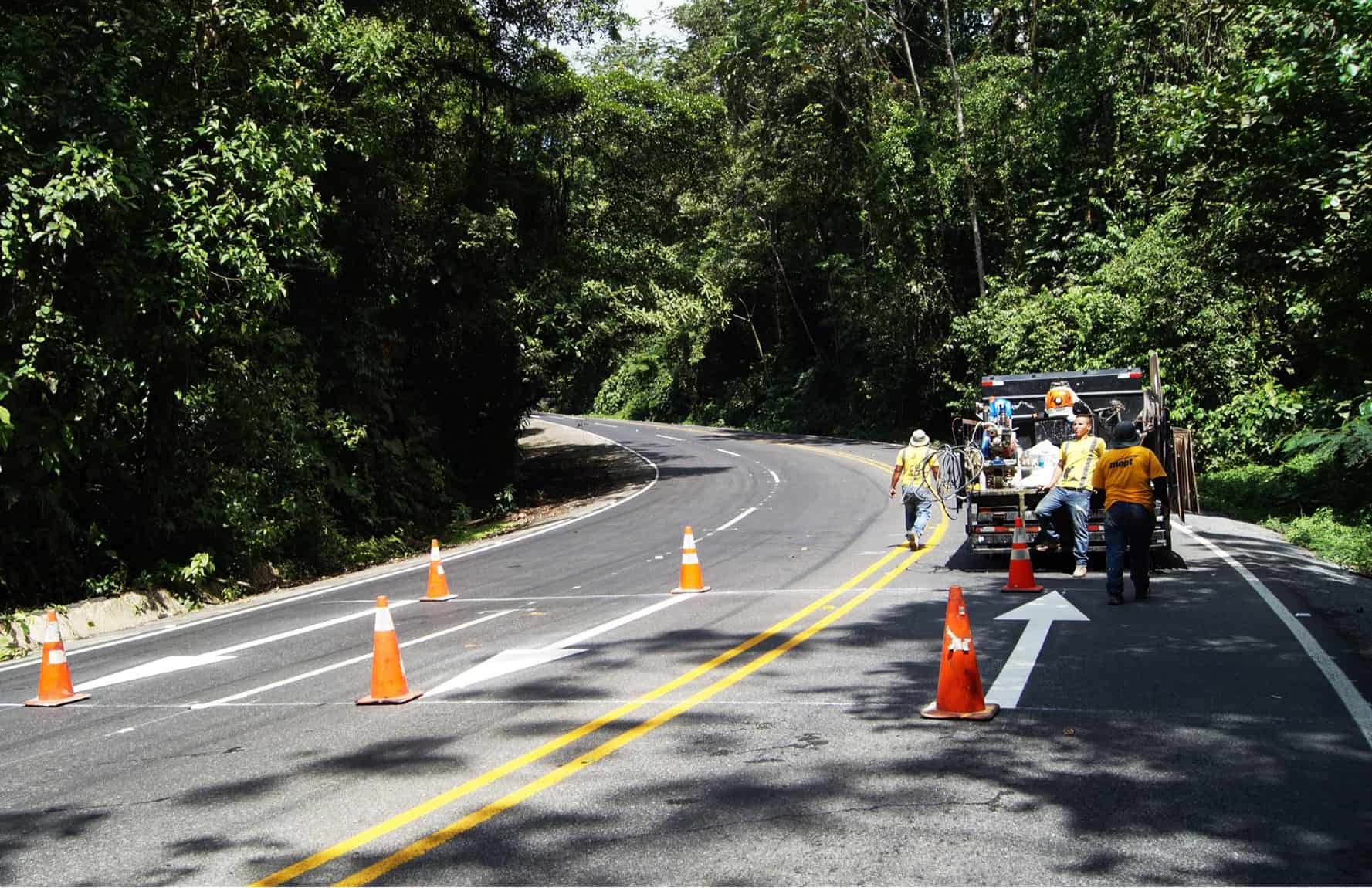
The percentage of Costa Rican roads in good condition increased over the past two years, the University of Costa Rica‘s National Laboratory of Materials and Structural Models (LANAMME) reported Wednesday. However, the laboratory’s “Seventh Report on the Status of the National Roadway Network” also characterized the country’s roadway maintenance strategy as reactive and poorly planned.
The National Roadway Council (CONAVI) repaired and maintained nearly half of the national roadway network during the period covered in the report. However, the number of roads in very bad condition also increased, researchers found.
The coordinator of LANAMME’s Transport Infrastructure Program, Luis Loría, said at a press conference that, in general, the national roadway network is still unstable, “because CONAVI mostly repaves roads instead of making in-depth repairs.”
The new layers of asphalt or cement are laid over damaged roads, so they are quickly destroyed.
“It’s pretty much like putting on make-up,” Loría said.
Results
Costa Rica has 5,053 Kilometers (3,140 miles) of paved roads. Of these, 1,913 Km (1,189 miles) were in good condition in 2015.
Two years later, the figure of roads in good condition rose to 2,456 Km (1,531 miles). This means that good roads increased from 38 to 48 percent of the total, LANAMME found.
However, the number of miles in poor condition, that is, requiring deep repairs or total rebuilding, increased by 71 percent, from 279 to 478 Km (173-297 miles).
Of the 48 percent of roads that are in good condition, 36 percent are in regular condition, while 5 percent require minor repairs.
Roy Barrantes, the coordinator of the study, said that the most significant result is that the number of roads in regular condition decreased.
“That means road conditions either improved or got worse in the past two years,” he said.
Public investment
The LANAMME study concluded that the government lacks a coherent policy for the maintenance or improvement of the country’s roadway network.
The laboratory noted that CONAVI maintains a reactive road policy: they work on a road only when crews find a pothole or other damage.
During the past two years, CONAVI allocated ₡14 billion ($24.6 million) for repairs along 907 Km (564 miles) of roads “without achieving the expected results,” the report says.
That figure represents 11.5 percent of the ₡122 billion ($213.7 million) invested in maintaining all the country’s paved roads for a year.
CONAVI invested that money mostly in fixing potholes and correcting irregularities on the surface, “but those roads actually required major repairs,” the report adds.
LANAMME investigators also found several cases of roads where asphalt or cement layers did not have the required thickness to withstand vehicle traffic, so that “those layers deteriorated faster than expected.”
Loría said LANAMME recommends that CONAVI change the way it creates contracts for building or fixing roads. Lab experts believe the agency should assign contractors a certain number of routes, and require them to keep them in good condition for a certain period of time.
Currently, CONAVI only signs maintenance contracts when crews find potholes or other problems on a road.