

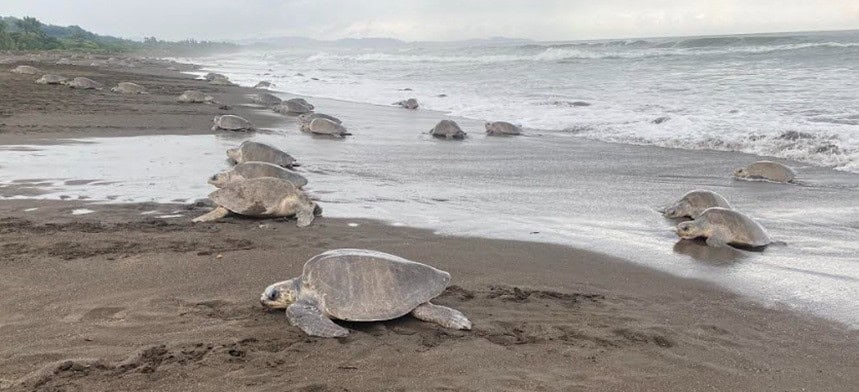
Costa Rica’s Ostional National Wildlife Refuge in Guanacaste has recorded an extraordinary mass nesting event involving approximately 347,000 female olive ridley sea turtles, lasting more than 50 days. The phenomenon, which began in September 2026, has drawn the attention of environmental authorities and researchers because of its exceptional duration and magnitude.
According to the Ministry of Environment and Energy (MINAE), available historical records contain no documented nesting event with comparable characteristics in Ostional or elsewhere in the world. Known as an arribada, this natural phenomenon occurs when large numbers of female sea turtles emerge from the ocean to lay their eggs on the same beach.
Although Ostional experiences multiple arribadas throughout the year, the duration of this event distinguishes it from previous nesting episodes. Park rangers from the Tempisque Conservation Area, part of the National System of Conservation Areas (SINAC), worked alongside researchers from the Foundation for the Balance between Conservation and Development (FUNDECODES) to monitor nesting activity day and night.
Historical figures released by MINAE illustrate the magnitude of the event. In 2021, the busiest month, September, recorded approximately 307,000 female turtles, while November 2022 registered around 206,000. The busiest nesting months in 2023, 2024 and 2025 recorded approximately 111,000, 160,000 and 190,000 females, respectively.
Costa Rica has recorded 11 arribadas in Ostional so far in 2026. The event that began in September stands out because of its prolonged duration and the number of turtles involved. The cause of the unusual behavior has not been determined. One hypothesis proposed by environmental authorities is that turtles originating from different regions of North and South America converged in Ostional during the same period.
MINAE said further scientific research and analysis of the monitoring data will be needed to establish whether this explains the phenomenon.Carlos Pizarro, administrator of the Ostional National Wildlife Refuge, emphasized the importance of continuous monitoring to understand the event and compare the findings with historical records.
Environmental authorities also recognized the contribution of the local community to protecting nesting beaches and supporting conservation efforts. Ostional is internationally recognized as one of the most important nesting sites for olive ridley sea turtles (Lepidochelys olivacea), and researchers there are also studying the turtles’ exposure to pollution.
Anyone going to the beach during an arribada must enter with an authorized local guide, a rule covered in our Guanacaste turtle season article. Touching turtles and disturbing nests are not allowed, and flash photography is prohibited during nighttime nesting.





