

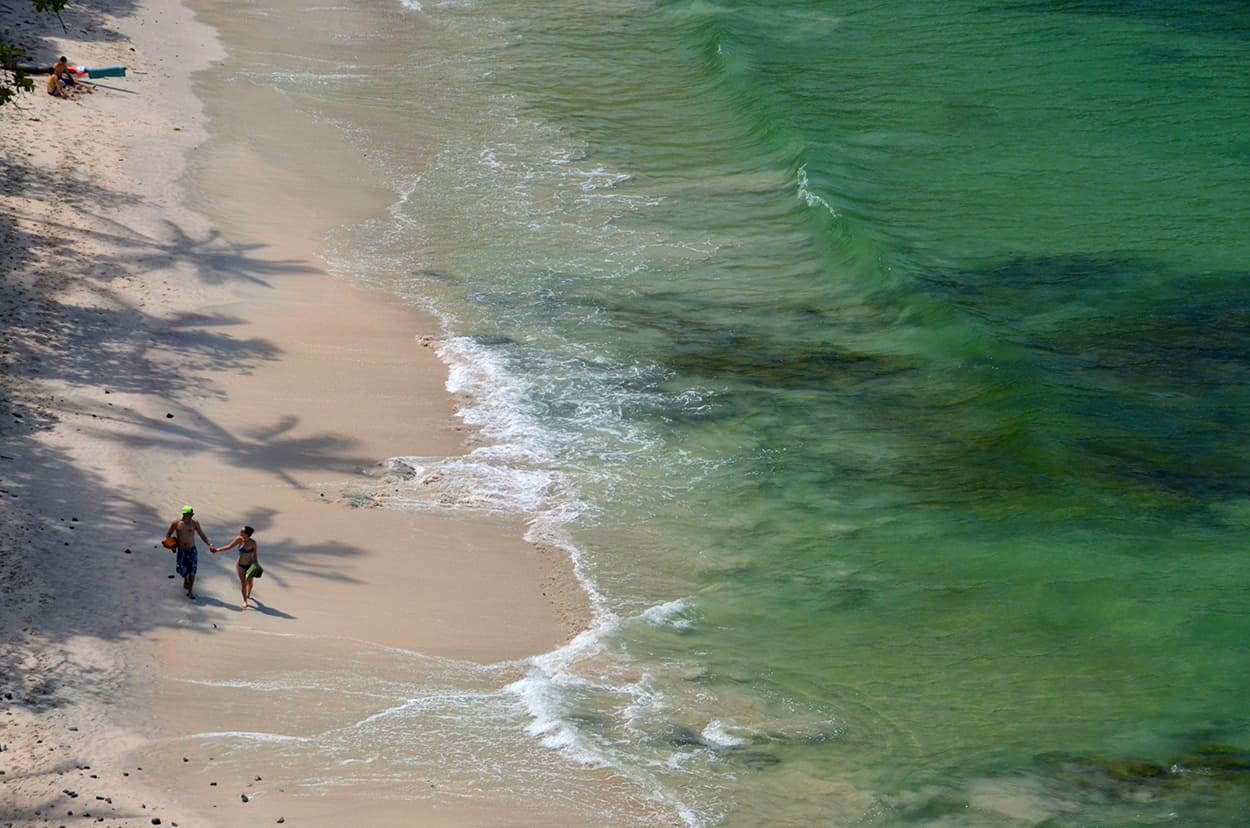
A Costa Rican court has temporarily suspended visitor and vehicle access to the Playa Blanca Marine Wetland in Garabito. The tribunal said public use cannot continue unchecked in a protected area that still has no management plan 32 years after it was created. The Contentious-Administrative Tribunal issued the precautionary order on Wednesday, Sept. 23. It covers the areas of direct and indirect access to the wetland, which lies southwest of the Punta Leona tourist complex on the Central Pacific coast.
The suspension will remain in place until the Ministry of Environment and Energy (MINAE) and the National System of Conservation Areas (SINAC) complete a scientific carrying-capacity study for the ecosystem. That study must set the conditions, limits and forms of visitation compatible with conservation. The measure can also end if a final judgment is issued in the underlying case.
Judge Víctor Orozco Solano signed the resolution. He was responding to an early precautionary request filed by environmental lawyer Wálter Brenes Soto in a lawsuit against the State, represented by the Attorney General’s Office, and SINAC. The order is provisional and does not decide the merits of the case. The court gave the State and SINAC three days to respond in writing and submit evidence.
In granting the measure, the tribunal found that the request met the standard of necessity and extreme urgency. It pointed to the risk of harm to the constitutional right to a healthy and ecologically balanced environment. It also cited the preventive and precautionary principles, along with in dubio pro natura, the legal doctrine that scientific uncertainty should be resolved in favor of nature.
In his filing, Brenes argued that the missing management plan threatens the wetland’s survival. He said no study establishes how many people and vehicles can enter the protected area, directly or indirectly. Brenes has said he went to court after noticing a sharp rise in visitors once access to Playa Blanca opened. He alleged that some visitors were drinking alcohol, playing music, lighting bonfires, camping and staying overnight. He also noted that the area has no public restrooms and no system for handling visitors’ waste.
SINAC has previously described a different situation. In an earlier constitutional case, the agency reported that a July 22 inspection found no significant tourist visitation inside the wetland. It added that urban development lies outside the wetland’s official boundaries. SINAC acknowledged, however, that a management plan would help it assess and reduce indirect impacts from the surrounding area.
The new order builds on a ruling by the Constitutional Chamber, known as Sala IV. In resolution 2026-033118, dated Aug. 27, the magistrates upheld an amparo appeal also filed by Brenes. They ordered MINAE and SINAC to issue a General Management Plan for the wetland within 12 months of being notified.
That plan is still neither approved nor in force. That gap led Brenes to seek the new precautionary measure. The suspension comes less than four months after the Municipality of Garabito removed the barrier that controlled vehicle entry through Punta Leona. The municipality cited a court ruling that recognized the access road as public. Since then, anyone has been able to reach the beach without being a guest or member of the resort and without paying to use the road.
Punta Leona maintains that the road crosses private land and that Playa Blanca has always had a separate official public access. The dispute over access at Punta Leona remains before the courts. The wetland was declared a protected wildlife area on April 7, 1994 and SINAC administers it through the Central Pacific Conservation Area (ACOPAC).
It covers about 5.5 square kilometers (2.1 square miles) from the shoreline, including marine waters up to six meters (20 feet) deep at low tide. It is the only marine wetland on Costa Rica’s Central Pacific coast. It is known for its coral and rocky reefs and as a nesting site for olive ridley sea turtles. It is also home to parrotfish, whose feeding helps produce the white sand that gives the beach its name.
As of this writing, authorities had not publicly explained how the order will be enforced on the ground. They also had not said whether it applies equally to people arriving on foot, or which agency will be responsible for controlling access while the State and SINAC prepare their response.





