

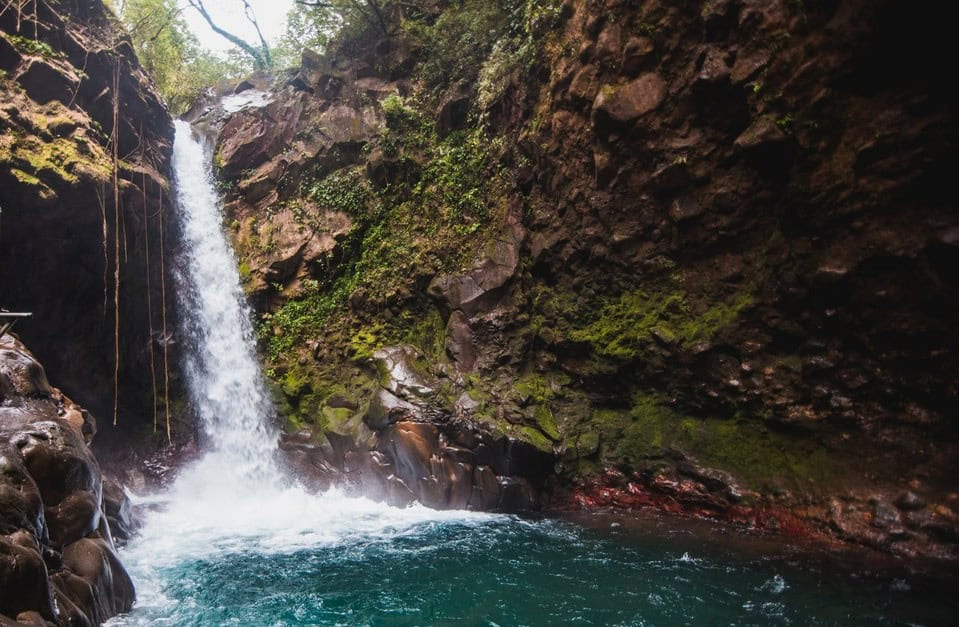
The body of a woman swept away by a sudden river surge in Guanacaste was recovered Sunday morning, ending a search that had run since midday Saturday at the Oropéndola waterfall in Curubandé de Liberia.
The Costa Rican Red Cross said rescuers located the body of an adult woman in a pool below the falls after search teams resumed work at first light. She was the only person still unaccounted for after the surge caught a group of visitors the previous day.
The emergency reached the Red Cross at 12:16 p.m. on Saturday, September 12. Responders confirmed that six people were swept into the current and that five of them got themselves out of the water and reached safety. Early reports had suggested as many as 10 people were involved, a figure the Red Cross later revised down to six.
Crews worked for several hours Saturday before suspending the search around 7 p.m. Adrián Gómez, regional operations coordinator for the Red Cross, said that day’s effort had produced no results. Teams returned early Sunday and found the woman a short time later.
Once the body was located, rescuers assembled specialized swiftwater and vertical rope equipment to lift it from the pool and move it to firm ground. Agents from the Judicial Investigation Agency were expected to take charge of the scene for the formal recovery and for identification procedures. Authorities had not released the woman’s name or nationality.
The Guanacaste Conservation Area clarified that the surge happened outside the boundaries of Rincón de la Vieja National Park, in the Guachipelín sector of Curubandé. The 25-meter (82-foot) Oropéndola waterfall sits on private land belonging to Hacienda Guachipelín, directly beside the national park entrance, and visitors reach it through the hotel rather than through the park itself. The distinction matters for anyone planning a trip, because the two sites have separate access points, separate admission and separate operators.
What swept the group away is what Costa Ricans call a cabeza de agua, a sudden rise in the level and force of a river or stream. It happens when heavy rain falls upstream and pushes a wall of water downstream, often reaching people who are standing in bright sunshine several kilometers below. Water level and current strength can change within seconds, which makes waterfalls, swimming holes and river crossings some of the most dangerous places to be during the rainy season.
The incident comes during a stretch of unsettled weather, with tropical waves and high atmospheric moisture producing heavy rainfall across much of the country. The area around Rincón de la Vieja has also drawn attention recently because of volcanic activity at the summit.
There is no indication that Saturday’s surge was linked to the volcano. Authorities have previously warned communities near Rincón de la Vieja about lahars, which are fast-moving flows of water, mud, rock and volcanic material that travel down river channels after eruptions or heavy rain. That hazard is separate from an ordinary rainy-season surge unless authorities establish a connection, and none has been established here.
If you are visiting rivers or waterfalls in the coming weeks, the most useful habit is to watch the water rather than the sky above you. Rain falling on a mountain you cannot see is what puts the surge in motion. Get out immediately if the water starts rising, turns muddy or begins carrying branches and debris, and do not wait to see whether it settles.
Costa Rica records deaths from cabezas de agua nearly every rainy season, most often at popular swimming spots where the water looks calm and the danger is entirely upstream.





