

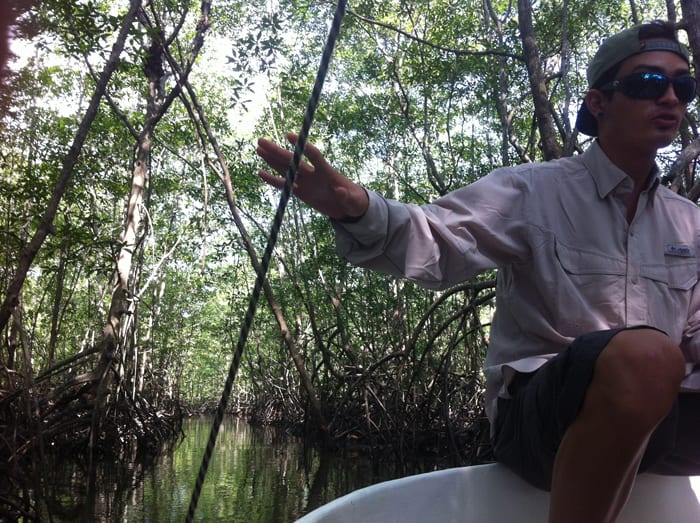
Costa Rica’s mangrove forests protect coastal towns, support fishing communities and provide breeding grounds for marine life. Researchers warn that pollution, construction and changes to rivers are slowly weakening these important coastal ecosystems. Mangroves are forests that grow where rivers meet the sea. Their tangled roots create sheltered areas where young fish, crabs, shrimp and other marine animals can grow before moving into open water.
Those roots also hold soil in place and absorb some of the force from waves, flooding and storms. Without mangroves, coastal areas can become more vulnerable to erosion and rising water. Costa Rica’s 2021 mangrove ecosystem map estimated that Costa Rica has approximately 52,802 hectares, or 130,477 acres, of mangrove environments. Most are found along the Pacific coast, including the Gulf of Nicoya, the Térraba-Sierpe wetlands and the Osa Peninsula.
Despite legal protections, many of these forests remain under pressure. The main threats include garbage and polluted water flowing down rivers, construction near the coast, agricultural runoff, sediment buildup and the clearing or filling of wetland areas. Some of the waste begins far from the coast. Plastic, sewage, chemicals and other pollutants from communities in the Greater Metropolitan Area can travel through rivers before reaching mangroves and the ocean.
Research from the University of Costa Rica has found pesticides, detergents and pharmaceutical substances in mangrove environments. These pollutants can damage water quality and affect the animals living among the roots. Changes to rivers create another problem. When a river is straightened, diverted or surrounded by farms and construction, the natural movement of water and sediment can change. Too much sediment may bury mangrove roots or block the normal exchange between fresh water and seawater.
Researchers have raised concerns about the Aranjuez River in Puntarenas, where changes to the river and years of sediment buildup have affected the nearby mangrove. Environmental specialists warn that further deterioration could leave parts of Puntarenas more exposed to coastal erosion and flooding.
The effects are already visible in some locations. Monitoring around Punta Flor on Isla Chira has found fewer crabs and other small marine animals in degraded sections of the mangrove than in healthier areas. A 2025 study of the Morales mangrove in Puntarenas found that the forest lost approximately 24 hectares, or 59 acres, between 1944 and 2020. Researchers linked much of that decline to changes in how surrounding land was used.
The loss of mangroves can also hurt the local economy. Fish, shrimp, crabs and shellfish depend on these forests during part of their life cycle. When mangrove habitats decline, fishing communities may eventually find fewer animals available to catch and sell. This is especially important around the Gulf of Nicoya, where families have long depended on small-scale fishing and the collection of shellfish. Damage to the mangroves can therefore affect jobs, household income and local food supplies.
Mangroves also store large amounts of carbon in their soil and roots. When the forest is destroyed or the soil is disturbed, part of that carbon can be released into the atmosphere, adding to the problem of climate change. Costa Rica has promised to protect and restore thousands of hectares of coastal wetlands as part of its international climate commitments. Scientists say restoration can help, but preventing pollution and further damage is usually easier and less expensive than trying to rebuild a mangrove after it has collapsed.
The warning is not that every mangrove in Costa Rica is disappearing at the same rate. Conditions vary considerably from one location to another. The larger concern is that damage has continued for decades while many coastal communities depend on these forests for protection and income.





