

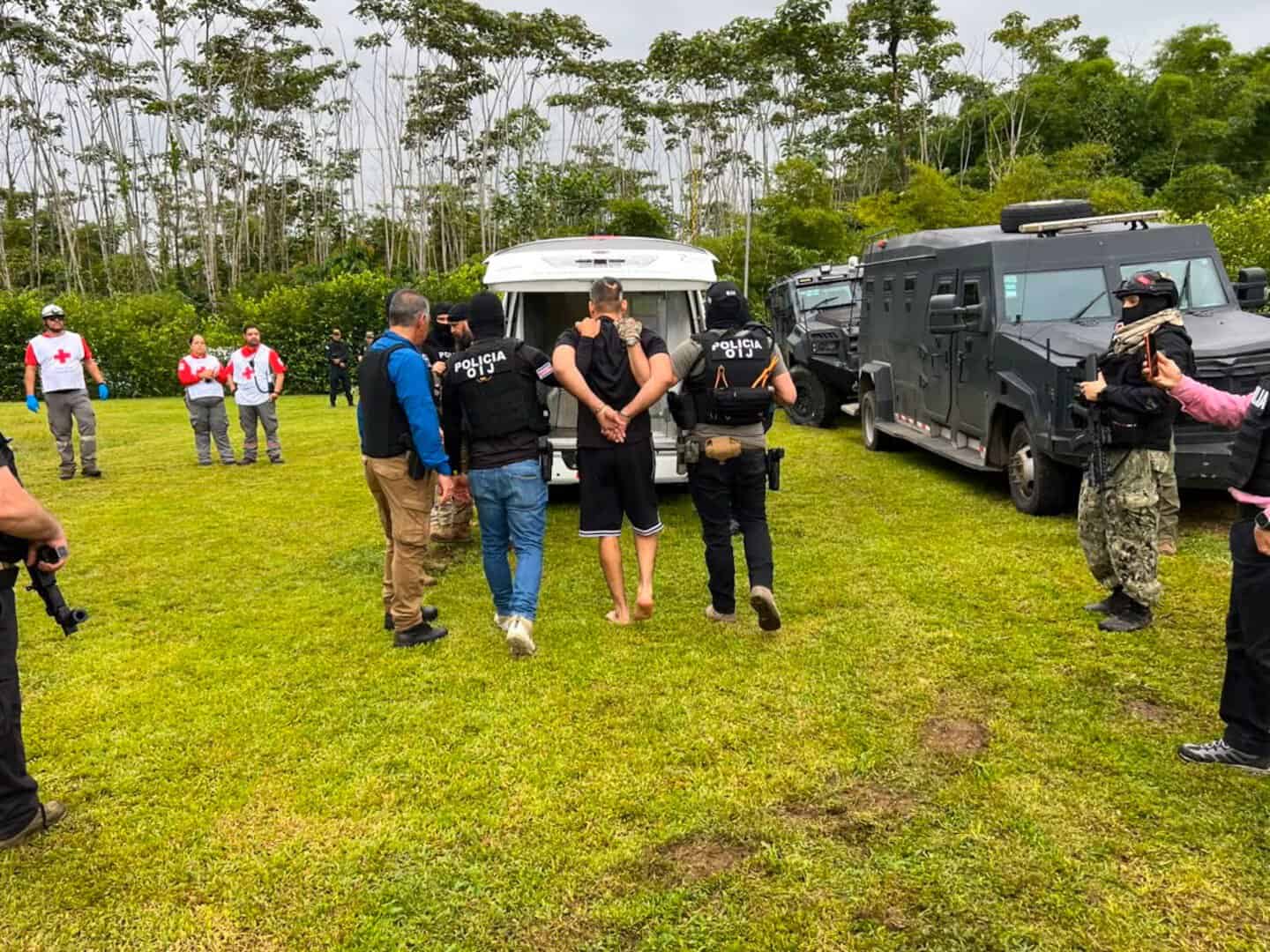
Costa Rican authorities detained Alejandro Arias Monge, the fugitive known as “Diablo,” early Friday morning in Sarapiquí, ending a manhunt that had run for nearly a decade and had drawn a half-million-dollar reward from the United States government. Attorney General Carlo Díaz confirmed the detention, which followed an armed confrontation between officers of the Judicial Investigation Agency (OIJ), and members of the criminal group protecting him.
The operation began shortly after 5 a.m. at a farm in the community of San Bernardino, in Río Frío de Sarapiquí, in the province of Heredia. Michael Soto, the OIJ’s interim director general, said agents from the agency’s Organized Crime Section and its Surveillance and Tracking Unit, supported by the Special Tactical Response Service and the Public Prosecutor’s Office, were met with gunfire as they entered the property. The exchange lasted approximately an hour. Soto described the intervention as a complex police operation and praised the conduct of the officers involved.
Five members of the Special Tactical Response Service, the OIJ’s tactical team, were wounded. According to the OIJ, four remained in stable condition and one was transferred to a medical center in San José for specialized care. The Costa Rican Red Cross gave a separate account of the evacuations, reporting that it moved four agents in advanced life support units, two classified as urgent and one in critical condition, while coordinating the air transfer of a fourth patient, also critical, to a hospital in the Greater Metropolitan Area. The two accounts differ on the severity of the injuries, and neither agency had issued a consolidated update at the time of writing.
Two other men considered senior figures in the organization were detained in the same operation. Jonathan Pérez Méndez, known as “Tan,” has been identified by the OIJ as Arias Monge’s presumed successor. Jorge David Núñez Aguilar, 31, known as “Coco Pastilla,” is considered the head of a group linked to the intellectual authorship of the killing of Geiner Zamora Hidalgo, the deputy chief of the OIJ’s Guápiles delegation, who was shot outside a restaurant in January 2025 and died days later. Núñez, a native of Pococí with a registered address in Guácimo, had been sought by the Judicial Police since that killing. A fourth suspect, identified by the surnames Ríos Oconitrillo and the alias “Coco Guácimo,” died during the operation after being shot by tactical officers, Soto said.
Agents seized five high-caliber rifles at the scene, including weapons of the AK-47 type, along with three pistols. Investigators also recovered drone equipment that the group is believed to have used to monitor the approaches to the property and complicate any police advance. Infobae reported that a FAL rifle was among the weapons recovered, a detail not carried by other outlets.
Arias Monge walked out of prison on October 28, 2016, after completing a period of preventive detention as a suspect in two homicide cases. He was subsequently declared in rebellion after failing to appear for trial, and his whereabouts remained unknown until Friday. Over the intervening years, authorities came to attribute to him as many as 100 killings, along with attempted homicides, drug trafficking, cattle theft and money laundering. The OIJ has also said he issued threats against police officers, including recordings in which he offered payment for the killing of agents. None of these allegations has been tested at trial, and the cases against him remain at the pre-trial stage.
Investigators had long placed him in the Guápiles area of Pococí, moving through rural terrain toward the northern border. Soto said in earlier interviews that Arias Monge relied on a small circle of people loyal to him to move undetected, and that the Judicial Police made more than ten attempts to detain him during 2024 alone. The Drug Enforcement Administration and Costa Rican authorities have identified cells operated by his network across all seven of the country’s provinces, with recent reporting placing its activity in the Caribbean, Sarapiquí, the northern zone, Pococí and Turrialba.
Soto has also cautioned that the figure of “Diablo” grew larger than the man. He has described the name functioning as a kind of franchise within criminal networks, used by others to frighten or extort victims, and has said a degree of mythology built up around him.
The case drew unusual attention from Washington. On April 30, 2025, the State Department’s Bureau of International Narcotics and Law Enforcement Affairs announced a reward of up to $500,000, roughly ₡250 million, under its Transnational Organized Crime Rewards Program, for information leading to the arrest or conviction of Arias Monge in any country. The offer, coordinated with the DEA, followed a series of meetings between the agency and Costa Rica’s Attorney General’s Office and OIJ. It is the largest reward the United States has offered for a Costa Rican national.
The State Department described him as the head of a violent transnational criminal organization and Costa Rica’s most wanted fugitive, wanted on multiple Costa Rican warrants for drug trafficking, robbery, aggravated homicide and money laundering. The DEA has said he conspired with traffickers to move multi-hundred-kilogram loads, or several hundred pounds, of cocaine from Colombia through Central America and Mexico toward the United States.
Speaking after the operation, Soto used the capture to argue for stronger funding for the judiciary, noting that his officers confronted an increasingly well-armed organization. The government of Laura Fernández announced in June a proposed reduction of ₡3.053 billion to the Judicial Branch’s 2026 budget, a cut the OIJ has said would constrain its capacity to carry out raids, conduct criminal analysis and protect victims.
Friday’s operation follows a sustained push against the network in recent weeks, including the July 9 detention of an alleged principal operator known as “Guato” in a mountainous area of Valle La Estrella. The OIJ said it would release further details in the coming hours on the circumstances of the detention and the condition of the wounded officers.





